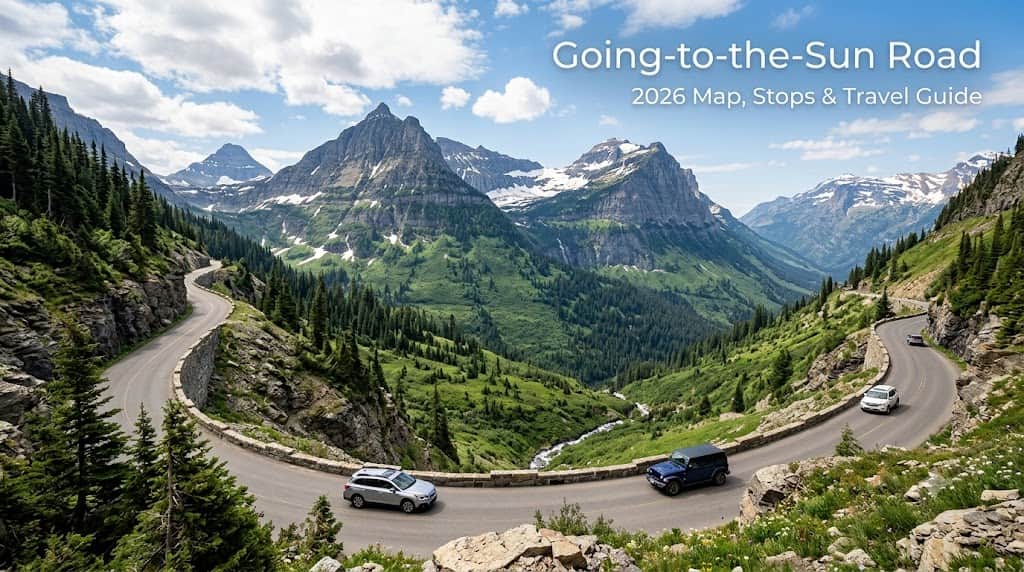
Going-to-the-Sun Road (2026): Map, Stops, Opening Dates, Shuttle & Driving Guide
Going-to-the-Sun Road is one of the most scenic drives in the United States and the signature road through Glacier National Park in Montana. The historic road crosses the Continental Divide at Logan Pass, 6,646 feet above sea level, and connects the park’s west and east sides across roughly 50 miles of mountains, forests, waterfalls, alpine terrain, and glacier viewpoints.
If you’re planning to drive Going-to-the-Sun Road in 2026, there are several important things to know before you go. The full road opened to motor vehicles for the 2026 season on June 23, and vehicle reservations are not required anywhere in Glacier National Park in 2026. However, Logan Pass has special parking and shuttle rules during the summer.
This guide explains everything you need to know about Going-to-the-Sun Road, including the map, best stops, driving time, entrances, opening dates, vehicle restrictions, Logan Pass parking, shuttle tickets, fees, hiking opportunities, and practical tips.
Going-to-the-Sun Road Quick Facts
| Information | Details |
|---|---|
| Location | Glacier National Park, Montana |
| Length | About 50 miles |
| Highest point | Logan Pass — 6,646 feet |
| West entrance | West Glacier / Apgar area |
| East entrance | St. Mary |
| Full 2026 opening | June 23, 2026 |
| Vehicle reservations in 2026 | Not required |
| Standard park entrance fee | $20–$35 depending on entry type |
| Road speed limit | 40 mph lower elevations; 25 mph alpine section |
| Large vehicle restriction | More than 21 ft long or 8 ft wide prohibited on central section |
| Logan Pass summer parking | 3-hour limit from July 1–September 7, 2026 |
| Logan Pass shuttle | Ticket required in 2026 |
Road conditions and operating rules can change quickly because of snow, rockfall, weather, construction, and congestion, so always check the latest Glacier National Park road status before starting your drive.
Going-to-the-Sun Road Map
Going-to-the-Sun Road runs from the West Glacier/Apgar area on the west side of Glacier National Park to St. Mary on the east side.
The major locations along the route include:
West Glacier → Apgar → Lake McDonald → Avalanche → The Loop → Big Bend → Logan Pass → Siyeh Bend → Jackson Glacier Overlook → Sun Point → Rising Sun → St. Mary
The road map includes numerous viewpoints, trailheads, picnic areas, campgrounds, visitor facilities, and scenic pullouts. The National Park Service’s road information and maps should be used for current closures and road conditions because portions of the route can change with weather and seasonal operations.
Going-to-the-Sun Road Map: Main Stops
If you are driving the road for the first time, these are some of the most useful places to know:
- Apgar Village
- Apgar Visitor Center
- Lake McDonald
- Lake McDonald Lodge
- Sprague Creek
- Avalanche
- West Tunnel
- The Loop
- Big Bend
- Logan Pass
- Lunch Creek
- Siyeh Bend
- Jackson Glacier Overlook
- St. Mary Falls area
- Sun Point
- Sunrift Gorge
- Rising Sun
- St. Mary
Not every location is a traditional roadside viewpoint or parking stop, and some areas have limited parking. Always use designated parking areas and do not stop in travel lanes or unauthorized pullouts.
How Long Is Going-to-the-Sun Road?
Going-to-the-Sun Road is approximately 50 miles long.
Without stopping, the full drive takes about two hours, according to the National Park Service. In reality, most visitors should allow considerably more time because the road is designed as a scenic experience rather than a point-to-point highway. Traffic, parking, wildlife, viewpoints, road work, and hiking stops can turn the drive into a half-day or full-day adventure.
If you want to stop at major viewpoints and take short walks, at least half a day is a much more practical plan. If you want to hike at Logan Pass, visit multiple viewpoints, explore Lake McDonald, or stop at waterfalls, consider dedicating an entire day to the road.
How Long Does It Take to Drive Going-to-the-Sun Road?
A useful planning estimate is:
- Driving without stops: about 2 hours
- Scenic drive with several stops: 4–6 hours
- Scenic drive plus hiking: 6–10+ hours
- Full-day exploration: best option for first-time visitors
These are planning estimates, not official travel times. Summer congestion can significantly increase travel time, especially around popular areas such as Logan Pass.
The National Park Service warns that parking is limited throughout Glacier National Park and that summer parking areas can fill early.
Best Going-to-the-Sun Road Stops
There are dozens of places to see along the route, but some stops stand out for first-time visitors.
1. Lake McDonald
Lake McDonald is one of the most recognizable landscapes in Glacier National Park. The large glacial lake sits on the west side of the park and provides beautiful views of mountains rising above the water.
The Lake McDonald area is also an important access point for visitors traveling toward Logan Pass.
If you’re beginning from the west entrance, don’t rush through this section. The combination of the lake, mountain scenery, forest, and historic lodge area makes it one of the best early stops on the road.
2. Avalanche
Avalanche is one of the major recreation areas along the western section of Going-to-the-Sun Road.
It provides access to trails and picnic opportunities, although parking can become difficult during busy summer periods.
If your goal is to drive the road all the way to Logan Pass, plan your time carefully before adding a longer hike here.
3. The Loop
The Loop is one of the most recognizable features of the road.
The road makes a large switchback as it climbs toward Logan Pass, providing dramatic mountain scenery.
It is also an important reference point for hikers because some trails connect with the road in this area.
4. Big Bend
Big Bend is a wide sweeping curve between The Loop and Logan Pass.
It is known for dramatic views of the surrounding mountains and the Lake McDonald Valley. The National Park Service notes that mountain goats and occasionally bighorn sheep can be seen in this area.
Big Bend is one of the places where the engineering and scenery of Going-to-the-Sun Road are especially easy to appreciate.
5. Weeping Wall
The Weeping Wall is a famous feature of the alpine section of Going-to-the-Sun Road.
Water from springs and melting snow flows down the rock face and can create dramatic waterfalls during the early season. The amount of water can change substantially as summer progresses.
When water is flowing strongly, westbound travelers may even experience spray near the roadway.
Do not stop in unsafe locations simply to photograph the waterfall. Use designated areas and follow all posted restrictions.
6. Logan Pass
Logan Pass is the highest point on Going-to-the-Sun Road at 6,646 feet.
It is one of the most popular destinations in Glacier National Park and provides access to famous alpine hiking routes, including the Hidden Lake area and Highline Trail.
The Logan Pass Visitor Center provides visitor information, exhibits, restrooms, drinking water, and other services.
Because Logan Pass is extremely popular, parking can fill very early in the day.
7. Jackson Glacier Overlook
Jackson Glacier Overlook is one of the best places to see a glacier from Going-to-the-Sun Road.
It is located on the eastern side of the road between Logan Pass and St. Mary. The National Park Service identifies this viewpoint as the best opportunity to see a glacier directly from the road.
8. Sun Point
Sun Point is another popular area on the eastern side of the road.
It provides access to scenic views and nearby hiking opportunities. It is also relevant to visitors using transportation from the St. Mary side.
9. Sunrift Gorge
Sunrift Gorge is a scenic feature along the eastern portion of Going-to-the-Sun Road.
It is particularly useful as part of an east-side itinerary that also includes Jackson Glacier Overlook, St. Mary Falls, and Rising Sun.
10. Rising Sun
Rising Sun is an important eastern-side location with visitor services, food and lodging options during the summer season, and access to the Going-to-the-Sun Road corridor.
11. St. Mary Lake and Wild Goose Island
The eastern side of Glacier National Park offers some of the road’s most famous lake and mountain scenery.
Wild Goose Island is a well-known viewpoint on St. Mary Lake and is a popular photography stop when conditions and access allow.
Going-to-the-Sun Road From West Glacier
If you’re approaching from the west, the usual route is through West Glacier and the Apgar area.
From the west side, you will travel through:
West Glacier → Apgar → Lake McDonald → Avalanche → The Loop → Big Bend → Logan Pass
The west side offers a gradual transition from lower-elevation forest and Lake McDonald scenery into the dramatic alpine landscape near Logan Pass.
The west entrance area can become congested during busy periods. The National Park Service has warned that waits approaching the West Glacier entrance can reach significant lengths during peak periods.
Going-to-the-Sun Road From St. Mary
If you’re staying on the east side of Glacier National Park, you can enter the road from St. Mary.
A typical east-side route is:
St. Mary → Rising Sun → Sun Point → Sunrift Gorge → St. Mary Falls area → Jackson Glacier Overlook → Siyeh Bend → Logan Pass
The east side provides easier access to several famous viewpoints, including Jackson Glacier Overlook and the alpine section leading toward Logan Pass.
The National Park Service lists Logan Pass as approximately 18 miles from the east entrance and approximately 32 miles from the west entrance.
Is Going-to-the-Sun Road Open in 2026?
Yes. Going-to-the-Sun Road is fully open for the 2026 summer season.
The National Park Service announced that the entire approximately 50-mile road opened to motor vehicles on June 23, 2026, allowing access to Logan Pass from both West Glacier and St. Mary.
However, the fact that the road is currently open does not mean every trail or facility along the route is necessarily open.
Snow, ice, rockfall, construction, wildlife activity, and other hazards can cause temporary closures.
Always check the current road and trail status before leaving.
When Does Going-to-the-Sun Road Open?
There is no fixed annual opening date for the entire Going-to-the-Sun Road.
The alpine section over Logan Pass depends heavily on snowfall, avalanche conditions, and snowplowing progress. The National Park Service typically expects the road to be fully open by early July, but the actual date can vary considerably from year to year.
Snow removal begins in spring, but crews must work through numerous avalanche paths and changing mountain conditions.
For that reason, you should not plan a June trip around a guaranteed opening date unless the park has already announced the road is open.
When Does Going-to-the-Sun Road Close?
The alpine section typically closes for winter around the third Monday of October, although the National Park Service emphasizes that weather can cause an earlier closure.
The lower-elevation sections of the road may remain open longer or operate differently depending on conditions.
If you’re visiting in October, November, or early spring, check the current road status rather than relying on historical dates.
Do You Need a Reservation for Going-to-the-Sun Road in 2026?
No. Vehicle reservations are not required in Glacier National Park in 2026.
This is an important change from previous years.
Glacier National Park is instead using a different system for 2026 that focuses on Logan Pass parking limits and a ticketed shuttle service.
So, if you’re searching for:
“Going-to-the-Sun Road reservation 2026”
the answer is:
You do not need a vehicle reservation to drive Going-to-the-Sun Road in 2026.
However, you may need a separate shuttle ticket if you choose the Logan Pass Shuttle.
Going-to-the-Sun Road Shuttle 2026
The shuttle system is different in 2026.
From July 1 through September 7, 2026, the park is operating a ticketed Logan Pass Shuttle designed to provide access to Logan Pass for visitors who want longer experiences in the alpine area.
The shuttle operates from both sides of the road.
West-side boarding locations
- Apgar Visitor Center
- Lake McDonald Lodge
East-side boarding locations
- Rising Sun Picnic Area
- St. Mary Visitor Center
The 2026 shuttle provides express service to Logan Pass rather than operating like the older hop-on/hop-off system.
A ticket is required to ride, and each ticket includes a non-refundable $1 processing fee. Tickets are assigned to a specific date, boarding location, and time.
Shuttle tickets are available through Recreation.gov.
Can You Get On and Off the 2026 Logan Pass Shuttle?
Not like the previous shuttle system.
The 2026 Logan Pass Shuttle is designed as an express service, and visitors cannot simply hop on and off at all the old shuttle stops.
The shuttle serves Logan Pass, with specific boarding locations and ticket requirements. A verified ticket and wristband are required to board, and the routes have fewer stops than the previous system.
This is important if you’re planning a full-day itinerary with multiple stops along Going-to-the-Sun Road.
If your priority is exploring multiple roadside locations independently, driving your own vehicle may be more flexible, provided your vehicle meets the road’s size restrictions and parking is available.
Logan Pass Parking in 2026
One of the biggest changes for 2026 is the new parking limit at Logan Pass.
From July 1 through September 7, 2026, private vehicle parking at Logan Pass is limited to three hours.
The three-hour limit is intended to increase parking turnover and allow more visitors to experience Logan Pass.
Three hours can be enough for:
- Logan Pass Visitor Center
- Hidden Lake Overlook
- Short alpine walks
- Scenic viewing
- A quick visit to the area
Visitors planning longer hikes from Logan Pass should consider the Logan Pass Shuttle instead.
Overnight parking is not permitted at Logan Pass except for certain permitted backcountry users and registered Granite Park Chalet guests.
Can You Drive Going-to-the-Sun Road Yourself?
Yes.
Private vehicles can drive Going-to-the-Sun Road when the road is open and their vehicle meets the park’s restrictions.
In 2026, you do not need a vehicle reservation.
However, driving your own car does not guarantee that you will find parking at popular locations. Logan Pass is particularly challenging during busy summer periods.
Parking outside designated spaces is prohibited because it can damage vegetation, cause erosion, and interfere with emergency access.
Going-to-the-Sun Road Vehicle Restrictions
This is one of the most important things to check before driving the road.
Vehicles and vehicle combinations longer than 21 feet, including bumpers, or wider than 8 feet, including mirrors, are prohibited between Avalanche Creek and Rising Sun.
Vehicles taller than 10 feet may also have difficulty traveling west from Logan Pass toward The Loop because of rock overhangs.
Going-to-the-Sun Road vehicle limits
- Maximum length: 21 feet
- Maximum width: 8 feet
- Height above 10 feet can create clearance problems
If you’re driving a large RV, camper, trailer, or oversized vehicle, do not assume you can drive the entire road.
Instead, check the latest NPS restrictions and consider using an approved transportation option or guided tour.
Is Going-to-the-Sun Road Free?
The road itself does not have a separate “Going-to-the-Sun Road ticket.”
However, Glacier National Park requires an entrance pass.
The current standard entrance fee ranges from $20 to $35, depending on the type of entry, and qualifying non-U.S. residents age 16 and older are subject to an additional $100 nonresident fee unless admitted with an eligible annual pass.
Visitors can use a standard entrance pass, an annual park pass, or an eligible America the Beautiful pass.
What Is the Speed Limit on Going-to-the-Sun Road?
The speed limit is:
- 40 mph at lower elevations
- 25 mph in the alpine section
The road contains sharp curves, steep drop-offs, narrow sections, wildlife, cyclists, pedestrians, and changing weather.
The posted speed limit is a maximum, not a target. Drive slower whenever conditions require it.
Can You Bike Going-to-the-Sun Road?
Bicycling is possible on Going-to-the-Sun Road, but seasonal restrictions apply.
During the 2026 peak-season period, bicycle restrictions apply to the Apgar-to-Logan Pass section during specified afternoon hours:
- Eastbound: 12 p.m. to 6 p.m.
- Westbound: 3 p.m. to 6 p.m.
These restrictions apply to portions of the road that are open to motor vehicles and are intended to address safety concerns on the narrow, steep, winding road.
Cyclists should always check the current NPS regulations before starting their ride because restrictions can change with road conditions and seasonal operations.
Best Time to Drive Going-to-the-Sun Road
The best time depends on what you want to see.
Early summer
Early summer can provide impressive waterfalls and dramatic snow-covered mountain scenery, but the alpine road may not yet be fully open.
The opening date depends on snow removal and avalanche conditions.
July and August
These months generally provide the best opportunity to experience the entire road when the alpine section is open.
However, they are also among the busiest periods.
Expect crowded parking areas, traffic, and heavy demand at Logan Pass.
September
September can be an excellent time for a quieter experience, but weather becomes more unpredictable and seasonal operations begin changing.
October
Fall can be beautiful, but the alpine section may close for winter around the third Monday of October or earlier if weather deteriorates.
What Is the Best Time of Day to Drive Going-to-the-Sun Road?
For the best combination of parking availability, cooler temperatures, and fewer crowds, early morning is generally the safest planning choice.
Logan Pass is especially popular, and its parking lot can fill very early.
An early start also gives you more time to stop at viewpoints and complete short hikes before afternoon congestion develops.
However, weather matters more than the clock. Mountain conditions can change quickly, so check the latest road and weather information before departure.
Best Going-to-the-Sun Road Itinerary
If you have one full day, a west-to-east itinerary could look like this:
Morning
Start at West Glacier/Apgar.
Visit:
- Apgar
- Lake McDonald
- Lake McDonald Lodge
- Avalanche
Continue toward the alpine section.
Late morning
Stop at:
- The Loop
- Big Bend
- Weeping Wall
- Logan Pass
Spend time at Logan Pass, but remember that the 2026 parking limit applies from July 1 through September 7.
Afternoon
Continue toward the east side and visit:
- Siyeh Bend
- Jackson Glacier Overlook
- St. Mary Falls area
- Sunrift Gorge
- Rising Sun
- St. Mary Lake
You do not need to visit every stop. A slower itinerary with fewer stops is usually more enjoyable than trying to photograph everything.
Going-to-the-Sun Road: West Side or East Side?
Both sides are worth visiting, but they offer different experiences.
West side
Best for:
- Lake McDonald
- Forest scenery
- Apgar
- Avalanche
- The Loop
- Big Bend
- Dramatic alpine climb toward Logan Pass
East side
Best for:
- St. Mary Lake
- Jackson Glacier Overlook
- Sun Point
- Sunrift Gorge
- Alpine scenery
- Easier access to Logan Pass from the east
If you have enough time, driving the entire route is the best way to experience the road.
Where Should You Stop for Food and Gas?
Do not depend on finding fuel inside Glacier National Park.
The National Park Service states that there are no fueling stations within the park. Food and lodging are available at locations including Apgar Village, Lake McDonald Lodge, and Rising Sun during the summer season.
Fill your gas tank before entering the park if you’re planning a long day on Going-to-the-Sun Road.
Also carry water and snacks, especially if you’re planning to hike.
Can You Camp Along Going-to-the-Sun Road?
Several Glacier National Park campgrounds are located along the road corridor, including:
- Apgar
- Sprague Creek
- Avalanche
- Rising Sun
- St. Mary
Camping availability and operating dates vary seasonally, and some campgrounds require reservations while others operate differently.
Do not assume you can simply sleep overnight at a roadside parking area or Logan Pass.
In particular, overnight parking at Logan Pass is restricted except for specific permitted users.
Going-to-the-Sun Road Safety Tips
This is a mountain road, so preparation matters.
1. Check road conditions before leaving
Road status can change because of snow, ice, rockfall, construction, wildlife, or other hazards.
2. Start with a full tank
There are no gas stations inside Glacier National Park.
3. Do not stop in the middle of the road
Use designated parking areas and pullouts.
4. Watch for wildlife
Animals can appear unexpectedly near the roadway.
5. Don’t rush
The road has blind curves, steep sections, and narrow mountain terrain.
6. Carry water
Some facilities and services are seasonal.
7. Check trail conditions separately
A road being open does not mean every trail is open.
8. Prepare for cold weather at Logan Pass
Even when lower elevations are warm, Logan Pass can remain cold, windy, snowy, or icy.
When the road opened fully in June 2026, the National Park Service warned visitors about lingering winter snow and cold, windy, icy conditions around Logan Pass.
Frequently Asked Questions About Going-to-the-Sun Road
Is Going-to-the-Sun Road open right now?
As of the 2026 season, the full road is open to motor vehicles. The National Park Service announced full opening on June 23, 2026. Temporary closures can still occur because of weather or other conditions, so check the current road status before traveling.
How long is Going-to-the-Sun Road?
The road is approximately 50 miles long from the west side of Glacier National Park to St. Mary.
How long does it take to drive Going-to-the-Sun Road?
The National Park Service estimates approximately two hours without stopping, but a realistic sightseeing drive usually takes much longer.
Do you need a reservation for Going-to-the-Sun Road in 2026?
No vehicle reservation is required in 2026. However, a separate ticket is required to use the 2026 Logan Pass Shuttle.
Do you need a ticket for Going-to-the-Sun Road?
You do not need a separate road ticket, but you need a valid Glacier National Park entrance pass. If you use the 2026 Logan Pass Shuttle, you need a shuttle ticket.
Is Going-to-the-Sun Road free?
No. Glacier National Park requires an entrance pass. The road itself does not have a separate admission charge.
Can an RV drive Going-to-the-Sun Road?
Only if it meets the road’s size restrictions. Vehicles or vehicle combinations longer than 21 feet or wider than 8 feet are prohibited between Avalanche Creek and Rising Sun. Vehicles over 10 feet tall may also encounter clearance problems in the alpine section.
What is the highest point on Going-to-the-Sun Road?
Logan Pass at 6,646 feet is the highest point on the road accessible by vehicle.
What are the best stops on Going-to-the-Sun Road?
Popular stops include Lake McDonald, Avalanche, The Loop, Big Bend, Weeping Wall, Logan Pass, Jackson Glacier Overlook, Sun Point, Sunrift Gorge, Rising Sun, and St. Mary Lake.
Can you drive Going-to-the-Sun Road both ways?
Yes, when the full road is open and conditions permit. Visitors can access Logan Pass from both the west and east sides.
What is the best entrance for Going-to-the-Sun Road?
There is no single best entrance for everyone. West Glacier provides access to Lake McDonald and the western portion of the road, while St. Mary provides access to the eastern section and Jackson Glacier Overlook.
Can you drive Going-to-the-Sun Road at night?
Road access and closures vary seasonally and with weather. Visitors should check current road status and avoid assuming that the full alpine route is available after dark, particularly during shoulder seasons.
Does Going-to-the-Sun Road have parking?
Yes, but parking is limited at many popular locations. Logan Pass is especially busy. From July 1 through September 7, 2026, private vehicle parking at Logan Pass is limited to three hours.
Is the Going-to-the-Sun Road scary to drive?
Some visitors may find the narrow mountain sections intimidating because of steep terrain, curves, rock walls, and drop-offs. Drive slowly, stay within your lane, follow the speed limit, and use designated stopping areas.
What is the best month for Going-to-the-Sun Road?
July and August generally offer the best chance of driving the entire road after the alpine section opens, but they are also among the busiest months. September can offer a different experience with potentially lighter crowds but more variable weather.
Final Tips for Driving Going-to-the-Sun Road in 2026
Going-to-the-Sun Road is more than a scenic drive. It is one of the best ways to experience the dramatic change in landscape across Glacier National Park, from Lake McDonald’s forests to the high alpine environment around Logan Pass and the glacier views on the eastern side.
For a successful trip in 2026:
- Check the official road status before leaving.
- No vehicle reservation is required in 2026.
- Get your park entrance pass ready.
- Start early during busy summer periods.
- Check your vehicle’s length and width before driving.
- Do not rely on finding gas inside the park.
- Allow much more than two hours if you want to stop and explore.
- Remember the three-hour Logan Pass parking limit from July 1 through September 7, 2026.
- Consider the Logan Pass Shuttle if you plan a longer Logan Pass visit.
- Carry water, food, layers, and appropriate hiking gear.
- Never assume a trail is open just because the road is open.
- Follow all posted parking, wildlife, and road restrictions.
Most importantly, treat Going-to-the-Sun Road as a mountain environment rather than simply a highway. Weather and road conditions can change quickly, and the National Park Service’s current road-status information should always take priority over an older itinerary or guide.
Read Also: Going-to-the-Sun Road Map: Every Stop, Viewpoint & Hidden Pullout You Shouldn’t Miss (2026 Guide)
How Long Does It Take to Drive Going-to-the-Sun Road? Every Stop Timed [2026 Map]
Pingback: Sun Road Glacier National Park: Going-to-the-Sun Road Guide