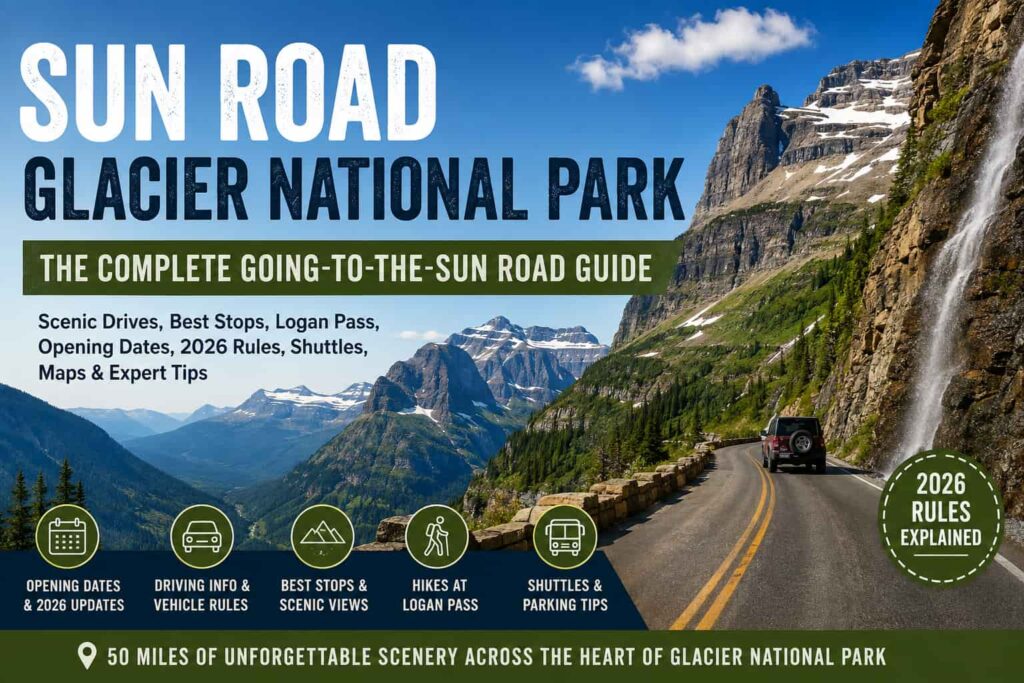
Sun Road Glacier National Park: Complete Guide to Going-to-the-Sun Road
If you are searching for Sun Road Glacier National Park, you are most likely looking for Going-to-the-Sun Road, the famous scenic highway that crosses the heart of Glacier National Park in Montana. Stretching for about 50 miles from the west side of the park to the St. Mary area on the east, the road climbs through forests, mountain valleys and alpine terrain before reaching Logan Pass at 6,646 feet.
Going-to-the-Sun Road is one of the best ways to experience Glacier National Park without committing to a long backcountry hike. Along the drive, visitors can see Lake McDonald, waterfalls, dramatic cliffs, alpine meadows, wildlife and some of the park’s most recognizable mountain scenery.
This guide covers everything you need to know about Sun Road in Glacier National Park, including the road’s location, opening dates, driving directions, Logan Pass, vehicle restrictions, parking, shuttle options, best time to visit, major stops, hiking opportunities and frequently asked questions.
What Is Sun Road in Glacier National Park?
The road commonly called “Sun Road” is officially named Going-to-the-Sun Road. It is the main east-west road through Glacier National Park and crosses the Continental Divide at Logan Pass.
The road is approximately 50 miles long, and driving the entire route without stopping takes around two hours. In reality, you should allow considerably more time because there are numerous scenic overlooks, trailheads, waterfalls, visitor facilities and places where you will want to stop.
The road is also historically significant. Its final section over Logan Pass was completed in 1932 after years of construction, and the road was formally dedicated in 1933. Today, Going-to-the-Sun Road is recognized as a National Historic Landmark and National Civil Engineering Landmark.
Where Is Going-to-the-Sun Road?
Going-to-the-Sun Road runs across the center of Glacier National Park in northwestern Montana.
There are two primary approaches:
- West side: West Glacier/Apgar area
- East side: St. Mary area
- Highest point: Logan Pass
- Total length: About 50 miles
- Logan Pass elevation: 6,646 feet
Logan Pass is approximately 32 miles from the west entrance and 18 miles from the east entrance.
Because the road crosses the park, visitors can experience very different landscapes during one drive. The western side is characterized by Lake McDonald, dense forest and lush vegetation, while the higher elevations become increasingly alpine as you approach Logan Pass.
Going-to-the-Sun Road Map and Route
The easiest way to understand the route is to think of it as a journey from West Glacier → Lake McDonald → Avalanche → The Loop → Logan Pass → Siyeh Bend → Rising Sun → St. Mary.
Some of the most popular areas along or near the road include:
- Apgar and Lake McDonald
- Lake McDonald Lodge
- Avalanche
- Trail of the Cedars
- The Loop
- Big Bend
- Weeping Wall
- Logan Pass
- Siyeh Bend
- Rising Sun
- St. Mary
You do not need to stop at every location. If you have limited time, prioritize Lake McDonald, The Loop/Big Bend area, Logan Pass and the viewpoints along the alpine section.
Is Going-to-the-Sun Road Open?
The answer depends heavily on the season and current weather.
The lower portions of Going-to-the-Sun Road can remain accessible for much of the year, but the alpine section over Logan Pass is seasonal. Heavy winter snow, avalanches and spring storms make snow removal a major operation every year. The National Park Service says there is no fixed annual opening date for the road over Logan Pass. Historically, the entire road is often open by early July, although conditions vary.
Is Going-to-the-Sun Road open in 2026?
Yes. For the 2026 season, Going-to-the-Sun Road fully opened to motor vehicles on June 22, 2026, allowing visitors to drive the entire 50-mile route and reach Logan Pass from both the west and east sides.
However, opening does not mean conditions will remain unchanged. Rockfall, snow, ice, storms and other natural hazards can cause temporary closures or delays.
Before driving, always check the latest road status from the National Park Service.
When Does Going-to-the-Sun Road Open?
There is no guaranteed opening date.
Glacier National Park begins snow removal operations in spring, but the road crosses numerous avalanche paths and reaches high alpine elevations. Snowstorms and avalanche conditions can continue well into spring, making it impossible for the park to announce a reliable opening date months in advance.
For travelers planning a summer trip, late June through September generally provides the best opportunity to experience the complete route, but road and trail conditions should always be checked immediately before your visit.
Best Time to Drive Going-to-the-Sun Road
July to August
July and August are generally the most popular months because the full road is normally accessible and alpine areas are easier to explore.
However, these months also bring the largest crowds. Logan Pass parking can become extremely difficult, particularly during the middle of the day.
September
September can be an excellent alternative. Crowds may decrease, fall colors begin appearing in some areas, and the weather can still be pleasant.
The downside is that alpine weather can change quickly, and seasonal services and road conditions may begin changing later in the month.
May and June
Early summer can be beautiful, but visitors should not assume the entire road will be open. Snow removal and avalanche conditions determine when the alpine section becomes accessible.
October through spring
The road is not generally available as a complete east-west driving route during the winter season. Lower portions may remain accessible, but the high-elevation section can be closed by snow.
Going-to-the-Sun Road in 2026: Important Changes
If you are visiting Glacier National Park in 2026, do not rely on older articles that describe the previous vehicle reservation system.
Vehicle reservations are not required for Going-to-the-Sun Road in 2026. Glacier National Park has changed its access system for this season.
Instead, the park introduced changes specifically focused on Logan Pass.
From July 1 through September 7, 2026, private vehicle parking at Logan Pass is limited to three hours. The park also introduced a ticketed Logan Pass Shuttle designed to provide access for visitors who want to spend longer at Logan Pass.
This is important because older search results may still tell visitors that they need a Going-to-the-Sun Road vehicle reservation.
Do You Need a Reservation for Going-to-the-Sun Road?
For 2026, no vehicle reservation is required to drive Going-to-the-Sun Road.
However, this does not mean that every type of access is reservation-free.
The 2026 Logan Pass Shuttle requires a ticket, and parking at Logan Pass is subject to the three-hour limit during the July 1–September 7 period.
Always check the current NPS rules before your trip because Glacier National Park’s access systems can change between seasons.
Logan Pass: The Highlight of Sun Road
For many visitors, Logan Pass is the main destination on Going-to-the-Sun Road.
At 6,646 feet, Logan Pass is the highest point on the road and the highest location in Glacier National Park accessible by vehicle. It sits on the Continental Divide and provides access to some of Glacier’s most popular hiking trails.
Popular hikes from the Logan Pass area include:
- Highline Trail
- Hidden Lake Overlook
- Hidden Lake area
The alpine environment can remain snowy even after the road opens, so trail openings should never be assumed. In 2026, for example, the National Park Service warned that lingering snow could affect conditions at Logan Pass and that popular trails could remain closed because of hazardous conditions.
Going-to-the-Sun Road Best Stops
1. Lake McDonald
Lake McDonald is one of the first major attractions you encounter on the western side.
The lake stretches through a spectacular mountain valley and is particularly beautiful in the morning or during calm weather when the surrounding peaks can reflect in the water.
2. Lake McDonald Lodge
Lake McDonald Lodge is a historic destination near the western portion of the road. It is a convenient place to pause and enjoy the scenery before continuing toward the alpine section.
3. Trail of the Cedars
The Trail of the Cedars is a popular accessible nature walk through an old-growth forest environment.
It is a good choice for visitors who want to get out of the car without committing to a strenuous mountain hike.
4. The Loop
The Loop is one of the most recognizable sections of Going-to-the-Sun Road.
The road makes a dramatic switchback here as it climbs toward Logan Pass. It also provides an important perspective on just how steep and rugged the surrounding terrain is.
5. Big Bend
Big Bend provides a dramatic roadside viewpoint in the alpine section.
The location is especially popular for photographs because the road and mountains create an impressive combination of foreground and background scenery.
6. Weeping Wall
The Weeping Wall is one of the iconic roadside features on Going-to-the-Sun Road.
During periods when snowmelt and water flow are strong, water cascades down the rock face beside the highway.
7. Logan Pass
Logan Pass is the must-see destination for many first-time visitors.
Besides the visitor center and alpine scenery, it provides access to popular hiking trails and opportunities to see wildlife.
8. Siyeh Bend
Siyeh Bend offers another excellent opportunity to stop and take in the mountains and valleys surrounding the eastern side of the road.
9. Rising Sun
Rising Sun is an important stopping area on the east side of the park and provides access to facilities and nearby attractions.
Going-to-the-Sun Road Driving Time
Driving the entire road without stopping takes approximately two hours according to the National Park Service.
But a realistic sightseeing itinerary should allow much longer.
For example:
Quick drive: 2–3 hours
Scenic drive with several stops: 4–6 hours
Drive + hikes: Full day
If this is your first visit to Glacier National Park, a full day is the better choice. Trying to rush through the road means missing many of the viewpoints and hiking opportunities that make it famous.
Can You Drive Going-to-the-Sun Road Yourself?
Yes, if your vehicle meets the park’s restrictions and the road is open to motor vehicles.
Self-driving is one of the best ways to experience the road because you can control your schedule and stop at viewpoints along the route.
However, the road is narrow and winding in places. Drivers should remain alert, obey posted speed limits and watch for wildlife, pedestrians, cyclists and other vehicles.
The speed limit is 40 mph at lower elevations and 25 mph in the alpine section.
Going-to-the-Sun Road Vehicle Restrictions
Vehicle size is one of the most important things to check before driving the road.
Between Avalanche Creek and Rising Sun, vehicles or vehicle combinations longer than 21 feet or wider than 8 feet are prohibited. Vehicles taller than 10 feet can also encounter difficulty on portions of the road because of rock overhangs.
This means visitors traveling in large RVs should check the dimensions carefully before planning to drive the entire route.
If your vehicle is too large, consider a shuttle, guided tour or another transportation option.
Going-to-the-Sun Road Shuttle in 2026
The shuttle system is different in 2026 from previous years.
Glacier National Park introduced a ticketed Logan Pass Shuttle for the 2026 season. The shuttle is intended to provide direct access to Logan Pass, particularly for visitors planning longer hikes such as the Highline Trail.
According to the National Park Service, shuttle tickets are released through two booking windows, including advance availability and additional next-day tickets.
Because shuttle procedures can change, check the NPS Logan Pass information page before your trip.
Is Going-to-the-Sun Road Scary to Drive?
For confident mountain drivers, the road is generally manageable, but it can feel intimidating.
The route includes:
- Narrow mountain sections
- Steep drop-offs
- Tight curves
- Rock walls
- Heavy summer traffic
- Cyclists and pedestrians
- Wildlife
- Changing weather
Take your time and do not stop in unsafe locations simply to take photographs.
If you are uncomfortable driving mountain roads, a shuttle or authorized guided tour may provide a more relaxing experience.
Is Going-to-the-Sun Road Dangerous?
The road is considered a major mountain highway and requires normal mountain-driving precautions.
Rockfall is a natural hazard in Glacier National Park, and conditions can change rapidly. The National Park Service advises visitors to pay attention to current conditions and follow all closures and warnings.
Weather is another important consideration. Snow, ice, rain, wind and fog can occur at higher elevations even when conditions are warm elsewhere in the park.
Drive defensively and never assume that summer weather at the park entrance means identical conditions at Logan Pass.
What Should You Bring for Going-to-the-Sun Road?
Even if you are only planning a scenic drive, bring more than you think you will need.
Recommended items include:
- Water
- Snacks
- Warm layers
- Rain jacket
- Comfortable hiking shoes
- Sunglasses
- Sunscreen
- Phone or camera
- Offline maps
- Emergency supplies
- Bear spray if you are hiking, used and carried according to park guidance
Do not depend on having cell service throughout the road. Download important maps and information before entering areas where reception may be limited.
At Logan Pass, food and water availability can be limited, so arriving prepared is especially important.
Tips for Driving Going-to-the-Sun Road
Start early
Early morning is one of the best ways to avoid some of the heaviest traffic and parking pressure.
Check road conditions before leaving
Do not rely on a blog post from a previous year. Road openings, closures and restrictions can change because of weather and maintenance.
Allow extra time
The two-hour nonstop driving estimate does not account for photographs, wildlife sightings, traffic or hikes.
Do not stop in unsafe locations
Use designated pullouts and parking areas whenever possible.
Check your vehicle dimensions
This is especially important if you are driving an RV, camper or vehicle with a trailer.
Prepare for changing temperatures
It can be significantly colder at Logan Pass than at lower elevations.
Respect wildlife
Never approach, feed or crowd wildlife for photographs.
Download information before entering the park
Cell service can be inconsistent, so offline maps are useful.
What Is the Best Direction to Drive Going-to-the-Sun Road?
There is no single correct direction.
Driving from west to east gives you the experience of climbing from Lake McDonald toward Logan Pass and then descending toward St. Mary.
Driving from east to west gives you a different perspective, with the dramatic alpine scenery appearing as you approach Logan Pass from the St. Mary side.
If you have flexibility, choose the direction that best fits your accommodation and other Glacier National Park activities.
How Long Do You Need for Going-to-the-Sun Road?
For simply driving the road, allow at least 2–3 hours.
For a sightseeing trip with multiple stops, 4–6 hours is more realistic.
If you want to hike at Logan Pass, photograph Lake McDonald, stop at waterfalls and explore several viewpoints, plan on making Going-to-the-Sun Road a full-day Glacier National Park experience.
Is Going-to-the-Sun Road Worth It?
Absolutely.
Going-to-the-Sun Road is one of the defining experiences of Glacier National Park. It combines historic engineering with dramatic Rocky Mountain scenery and gives visitors access to places that would otherwise require much more hiking.
The road crosses forests, mountain valleys and alpine terrain before reaching Logan Pass and the Continental Divide. Its historic significance and scenery have made it one of the park’s most famous attractions.
For first-time visitors to Glacier National Park, it should be near the top of the itinerary.
Frequently Asked Questions About Sun Road Glacier National Park
What is Sun Road in Glacier National Park called?
The official name is Going-to-the-Sun Road. “Sun Road” is a common shortened name used by visitors when searching for information about the route.
How long is Going-to-the-Sun Road?
Going-to-the-Sun Road is approximately 50 miles long.
How high is Going-to-the-Sun Road?
The road reaches its highest point at Logan Pass, 6,646 feet above sea level.
How long does it take to drive Going-to-the-Sun Road?
The National Park Service estimates approximately two hours without stopping. A sightseeing trip usually takes much longer.
Do I need a reservation for Going-to-the-Sun Road in 2026?
No vehicle reservation is required for Going-to-the-Sun Road in 2026. However, Logan Pass has special parking rules and the 2026 Logan Pass Shuttle requires a ticket.
When does Going-to-the-Sun Road open?
There is no fixed annual opening date. The alpine section depends on snow removal, avalanche conditions and weather. The full road opened on June 22 for the 2026 season.
Can RVs drive Going-to-the-Sun Road?
Some RVs can, but strict size restrictions apply. Vehicles longer than 21 feet or wider than 8 feet are prohibited on the restricted section between Avalanche Creek and Rising Sun. Vehicles taller than 10 feet can have difficulty on some western portions of the alpine section.
Is Going-to-the-Sun Road free?
Going-to-the-Sun Road itself does not have a separate road toll, but visitors must meet Glacier National Park’s entrance requirements and pay the applicable park entrance fee unless they qualify for an exemption or have an appropriate pass.
What is the best month to drive Going-to-the-Sun Road?
July and August offer the best chance of experiencing the entire road and its alpine attractions, although they are also the busiest months. September can provide a good balance of accessibility and somewhat lighter crowds.
Final Thoughts
Going-to-the-Sun Road is the scenic backbone of Glacier National Park, connecting the park’s western and eastern sides while crossing some of Montana’s most spectacular mountain scenery.
If you are planning a trip, do not treat it as simply a 50-mile drive. Give yourself enough time to stop at Lake McDonald, waterfalls and viewpoints, explore Logan Pass, and enjoy the surrounding landscape.
Most importantly, check the latest National Park Service road, trail and access conditions before leaving. Glacier’s mountain weather can change quickly, and the rules for parking, shuttles and road access can change from one season to the next.
For a 2026 visit, remember the biggest update: Going-to-the-Sun Road does not require a vehicle reservation, but Logan Pass has a three-hour private-vehicle parking limit from July 1 through September 7, and the new Logan Pass Shuttle operates with advance tickets.
Read Also: Going-to-the-Sun Road (2026): Map, Stops, Opening Dates, Shuttle & Driving Guide