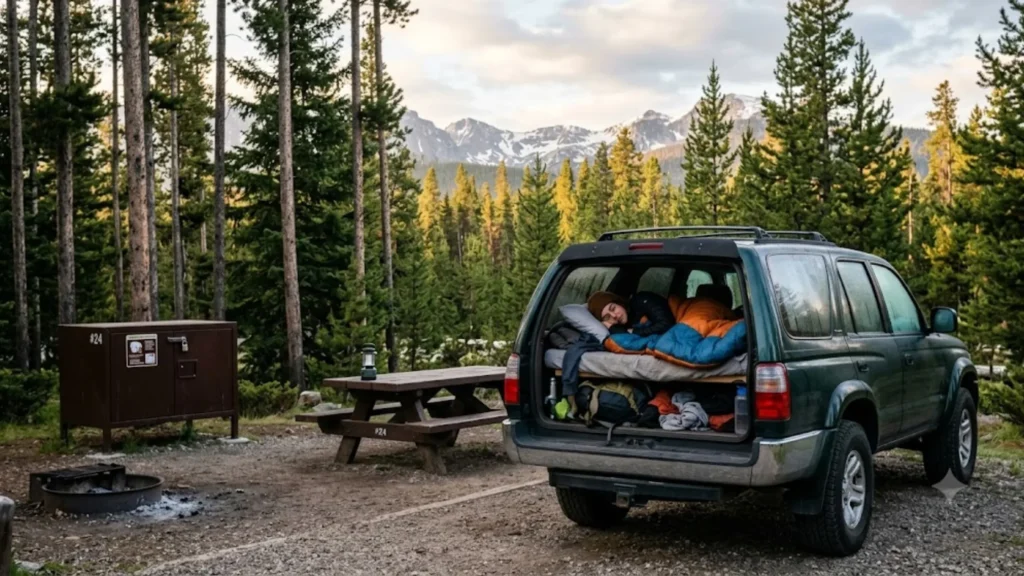
Can You Sleep in Your Car in Yellowstone? 2026 Rules
Planning a Yellowstone road trip and wondering, “Can you sleep in your car in Yellowstone?” The answer is yes, but only in a designated campground or other authorized overnight camping area.
You cannot simply park at a Yellowstone parking lot, roadside pullout, scenic viewpoint, picnic area, or trailhead and spend the night in your vehicle. The National Park Service specifically prohibits car camping and overnight vehicle parking outside designated campgrounds.
That distinction is important because sleeping inside your car does not make an unauthorized overnight stay legal.
If you want to save money on a Yellowstone trip, sleeping in your vehicle at a legal campground can be an option. But you need to plan your overnight stay before arriving, especially during the busy summer season.
Can You Sleep in Your Car in Yellowstone?
Yes, you can sleep in your car in Yellowstone if you are staying at a designated campground and following the campground’s rules.
What you cannot do is use your vehicle as a makeshift campsite in an ordinary parking area or pullout.
The National Park Service states that no car camping or overnight vehicle parking is allowed in pullouts, parking areas, picnic grounds, or anywhere other than a designated campground in Yellowstone National Park.
So the simple rule is:
- Sleeping in your car at a designated campground: Allowed, subject to campground rules.
- Sleeping in your car in a parking lot: Not allowed.
- Sleeping in your car at a roadside pullout: Not allowed.
- Sleeping in your car at a picnic area: Not allowed.
- Sleeping in your car at a trailhead: Not allowed unless specifically authorized as an overnight camping location.
- Random roadside camping: Not allowed.
If you’re searching “can you sleep in your car at Yellowstone,” this is the key point to remember: the location matters more than the type of vehicle you’re sleeping in.
Why Can’t You Sleep in Your Car Anywhere in Yellowstone?
Yellowstone is a protected national park, not a collection of public parking areas where visitors can stay overnight wherever they choose.
The park has specific camping areas to manage overnight visitors, protect natural resources, maintain traffic safety, and reduce conflicts between people and wildlife.
Yellowstone is also home to large wildlife, including bears and bison. Visitors are expected to follow strict food-storage and wildlife-safety rules while camping.
The park’s 2026 Superintendent’s Compendium requires an overnight camping permit, camping permit, or reservation for overnight stays and identifies designated locations where camping is permitted.
Can You Sleep in Your Car at a Yellowstone Campground?
Yes. If you have a legal campsite and the campground permits your vehicle setup, sleeping inside your vehicle can be a practical way to spend the night.
You do not necessarily need to sleep in a tent simply because you are staying at a campground. The important issue is that your overnight stay is taking place at an authorized campsite and that you comply with the applicable campground rules.
However, individual campgrounds can have different vehicle, occupancy, and equipment restrictions.
For example, Fishing Bridge RV Park is restricted to hard-sided vehicles, and it is the only Yellowstone campground offering water, sewer, and electrical hookups.
Before booking, check the current rules for the specific campground you plan to use.
Where Can You Legally Sleep in Your Car in Yellowstone?
The safest legal option is a designated Yellowstone campground.
For 2026, the National Park Service lists these frontcountry camping locations:
- Bridge Bay Campground
- Canyon Campground
- Fishing Bridge RV Park
- Grant Village Campground
- Indian Creek Campground
- Lewis Lake Campground
- Madison Campground
- Mammoth Campground
- Pebble Creek Campground
- Slough Creek Campground
- Tower Fall Campground
The NPS currently lists 11 campgrounds with more than 2,000 established campsites. Availability and operating dates vary by campground and season.
Important 2026 campground update
Not every campground is operating normally in 2026.
For example, the NPS currently lists Pebble Creek Campground as closed because of flood-recovery work. Operating dates can also change, so check the official Yellowstone camping page before making your plans.
Can You Sleep in Your Car in a Yellowstone Parking Lot?
No.
You cannot use a Yellowstone parking lot as an overnight campsite simply because your vehicle is legally parked there during the day.
The National Park Service specifically prohibits car camping and overnight vehicle parking in parking areas unless the location is a designated campground.
This applies to the kinds of places travelers may be tempted to use when they are tired after a long day of driving, including:
- Visitor center parking lots
- Attraction parking areas
- Trailhead parking lots
- Scenic viewpoint parking areas
- Picnic-area parking lots
- General roadside parking areas
If you need to spend the night, use an authorized campground instead.
Can You Sleep in Your Car at a Yellowstone Pullout?
No.
Roadside pullouts may look like convenient places to stop, but they are not automatically overnight camping areas.
The NPS specifically says that overnight vehicle parking and car camping are not allowed in pullouts.
A pullout can be useful for taking a break during your drive, but it should not be treated as a free campsite.
Can You Sleep in Your Car at Old Faithful?
No, not in the Old Faithful parking areas.
Old Faithful is one of Yellowstone’s busiest areas, and its parking areas are not designated overnight campsites.
If you want to spend the night in the Old Faithful area, arrange an authorized campground or lodging option rather than sleeping in the attraction’s parking lot.
Can You Sleep in Your Car at a Yellowstone Trailhead?
Generally, no.
A trailhead parking area is intended for visitors accessing trails, not for overnight vehicle camping.
Unless a specific area has been designated or authorized for overnight camping, you should not assume that you can sleep in your vehicle there.
For backcountry overnight stays, Yellowstone requires a backcountry permit and camping is restricted to authorized sites.
Do You Need a Reservation to Sleep in Your Car in Yellowstone?
If you want to stay at a campground, you need an authorized campsite for your overnight stay.
For most Yellowstone campgrounds, reservations are available and strongly recommended. The NPS says most campsites are reserved well in advance.
There is one important seasonal exception: Mammoth Campground offers first-come, first-served sites from October 15 through April 1, according to the current NPS camping information.
Because campground availability changes by date and season, don’t assume that you can arrive late and find an empty campsite.
How Far in Advance Can You Book Yellowstone Campgrounds?
Yellowstone campground reservations open on a rolling basis.
The NPS currently says reservations can be made six months before the date of your stay, subject to availability. Popular summer dates can fill quickly.
If you know your travel dates, booking as early as possible is a much better strategy than planning to find a random place to sleep inside the park.
How Much Does It Cost to Camp in Yellowstone in 2026?
Campground prices vary depending on the campground.
For 2026, the NPS currently lists examples such as:
| Campground | 2026 nightly fee |
|---|---|
| Bridge Bay | $38 + taxes |
| Canyon | $45 + taxes |
| Fishing Bridge RV Park | $94 + taxes |
| Grant Village | $45 + taxes |
| Madison | $38 + taxes |
| Indian Creek | $20 |
| Lewis Lake | $20 |
| Mammoth | $25 |
| Slough Creek | $20 |
| Tower Fall | $20 |
These rates are subject to change, and some campground fees may have additional taxes or conditions.
For a traveler trying to reduce accommodation costs, a campground can be significantly cheaper than a Yellowstone-area hotel, but availability is the bigger issue during peak season.
Is Sleeping in Your Car in Yellowstone the Same as Camping?
For practical purposes, you should treat an overnight stay in your vehicle as an overnight camping situation.
The important thing is not whether you are sleeping in a tent, SUV, van, or other vehicle. You need to be in an authorized overnight camping location.
That’s why parking your car legally during the day does not automatically give you permission to remain there overnight.
Can You Sleep in an SUV or Van in Yellowstone?
You may be able to sleep in an SUV or van at an authorized campground, provided the campsite and campground rules allow your vehicle setup.
The same basic rule applies:
Vehicle + designated campsite = potentially legal overnight stay.
Vehicle + parking lot/pullout = not legal for overnight camping.
For larger vehicles, check the campground’s maximum vehicle-length restrictions before booking. The NPS publishes these restrictions for individual campgrounds.
Can You Sleep in an RV Anywhere in Yellowstone?
No.
RV travelers also have to use designated camping areas.
You cannot simply park an RV overnight at a scenic overlook, parking lot, roadside pullout, or other unauthorized location and treat it as a campsite.
Fishing Bridge RV Park is a dedicated option and has specific requirements. The NPS says it is for hard-sided vehicles only and offers water, sewer, and electrical hookups.
Is Boondocking Allowed Inside Yellowstone National Park?
No, not as general dispersed camping.
You cannot simply find an undeveloped spot inside Yellowstone and spend the night there.
The park’s regulations prohibit undesignated summer camping except when it is specifically authorized under a valid Yellowstone backcountry permit.
That means visitors should not assume that the rules for dispersed camping on nearby public lands also apply inside Yellowstone.
What About Free Camping Near Yellowstone?
This is where things get different.
Outside Yellowstone, some nearby public lands may offer dispersed camping opportunities, but the rules depend on the specific land-management agency and location.
National forests around the Yellowstone region can have their own camping regulations, seasonal restrictions, road conditions, fire restrictions, and stay limits.
If you’re considering sleeping outside the park to save money, check the rules for the exact location rather than assuming that free camping is allowed everywhere.
What Happens If You Sleep in Your Car Illegally in Yellowstone?
The consequences can vary depending on the circumstances, but an unauthorized overnight stay can result in enforcement action.
You may be asked to leave the area, and violations of park regulations can result in citations or other penalties.
The easiest way to avoid the problem is also the simplest: don’t use parking lots, pullouts, picnic areas, or roadsides as overnight campsites.
Is It Safe to Sleep in Your Car in Yellowstone?
Sleeping in your vehicle at an authorized campground can be a reasonable option, but Yellowstone still requires serious wildlife awareness.
You are in an environment where wild animals move through areas used by visitors.
Follow Yellowstone’s food-storage rules and never leave food, garbage, or scented items lying around your campsite.
The National Park Service advises visitors to secure food and other attractants because wildlife can be dangerous when it becomes accustomed to human food.
Important safety tips
- Keep food and scented items properly secured.
- Never approach wildlife.
- Keep your campsite clean.
- Follow campground-specific food-storage requirements.
- Don’t leave garbage outside.
- Keep doors and windows secured when appropriate.
- Check weather conditions before sleeping in your vehicle.
- Have enough water and emergency supplies.
- Download important maps before entering areas with limited cell service.
Yellowstone Bear Safety When Sleeping in Your Car
Bear safety is especially important if you’re camping in Yellowstone.
Do not treat the inside of your campsite as a place to store food carelessly. Follow the current campground food-storage requirements and keep attractants properly secured.
The park also has specific backcountry food-storage requirements, including rules for bear-resistant food containers in applicable areas.
Remember that a vehicle is not an excuse to ignore Yellowstone’s wildlife rules.
Can You Sleep in Your Car During Winter in Yellowstone?
Winter is different from summer because Yellowstone has limited services, seasonal closures, snow, and changing road access.
Yellowstone itself remains open year-round, but many facilities and roads operate seasonally. The NPS notes that relatively few facilities are open year-round and services become limited from early November through late April.
Mammoth Campground is listed as open year-round, while many other campgrounds operate only during specific seasons.
If you’re planning to sleep in your vehicle during winter, make sure you understand the current road conditions, campground availability, weather, and cold-weather risks before traveling.
What Is the Cheapest Legal Way to Stay Overnight in Yellowstone?
For travelers who want to stay inside the park, a campsite is generally one of the more budget-friendly legal accommodation options.
The cheapest option depends on the campground and date, but several 2026 campgrounds are listed at around $20 per night before any applicable additional charges.
If campsites are unavailable, staying in a nearby gateway community or finding a legal camping option outside the park may be another solution.
The important part is not to turn a free parking spot into an unauthorized campsite.
Best Tips for Sleeping in Your Car at a Yellowstone Campground
If you’re planning to use your vehicle as your sleeping space, a little preparation can make a big difference.
Bring proper bedding
Yellowstone nights can be surprisingly cold, even outside the winter season. Bring sleeping bags, blankets, and clothing appropriate for the forecast.
Use window covers
Window covers can provide privacy and help reduce early-morning sunlight.
Keep your vehicle organized
A cramped vehicle becomes uncomfortable quickly. Keep essential items within easy reach and avoid blocking your ability to exit the vehicle.
Arrive before dark
Arriving during daylight makes it easier to find your campsite, understand the layout, and set up safely.
Check the weather
Yellowstone’s weather can change quickly. Snow is possible in the park even outside the traditional winter months.
Download offline information
Cell service can be limited in Yellowstone. Download maps and important information before entering areas where connectivity may disappear.
What Should You Do If You’re Too Tired to Drive?
If you’re already inside Yellowstone and you’re too tired to continue driving, don’t assume that you can sleep in the nearest parking lot.
Instead, look for an authorized campground or lodging option.
Yellowstone’s own visitor guidance warns travelers to have accommodation plans because campgrounds and lodging can be full, and the nearest available room or campsite may be far away.
Never compromise safety by continuing to drive while dangerously tired, but also don’t assume that a roadside pullout is an acceptable overnight campsite.
Common Mistakes Travelers Make
Here are some of the biggest mistakes people make when planning to sleep in their car in Yellowstone:
1. Assuming any parking area is legal overnight
It isn’t.
2. Thinking sleeping in a vehicle isn’t camping
The fact that you’re inside a car doesn’t make an unauthorized overnight stay permissible.
3. Arriving without a campground plan
Popular Yellowstone campsites can fill well ahead of time.
4. Assuming dispersed camping rules apply inside Yellowstone
They don’t.
5. Ignoring campground-specific vehicle restrictions
Some locations have specific vehicle requirements and size limits.
6. Forgetting wildlife safety
Food, trash, and scented items need to be managed responsibly.
7. Relying on cell service
Connectivity can be limited in many areas of the park.
Quick Answer: Can You Sleep in Your Car in Yellowstone?
Yes, but only at an authorized overnight camping location such as a designated campground, and you must follow the applicable campground rules.
You cannot legally sleep in your car at an ordinary Yellowstone parking lot, roadside pullout, picnic area, or other unauthorized location. The NPS explicitly prohibits car camping and overnight vehicle parking outside designated campgrounds.
If you want the cheapest legal option, check campground availability before your trip and book as early as possible.
Final Thoughts
So, can you sleep in your car in Yellowstone? Yes—but don’t confuse sleeping in your vehicle with being allowed to camp anywhere you can park.
The safest approach is straightforward:
Book or obtain an authorized campsite, park your vehicle at the designated site, follow the campground rules, and respect Yellowstone’s wildlife and food-storage requirements.
For 2026, the National Park Service lists 11 campgrounds with more than 2,000 established campsites, although individual campground operating dates and availability vary.
If you’re planning a Yellowstone road trip, checking the current campground status before leaving is especially important because seasonal dates and closures can change.
FAQs
Can you sleep in your car in Yellowstone?
Yes, you can sleep in your car at a designated campground, provided your vehicle and stay comply with the campground’s rules. You cannot sleep overnight in ordinary parking areas, pullouts, picnic grounds, or other unauthorized locations.
Can you sleep in your car at Yellowstone?
Yes, but only at an authorized overnight camping location. Yellowstone does not permit overnight vehicle parking or car camping in ordinary parking lots or pullouts.
Can you sleep in your car in Yellowstone National Park?
Yes, sleeping in your vehicle can be allowed at a designated campground. You cannot simply park somewhere inside the park and sleep overnight there.
Can you sleep in your car at a Yellowstone parking lot?
No. Yellowstone prohibits overnight vehicle parking and car camping in parking areas unless the location is a designated campground.
Can you sleep in your car at a Yellowstone pullout?
No. Pullouts are specifically included among the places where car camping and overnight vehicle parking are prohibited.
Can you sleep in your car at Old Faithful?
Not in the Old Faithful parking areas. Use an authorized campground or lodging option for an overnight stay.
Can you sleep in your car at a Yellowstone trailhead?
Generally no. Trailhead parking is not automatically an overnight camping area. Use a designated campground or obtain the appropriate authorization for backcountry camping.
Do you need a reservation to sleep in your car in Yellowstone?
You need an authorized campsite for an overnight campground stay. Most Yellowstone campsites require advance reservations, while Mammoth has a seasonal first-come, first-served period.
Can you sleep in an SUV in Yellowstone?
Yes, an SUV can be used as a sleeping space at an authorized campsite if the campground’s rules and site restrictions allow it.
Can you sleep in a van in Yellowstone?
You may be able to sleep in a van at an authorized campground, subject to that campground’s vehicle requirements and site restrictions.
Is overnight parking allowed in Yellowstone National Park?
Overnight vehicle parking is not allowed in pullouts, parking areas, picnic grounds, or other non-designated locations. Overnight camping must take place in an authorized camping area.
Is boondocking allowed in Yellowstone?
General free dispersed camping is not allowed inside Yellowstone. Undesignated summer camping is prohibited except when specifically authorized through a valid backcountry permit.
What is the cheapest way to sleep in Yellowstone?
A campground can be one of the least expensive legal overnight options inside the park. Several 2026 campgrounds are listed at $20 per night, while others cost more depending on the campground.
Is it safe to sleep in your car in Yellowstone?
Sleeping in your vehicle at an authorized campground can be reasonable, but visitors must follow wildlife and food-storage rules and prepare for Yellowstone’s changing weather.
Are Yellowstone campgrounds open year-round?
No. Most operate seasonally. Mammoth Campground is listed as open year-round, while other campgrounds have specific 2026 operating dates.
Can you sleep in your car in Yellowstone during winter?
It may be possible at an authorized campground that is open during winter, but winter conditions can be severe and many facilities and roads operate seasonally. Check current operating dates and road conditions before traveling.