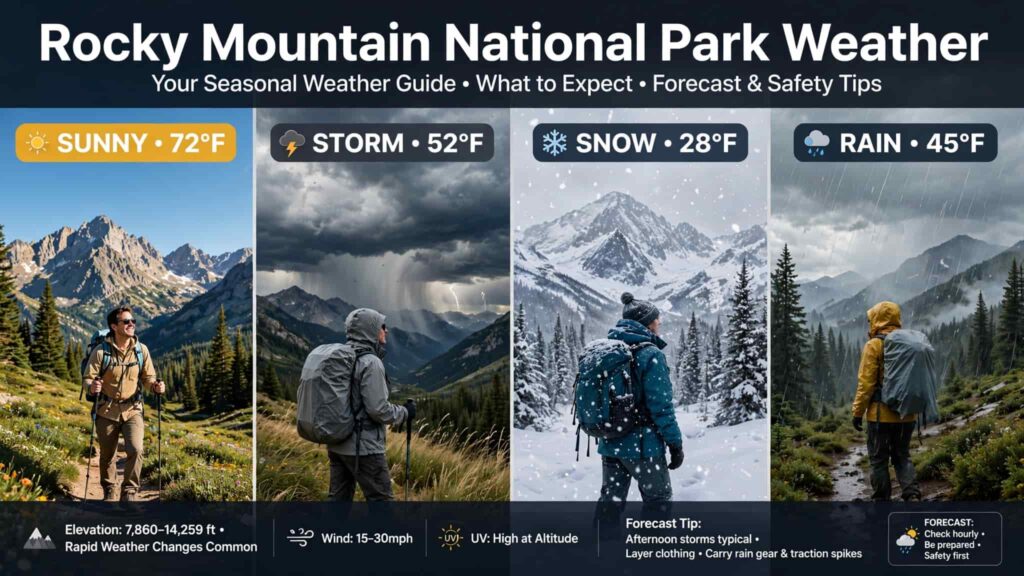
Rocky Mountain National Park Weather by Month: Temperatures, Snow & Rain
Planning a trip to Rocky Mountain National Park (RMNP) and wondering what the weather will be like? Weather in the park changes dramatically throughout the year because of its high elevation, mountainous terrain, and the Continental Divide.
You can experience warm sunshine, afternoon thunderstorms, rain, strong winds, and even snow during summer, sometimes within the same day. At higher elevations, snow can remain well into summer, while lower elevations around Estes Park may be considerably warmer.
This Rocky Mountain National Park weather by month guide covers average temperatures, snowfall, precipitation, seasonal conditions, and what to expect when visiting each month.
Quick answer: July and August are generally the warmest months, while January through March are among the coldest and snowiest periods. September and early October often bring crisp, relatively dry weather and fall colors. However, conditions at high elevations can be very different from those in Estes Park.
Rocky Mountain National Park Weather at a Glance
| Month | Estes Park Avg. High | Avg. Low | Snowfall* | Typical Weather |
|---|---|---|---|---|
| January | 39°F | 16°F | 4.6 in | Cold, snowy |
| February | 41°F | 17°F | 6.3 in | Cold, snowy |
| March | 45°F | 21°F | 7.8 in | Snowy, variable |
| April | 53°F | 27°F | 3.8 in | Cool, spring snow |
| May | 62°F | 34°F | 0.5 in | Mild, unsettled |
| June | 73°F | 41°F | 0.1 in | Warm, storms possible |
| July | 78°F | 46°F | 0 in | Warmest, afternoon storms |
| August | 77°F | 45°F | 0 in | Warm, thunderstorms |
| September | 70°F | 38°F | 0.5 in | Cool, crisp, generally dry |
| October | 60°F | 30°F | 1.0 in | Cool, fall weather |
| November | 46°F | 23°F | 3.8 in | Cold, increasing snow |
| December | 40°F | 18°F | 5.7 in | Cold, snowy |
*These figures are representative Estes Park climate statistics, not conditions across the entire national park. RMNP’s elevations range from roughly 7,860 to 14,259 feet, so temperatures and snowfall can vary substantially by location and elevation.
Why Rocky Mountain National Park Weather Changes So Much
Rocky Mountain National Park has a huge elevation range. A sunny and relatively mild morning near Estes Park can turn into a cold, windy afternoon at Trail Ridge Road or another high-elevation location.
The Continental Divide also creates different weather patterns on the eastern and western sides of the park. The east side near Estes Park is generally drier, while the Grand Lake side receives more moisture.
At elevations such as Bear Lake, Trail Ridge Road and Longs Peak, snow can occur even during July. The National Park Service also warns that summer afternoon thunderstorms and rapid temperature drops are normal in the high country.
Rocky Mountain National Park Weather in January
January is one of the coldest months in Rocky Mountain National Park.
Around Estes Park, average temperatures are approximately 39°F during the day and 16°F at night, with about 4.6 inches of average snowfall in the NPS climate statistics.
Higher elevations are considerably colder and can have substantial snow and ice.
What January weather is like
- Cold temperatures
- Snow and ice at higher elevations
- Short daylight hours
- Winter trail conditions
- Strong winds and rapidly changing conditions
- Excellent conditions for snowshoeing in suitable areas
The park’s higher elevations can experience severe winter conditions, including strong winds, deep snow and sudden storms.
Best for: Winter scenery, snowshoeing and a quieter park experience.
Rocky Mountain National Park Weather in February
February remains firmly in winter.
Estes Park averages around 41°F for the high and 17°F for the low, with approximately 6.3 inches of snowfall in the NPS statistics.
The mountains can be much colder than the town, and trails at higher elevations are commonly covered in snow and ice.
If you’re visiting in February, bring insulated clothing, waterproof footwear and traction equipment appropriate for winter trails.
Rocky Mountain National Park Weather in March
March is often a surprisingly snowy month in the Rockies.
Estes Park averages approximately 45°F during the day and 21°F at night, with around 7.8 inches of average snowfall in the NPS statistics. That makes March the snowiest month in the Estes Park table.
Don’t assume that March means spring in RMNP. The National Park Service notes that March and April are historically among the snowiest months in the Rocky Mountains.
March conditions
- Snow remains common
- Trails can be icy
- Higher elevations remain firmly in winter
- Lower elevations may have occasional warm, sunny days
- Snowstorms can occur with little warning
Best for: Visitors specifically interested in late-winter scenery and snow activities.
Rocky Mountain National Park Weather in April
April brings more noticeable signs of spring at lower elevations, but winter is far from over.
Average Estes Park temperatures are about 53°F high and 27°F low, with approximately 3.8 inches of snowfall.
At higher elevations, snow and ice can still dominate the landscape.
The National Park Service describes spring in RMNP as unpredictable, with warm and cold, wet and dry conditions alternating.
Is April a good time to visit?
April can be a good month if you want fewer visitors and don’t mind variable conditions. However, it is not an ideal month for guaranteed snow-free hiking.
Rocky Mountain National Park Weather in May
May is a transition month.
Estes Park averages approximately 62°F during the day and 34°F at night. Average snowfall drops to around 0.5 inches in the Estes Park statistics, but that number doesn’t tell the whole story.
At elevations above 9,000 feet, winter-like conditions can persist into May and June. The NPS specifically advises visitors to be prepared for winter hiking conditions at higher elevations during these months.

May weather can include
- Warm afternoons at lower elevations
- Freezing nights
- Snow on higher trails
- Mud and wet trails
- Occasional spring snowstorms
- Rapid changes in weather
Tip: Pack layers rather than relying on a single warm-weather outfit.
Rocky Mountain National Park Weather in June
June is one of the most interesting months because conditions vary dramatically depending on elevation.
Estes Park averages approximately 73°F high and 41°F low, while average snowfall there is only about 0.1 inches.
However, higher portions of the park can still have significant snow. The NPS notes that spring reaches the subalpine elevations later than lower areas, and many trails can remain snow-covered.
June also marks the beginning of the summer thunderstorm pattern.
June weather
- Warm lower elevations
- Snow still possible at high elevations
- Afternoon rain and thunderstorms
- Rapid temperature drops
- Increasing wildflowers at lower elevations
Best for: Visitors who want early summer scenery and are prepared for changing trail conditions.
Rocky Mountain National Park Weather in July
July is generally the warmest month in the Estes Park climate statistics, with an average high of about 78°F and a low around 46°F.
Average snowfall in Estes Park is essentially zero during July, but don’t interpret that as meaning there is no snow anywhere in RMNP.
The National Park Service notes that it can still snow at high elevations such as Bear Lake, Trail Ridge Road and Longs Peak during July.

July weather patterns
Mornings can begin with clear blue skies, while clouds often build during the afternoon. Thunderstorms, rain, lightning and strong winds can develop quickly.
The NPS recommends being prepared for temperature drops of 10–20°F during summer weather changes.
Best for: Hiking, scenic drives, wildflowers and accessing higher-elevation areas when roads and conditions permit.
Rocky Mountain National Park Weather in August
August is very similar to July.
Average temperatures around Estes Park are approximately 77°F high and 45°F low.
August is usually warm at lower elevations, but afternoon thunderstorms remain an important consideration.
August weather can include
- Warm mornings
- Comfortable daytime temperatures
- Afternoon thunderstorms
- Lightning and strong winds
- Cool evenings
- Snow possible at high elevations
If you’re hiking above treeline, it’s particularly important to start early and monitor changing weather.
Rocky Mountain National Park Weather in September
September is one of the most appealing months for visiting RMNP.
Average Estes Park temperatures fall to approximately 70°F during the day and 38°F at night. Average snowfall is only around 0.5 inches in the NPS statistics.
The National Park Service describes September and October as generally clear, crisp and dry, although early snowstorms can occur.

September is also the beginning of the famous fall elk season, while aspen leaves begin changing color around mid-September.
Best for: Hiking, wildlife viewing, fall colors and generally comfortable daytime temperatures.
Rocky Mountain National Park Weather in October
October brings unmistakable fall weather.
Estes Park averages approximately 60°F high and 30°F low, with about 1 inch of average snowfall.
Snow can arrive early, particularly at higher elevations. Meanwhile, lower areas may still have pleasant sunny days.
Trail Ridge Road typically closes for the winter by mid-October, although exact conditions and closure dates can vary.
October weather
- Cool mornings
- Mild afternoons
- Fall colors early in the month
- Increasing chance of snow
- Freezing temperatures at night
- Winter conditions at high elevations
Best for: Fall scenery, photography and cooler hiking conditions.
Rocky Mountain National Park Weather in November
November marks the return of more consistent winter conditions.
Estes Park averages around 46°F high and 23°F low, with approximately 3.8 inches of snowfall.
Higher elevations can already have substantial winter snowpack, while lower elevations may alternate between snow, ice and dry conditions.
If you’re hiking, check current trail conditions rather than relying only on monthly averages.
Rocky Mountain National Park Weather in December
December is a cold and snowy month.
Estes Park averages approximately 40°F during the day and 18°F at night, with around 5.7 inches of average snowfall.
At higher elevations, conditions are much more severe. Winter storms can bring heavy snow, strong winds and extremely cold temperatures.

The park’s winter season generally brings snow-packed and icy trails, especially at higher elevations.
Best for: Winter landscapes, snowshoeing and a peaceful snowy experience.
Rocky Mountain National Park Rain by Month
Rainfall also varies significantly throughout the park.
For example, the NPS estimates annual moisture at approximately 13.10 inches for Estes Park and 19.95 inches for Grand Lake, demonstrating the difference between the east and west sides of the park.
The monthly Estes Park precipitation averages are:
| Month | Average Precipitation |
|---|---|
| January | 0.37 in |
| February | 0.45 in |
| March | 0.86 in |
| April | 1.28 in |
| May | 2.02 in |
| June | 1.76 in |
| July | 2.21 in |
| August | 1.86 in |
| September | 1.17 in |
| October | 0.81 in |
| November | 0.60 in |
| December | 0.47 in |
July has the highest average precipitation in the Estes Park statistics, while April through August generally represent a wetter portion of the year.
When Does It Snow in Rocky Mountain National Park?
Snow is possible in RMNP during every month of the year at the highest elevations.
However, the most reliable period for widespread winter snow is generally from late fall through spring.
The NPS states that October through early June can bring snow-packed trails and winter conditions in many parts of RMNP, while March and April are historically among the snowiest months.
At high elevations, snow can survive into summer. Therefore, if you’re visiting in May, June or even July, don’t assume every trail will be snow-free.
What Is the Best Month to Visit Rocky Mountain National Park?
The best month depends on what you want to do.
For warm-weather hiking: July and August
These are generally the warmest months, but afternoon thunderstorms are common enough that early starts are a smart strategy.
For fall colors: September and early October
September offers cooler temperatures, crisp air and the beginning of the famous aspen color season.
For snow: December through March
Winter provides the most reliable snow conditions, especially at higher elevations.
For fewer crowds: Late fall, winter and spring
These periods can be quieter, but visitors need to be prepared for winter conditions and seasonal closures.
What to Pack for Rocky Mountain National Park Weather
Because weather can change quickly, packing for RMNP should be based on layers and flexibility, not simply the forecast for Estes Park.
Consider bringing:
- Warm insulating layer
- Waterproof or rain jacket
- Hat and gloves
- Moisture-wicking clothing
- Sun protection
- Sturdy hiking shoes
- Extra socks
- Water
- Traction devices during icy conditions
- Snowshoes when appropriate
- Emergency layers for high-elevation hikes
The National Park Service emphasizes that weather can change quickly and advises visitors to be prepared to turn back if conditions become unsafe.
Rocky Mountain National Park Weather: East Side vs. West Side
One important thing to remember is that RMNP does not have one single weather pattern.
The Continental Divide runs through the park and helps create different conditions on its two sides.
Estes Park / east side:
- Generally drier
- Often warmer at comparable lower elevations
- Popular access point for Bear Lake and many eastern trails
Grand Lake / west side:
- Generally wetter
- More winter snowfall
- Different cloud and precipitation patterns
Historical NPS statistics show just how different the two communities can be. Grand Lake’s average January snowfall, for example, is listed at about 29.6 inches, compared with 4.6 inches in Estes Park.
Does Rocky Mountain National Park Get Snow in Summer?
Yes.
This is one of the most important things to understand when planning a summer trip.
Lower elevations can be warm and snow-free while high-elevation locations still have snowfields. According to the NPS, it may snow at Bear Lake, Trail Ridge Road and Longs Peak even in July.
Summer visitors should also be prepared for thunderstorms, strong winds and sudden temperature drops.
Final Thoughts
Rocky Mountain National Park weather by month varies much more than a typical destination because of the park’s enormous elevation range.
For the warmest conditions, July and August are usually the best choices. For fall scenery, September and early October are excellent. For snow and winter landscapes, December through March offer the strongest winter experience.
But monthly averages are only a starting point. Before heading into the mountains, always check the current forecast, trail conditions, snow conditions and road status for the specific area you’re visiting. The National Park Service provides current RMNP weather information, while the National Weather Service provides detailed forecasts and winter-weather information for the park.
Useful official resources: Rocky Mountain National Park Weather — NPS · RMNP Weather Decision Support — National Weather Service
Quick takeaway
| If you want… | Consider visiting |
|---|---|
| Warmest weather | July–August |
| Hiking | July–September |
| Wildflowers | Late June–August |
| Fall colors | Mid-September–early October |
| Snow | December–March |
| Fewer visitors | Late fall–winter/spring |
| A balance of weather + scenery | September |
Note: Climate figures above are representative historical statistics from NPS stations at Estes Park and Grand Lake and should not be treated as a precise forecast for every location inside Rocky Mountain National Park.
Read Also: Rocky Mountain National Park Timed Entry: Reservations, Times & 2026 Guide
Pingback: Trail Ridge Road Rocky Mountain National Park: Complete Guide - Park Trails Guide