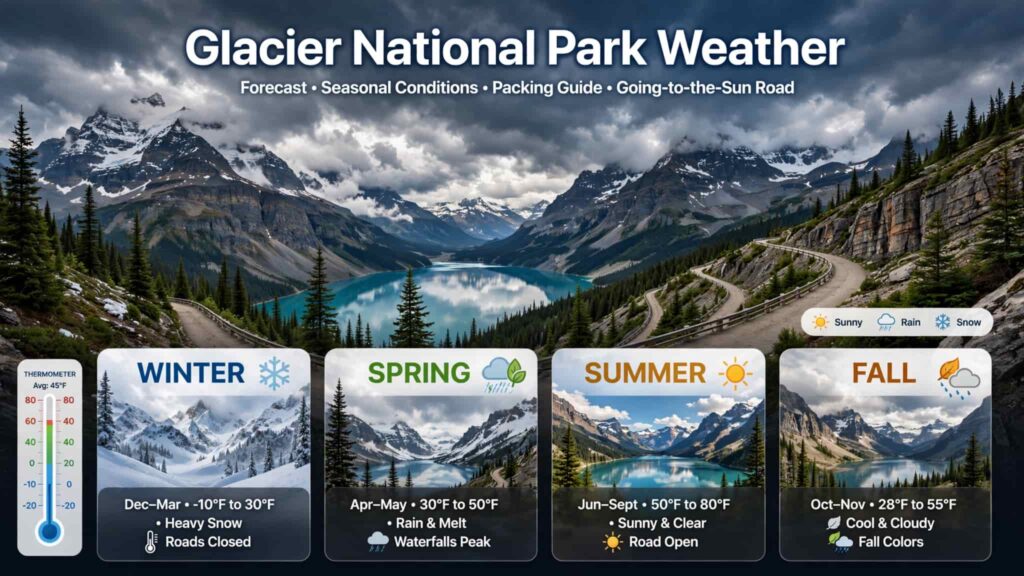
Glacier National Park Weather by Month: Temperatures, Snow, Rain & Best Time to Visit (2026)
Planning a trip to Glacier National Park in 2026? Weather can make a major difference in what you are able to see and do. Glacier has cold, snowy winters, a cool and often wet spring, warm summer days, and a rapidly changing fall season.
The National Park Service (NPS) describes Glacier’s weather as highly variable, with conditions that can change quickly. Weather also differs considerably between the west and east sides of the park, while higher elevations such as Logan Pass are generally much colder than the valleys.
This Glacier National Park weather by month guide covers average temperatures, rain, snow, seasonal conditions, hiking considerations, and the best months to visit in 2026.
Quick answer: For the widest range of visitor services, scenic drives and hiking opportunities, late July through August is generally the most reliable period. Early September can also be excellent, although temperatures begin dropping and snow can return at higher elevations.
Glacier National Park Weather at a Glance
Glacier’s weather varies by elevation, so the numbers below should be treated as planning averages for the West Glacier area, not exact conditions everywhere in the park.
| Month | Avg. High | Avg. Low | Typical Conditions | Snow |
|---|---|---|---|---|
| January | ~29°F | ~15°F | Cold, snowy | Heavy |
| February | ~35°F | ~17°F | Cold, snowy | Heavy |
| March | ~44°F | ~23°F | Cold, unsettled | Moderate |
| April | ~53°F | ~30°F | Cool, wet, changing | Some |
| May | ~64°F | ~37°F | Mild valleys, snow at elevation | Light |
| June | ~70°F | ~43°F | Warmer, rain possible | Snow at high elevations |
| July | ~81°F | ~48°F | Warm, generally drier | Little/none in valleys |
| August | ~80°F | ~46°F | Warm, relatively dry | Little/none in valleys |
| September | ~69°F | ~39°F | Cool mornings, pleasant days | Possible at elevation |
| October | ~53°F | ~31°F | Cool, wetter, early snow | Increasing |
| November | ~39°F | ~25°F | Cold, snowy | Moderate/heavy |
| December | ~31°F | ~18°F | Cold and snowy | Heavy |
Climate sources for West Glacier show the warmest average conditions in July and August, while winter temperatures remain near or below freezing. NPS also notes that temperatures at higher elevations such as Logan Pass can be 10–15°F colder than the West Glacier area.
Glacier National Park Weather in January
Average high: around 29°F
Average low: around 15°F
January is deep winter in Glacier National Park. Snow covers much of the park, temperatures are often below freezing, and many roads and facilities are closed or operating on a limited schedule.
NPS notes that most of the park receives several feet of snow during winter, while the park’s higher elevations can remain snow-covered for much longer.
What to expect
- Freezing or sub-freezing temperatures
- Frequent snow and cloudy conditions
- Limited visitor services
- Many roads inaccessible by vehicle
- Winter recreation such as snowshoeing and skiing in suitable areas
The road between West Glacier and Lake McDonald Lodge is often plowed and can remain open during winter weather permitting, while much of the rest of the Going-to-the-Sun Road is closed.
Best for: winter scenery, snowshoeing and a quieter park experience.
Glacier National Park Weather in February
Average high: around 35°F
Average low: around 17°F
February remains firmly in the winter season. Snow is common, and temperatures can fluctuate considerably.
Although occasional warmer periods can occur, visitors should plan for winter conditions rather than spring-like weather.
February conditions
- Snow remains widespread
- Nights are very cold
- Roads remain limited
- Higher elevations are heavily snow-covered
- Winter services are limited
If you visit in February, bring insulated clothing, waterproof boots, gloves and multiple layers.
Glacier National Park Weather in March
Average high: around 44°F
Average low: around 23°F
March marks the beginning of the transition toward spring in the valleys, but Glacier is still very much a winter environment at higher elevations.
Snow can continue to accumulate, while lower elevations may experience a mixture of rain and snow.
Is March a good time to visit?
March can work for visitors specifically interested in winter conditions, but it isn’t usually the month to choose if your main goal is hiking Glacier’s high-elevation trails or driving across the entire Going-to-the-Sun Road.
Glacier National Park Weather in April
Average high: around 53°F
Average low: around 30°F
April brings warmer temperatures to the lower elevations, but spring arrives slowly in Glacier.
Rain, snow and rapidly changing weather are all possible. NPS specifically notes that spring can bring rainy days and cool temperatures, including into June.
April weather
- Mild afternoons are possible
- Freezing nights remain common
- Rain and snow can both occur
- High-elevation trails remain snow-covered
- Many seasonal facilities aren’t operating yet
April is better suited to flexible travelers than visitors looking for a traditional summer Glacier experience.
Glacier National Park Weather in May
Average high: around 64°F
Average low: around 37°F
May feels much more like spring in the valleys. However, don’t assume that the mountains are snow-free.
The NPS says higher-elevation trails can remain dangerous and snow-covered until late June, depending on conditions.
What May is like
- Comfortable daytime temperatures in lower elevations
- Cool mornings and nights
- Rain showers possible
- Snow still present in the mountains
- Some seasonal services begin reopening
May can be a good month for lower-elevation sightseeing, but hiking conditions can be considerably different from what you see in photographs of Glacier during July and August.
Glacier National Park Weather in June
Average high: around 70°F
Average low: around 43°F
June is one of the most complicated months for Glacier weather.
Valley temperatures can feel pleasantly warm, but substantial snow can remain at high elevations. NPS says rainy days and cooler temperatures can occur even throughout June.

June travel conditions
You may encounter:
- Warm afternoons in the valleys
- Cool nights
- Rain showers
- Snow at Logan Pass and other high elevations
- Trail closures caused by snow
- Changing road conditions
June can be beautiful, but it is important to check current road and trail conditions before planning a high-elevation hike.
Glacier National Park Weather in July
Average high: around 81°F
Average low: around 48°F
July is when Glacier begins to feel like the classic summer national park shown in photographs.
Days can be warm, especially in lower elevations, while nights remain cool. The NPS notes that hot days and cool nights are normal during July and August.
Why July is popular
- Warm daytime temperatures
- Long daylight hours
- Many trails become accessible
- Major scenic routes are generally in their summer season
- Excellent conditions for hiking and sightseeing
However, July is also part of Glacier’s busiest season. NPS identifies May through September as the busiest period, with July and August the busiest months within that period.
Wildfire smoke can also affect visibility during dry summer periods, particularly from mid-July into September.
Glacier National Park Weather in August
Average high: around 80°F
Average low: around 46°F
August is typically one of the warmest months in Glacier and is one of the most popular times to visit.
The combination of warm valley temperatures, accessible roads and extensive hiking opportunities makes August particularly attractive for a first visit.
August weather
- Warm afternoons
- Cool mornings and evenings
- Generally lower precipitation than spring
- Little or no valley snowfall
- Possible afternoon thunderstorms or showers
- High elevations can still be much colder
Even in August, don’t pack only summer clothing. NPS recommends rain gear and extra layers because conditions can change quickly.
Glacier National Park Weather in September
Average high: around 69°F
Average low: around 39°F
September is a transition month. Early September can still feel like summer, while late September can bring distinctly cooler weather.
Snow may occur at lower elevations as early as mid-September, according to the National Park Service.
September advantages
- Cooler hiking temperatures
- Beautiful late-summer scenery
- Fewer peak-summer crowds later in the month
- Good opportunities for scenic drives
- Excellent period for seeing glaciers after much of the seasonal snow has melted
NPS specifically identifies late August and early September as a good period for viewing glaciers because much of the winter’s seasonal snow has melted away.
Glacier National Park Weather in October
Average high: around 53°F
Average low: around 31°F
October brings a noticeable change in conditions.
Days become cooler, nights can fall below freezing, and precipitation increasingly comes as snow at higher elevations.

October conditions
- Cool afternoons
- Freezing nights
- Rain and snow possible
- Shorter daylight
- Many seasonal services begin closing
- Increasing road restrictions
October can be rewarding for travelers interested in fall scenery, but it isn’t the same Glacier experience as July or August.
Glacier National Park Weather in November
Average high: around 39°F
Average low: around 25°F
November marks the beginning of the long winter season.
Snow becomes increasingly common, and many roads and visitor services close for the season.
At West Glacier, climate data show snowfall returning strongly in November, while temperatures remain close to freezing or below.
November travel
Expect:
- Cold temperatures
- Increasing snowfall
- Limited services
- Shorter days
- Winter road conditions
- Very limited high-country access
Glacier National Park Weather in December
Average high: around 31°F
Average low: around 18°F
December is another deep-winter month.
Snow and freezing temperatures dominate the landscape, and most park infrastructure operates on a reduced winter schedule.
For visitors who specifically want a snowy Rocky Mountain landscape, December can offer a completely different side of Glacier.
For typical sightseeing and hiking, however, many areas are inaccessible.
Does It Snow in Glacier National Park in Summer?
Yes, especially at higher elevations.
This is one of the most important things to understand about Glacier weather.
Even if temperatures reach 70–80°F in West Glacier, conditions can be considerably colder at Logan Pass and other high elevations.
NPS states that snow can occur at any time of year, and higher elevations are generally 10–15°F colder than the West Glacier reference area.
That’s why a July or August hiking trip can still require:
- Rain jacket
- Warm layer
- Long pants
- Gloves or hat for high elevations
- Extra food and water
- Sun protection
Glacier National Park Weather: West Side vs. East Side
Glacier isn’t uniform when it comes to weather.
The Continental Divide separates two significantly different climate influences.
West side
The western side receives greater influence from Pacific weather systems. It generally has:
- More precipitation
- More moisture
- Milder conditions in some situations
- Wetter forests and valleys
East side
The eastern side is generally:
- Drier
- Windier
- More exposed
- Subject to stronger temperature swings
NPS notes that downslope winds on the east side can exceed 50 mph and can occasionally reach around 100 mph.
This means the forecast for West Glacier should not automatically be treated as the forecast for St. Mary, Many Glacier or Logan Pass.
Glacier National Park Weather at Logan Pass
Logan Pass sits at approximately 6,646 feet, considerably higher than West Glacier.
That elevation difference matters.
NPS says higher elevations such as Logan Pass are generally 10–15°F cooler than West Glacier. Snow can remain at high elevations well into summer, and winter conditions return early in the fall.
So if West Glacier is 75°F, don’t assume Logan Pass will also be 75°F.
For hiking at Logan Pass, always check a location-specific forecast before leaving.
What Is the Best Month to Visit Glacier National Park?
There isn’t one perfect month for every traveler, but weather and accessibility make the summer period the easiest time for a traditional Glacier National Park trip.
July: Warm summer conditions
July generally offers:
- Warm temperatures
- Extensive trail access
- Long days
- Summer services
- Good conditions for scenic drives
The downside is that July is one of the busiest months.
August: Warm and generally dry
August offers similar temperatures with generally favorable summer conditions.
It is also very popular, so visitors should plan accommodations and activities ahead of time.
Early September: Cooler and quieter
Early September can be an attractive alternative if you prefer:
- Cooler hiking temperatures
- Late-summer scenery
- Potentially fewer peak-season crowds
- Good glacier-viewing conditions
But weather becomes less predictable as September progresses, and snow can return at higher or even lower elevations.
Best Time to Visit Glacier National Park for Different Activities
| Activity | Good Time to Consider |
|---|---|
| Going-to-the-Sun Road sightseeing | Summer season, depending on road conditions |
| High-elevation hiking | July–August, depending on snow |
| Cooler hiking weather | Early September |
| Glacier viewing | Late August–early September |
| Wildflowers | Summer, timing varies by elevation |
| Fall colors | September–early October |
| Snowshoeing | Winter |
| Snow-covered scenery | December–March |
| Avoiding peak summer conditions | Late September–October, with more closures |
These are planning windows rather than guarantees. Glacier’s mountain weather can change quickly, and road and trail access depends on actual conditions.
What Should You Pack for Glacier National Park Weather?
Regardless of the month, layers are the safest approach.
Summer packing
Bring:
- Lightweight hiking clothes
- Rain jacket
- Warm fleece or jacket
- Hiking shoes
- Sun protection
- Hat
- Extra socks
- Water
Spring and fall
Add:
- Insulated jacket
- Waterproof footwear
- Gloves
- Warm hat
- Extra layers
Winter
Plan for genuine winter conditions:
- Insulated winter jacket
- Warm gloves
- Winter hat
- Waterproof boots
- Thermal layers
- Snowshoes or appropriate winter equipment where needed
The NPS specifically recommends extra layers and rain gear because weather can change quickly even during warm summer days.
Does Glacier National Park Get a Lot of Rain?
Yes, but precipitation varies substantially across the park.
NPS reports that the driest corners of the park receive roughly 23 inches of precipitation annually, while western lowlands receive around 30 inches, and some high-elevation mountain cirques can receive 100 inches or more.
That variation explains why a rainy forecast in one part of Glacier doesn’t necessarily mean the entire park will have the same weather.
How Much Snow Does Glacier National Park Get?
Glacier receives substantial snowfall, especially at higher elevations.
NPS reports an average snowpack of around 16 feet in the park, although snow depth varies greatly by location and elevation.
Snow removal on Going-to-the-Sun Road can take months because of the huge amount of winter snow at higher elevations.
This is why the road’s opening date can vary from year to year.
Glacier National Park Weather Tips for 2026
Before heading into the park, don’t rely only on a monthly average.
For your actual travel date:
- Check the NPS weather page.
- Check a location-specific forecast for West Glacier, St. Mary or Logan Pass.
- Check road conditions.
- Check trail closures.
- Look at current wildfire and air-quality information during summer.
- Carry rain gear and extra layers even when the forecast looks warm.
The NPS specifically recommends checking forecasts for different areas because conditions can vary significantly between the east and west sides.
Final Thoughts
Glacier National Park weather changes dramatically throughout the year.
Winter brings deep snow and limited access. Spring brings gradually warming temperatures but plenty of snow at higher elevations. July and August generally provide the warmest and most accessible conditions for traditional sightseeing and hiking. September offers cooler weather and can be excellent for late-summer scenery, while October brings a rapid transition toward winter.
For a first-time Glacier National Park trip in 2026, the practical planning window is generally July through early September, while travelers interested in winter scenery or fewer services can experience the park during the colder months.
Most importantly, remember that Glacier’s monthly averages don’t tell the whole story. Elevation, the Continental Divide, wind and rapidly changing mountain weather can make conditions very different from one location to another.
Official Glacier National Park Weather Resources
Glacier National Park — Official NPS Weather Information
Glacier National Park — Current Conditions
Glacier National Park — Operating Hours & Seasons
Sources: National Park Service weather and climate information, with West Glacier climate averages used as a reference point. NPS emphasizes that conditions vary substantially by elevation and by the east/west side of the park.
Also See: Where Is Glacier National Park? Location, Map & How to Get There (2026)