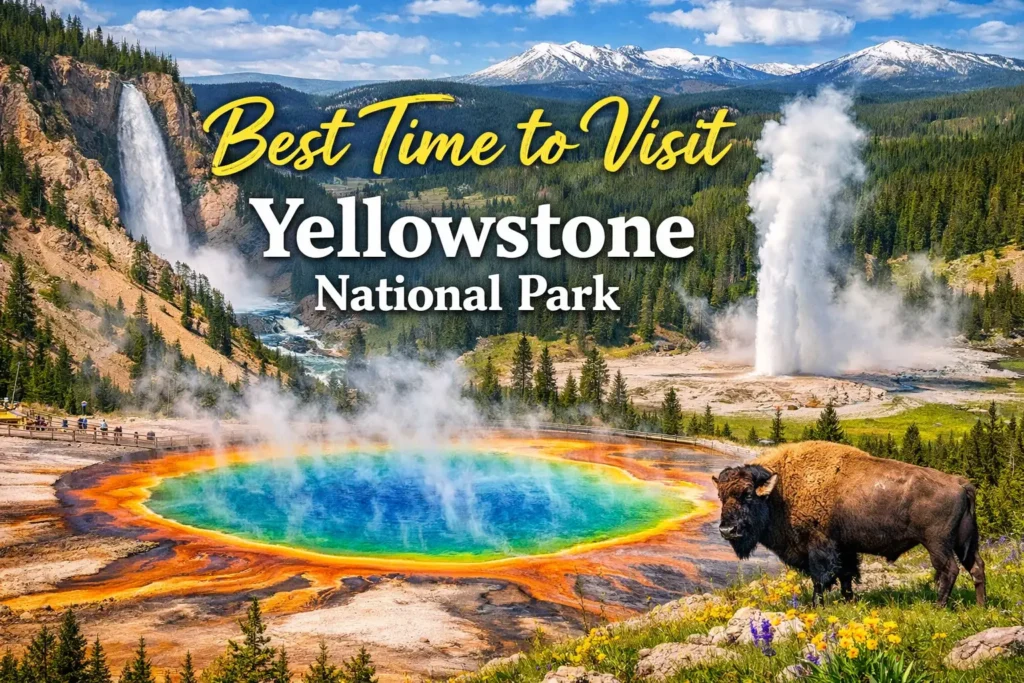
Best Time to Visit Yellowstone National Park (Month-by-Month Guide)
Yellowstone. Just saying the name out loud feels like an adventure. It’s one of those rare places on Earth where you genuinely can’t predict what’s around the next bend — a bison herd crossing the road, a geyser erupting right on schedule, or a wolf slipping quietly through a snow-covered meadow at dawn.
But here’s the thing most travel blogs won’t tell you: there is no single “best” time to visit Yellowstone. It entirely depends on what you’re after. Summer offers wildlife and accessibility. Winter transforms it into a frozen wonderland. Spring brings newborn animals. Fall explodes in color.
This guide walks you through every month of the year so you can decide for yourself — based on your travel style, budget, and bucket list.
Quick Answer: When Is the Best Time to Visit Yellowstone?
If you’re looking for a fast answer, here it is:
- Best overall: Late May to early June, or September
- Best for wildlife: April–May (spring) or October–November (fall rut)
- Best for crowds: March, November, or January–February
- Best for geysers and thermal features: Year-round (they don’t care about seasons)
- Best for families: July–August (though expect peak crowds)
- Best for budget travelers: Shoulder seasons — April, May, September, October
Now let’s break it all down, month by month.
Month-by-Month Guide to Visiting Yellowstone
January & February — The Frozen Kingdom
Most people never see Yellowstone in winter, and that is honestly their loss.
When snow buries the park in January and February, something magical happens. The crowds evaporate. The roads close to regular vehicles — but snowcoaches and snowmobiles take over, and you suddenly have one of America’s most spectacular landscapes almost entirely to yourself.
Temperatures can plunge to -20°F (-29°C) at night, so packing layers is non-negotiable. But the reward? Bison trudging through deep snow with steam rising from geysers behind them. Wolves crossing the Lamar Valley while the world is still and silent. Old Faithful erupting against a pale winter sky.
Wildlife highlight: Wolves are most active and visible in winter. The Lamar Valley — sometimes called “the Serengeti of North America” — is at its absolute best for wolf-watching from January through March.

Practical note: Only the North Entrance (Gardiner, Montana) remains open to wheeled vehicles in winter. All other access requires guided snow transportation.
March — The Shoulder Season Sweet Spot
March sits right at the edge of winter and spring, and it’s a fascinating time to visit if you’re flexible. Roads begin to open in mid-to-late March, wildlife starts moving, and lodging prices haven’t caught up yet.

It’s also calving season for bison — you may spot wobbly, orange-furred bison calves just finding their legs in the snow. Few things in nature are quite as endearing.
Weather is unpredictable. March can bring blizzards one week and clear skies the next. Pack for everything.
April — Spring Awakens (And So Does the Wildlife)
April is one of the park’s most underrated months, and experienced Yellowstone travelers know it.
The Lamar Valley and Hayden Valley are teeming with activity. Bears emerge from hibernation — typically grizzlies in late March and black bears a little later in April. Pronghorn, elk, and bison are all on the move, and with far fewer tourists on the roads, your chances of lingering with wildlife without a traffic jam are genuinely higher.
Wildflowers begin dotting the meadows. Snow still clings to the peaks. The contrast between the lush valley floors and snow-capped ridgelines makes for spectacular photography.
Expert tip: The Yellowstone Insider newsletter and ranger programs run by the National Park Service often highlight early bear activity each spring — these reports are worth following before your trip.
May — The Sweet Spot Before the Rush
May is widely considered by experienced park-goers to be one of the top two or three months to visit Yellowstone — and here’s why.
Most of the park’s 466 miles of roads fully reopen in mid-to-late May (check the NPS website for exact dates each year, as they vary). The crowds are building, but they haven’t hit the wall-to-wall density of July and August yet. Hotels and campgrounds are available at lower rates than peak summer. And the wildlife activity is extraordinary.
Baby bison, elk calves, and pronghorn fawns appear across the valley floors. Migratory birds return. Rivers run high and wild with snowmelt. The whole park feels alive in a way that’s hard to describe unless you’ve seen it.

If you can only visit once and have flexibility over your dates, May is a strong contender for the best month.
June — Summer Kicks In (Bring Your Patience)
June brings long days — sometimes 16 hours of daylight — and with them, the first major surge in visitors. Yellowstone sees roughly 4 million visitors per year, and a significant chunk of those arrive between late June and August.
That said, early June (before schools let out) still feels manageable. The wildflowers are spectacular, waterfalls are at peak flow from snowmelt, and the weather is genuinely pleasant — daytime highs in the 70s°F are common in lower elevations.
By late June, expect traffic at major attractions. Old Faithful, the Grand Prismatic Spring overlook, and the Lamar Valley road can all see significant backups during peak hours.
Pro tip: Arrive at popular spots before 8 a.m. or after 6 p.m. Yellowstone’s evening light is extraordinary, and the animals don’t punch out at 5.
July & August — Peak Season, Peak Everything
July and August are when Yellowstone is at maximum capacity — maximum visitors, maximum heat (by park standards), and maximum sticker shock on lodging.
But here’s the counterintuitive truth: millions of people visit for good reason. The park is fully accessible, every amenity is open, ranger programs are running daily, and the weather is as reliable as it gets. Families with school-age kids often don’t have a choice, and that’s completely okay.
What to expect in summer:
- Daytime temperatures ranging from 70–80°F in lower valleys
- Afternoon thunderstorms are common — they clear fast and keep things cool
- Wildlife activity tends to shift to early morning and evening (animals rest in midday heat)
- Campsite reservations often sell out 6 months in advance — book early
Featured snippet target: The busiest months at Yellowstone National Park are July and August, when daily visitation can exceed 30,000 people. Arriving before 8 a.m. at major attractions significantly reduces wait times and improves wildlife sightings.
September — The Park’s Best-Kept Secret
Ask any Yellowstone ranger or veteran park visitor when they prefer to visit, and there’s a good chance they’ll say September.
The summer crowds thin noticeably after Labor Day. Temperatures cool into the comfortable 50s and 60s°F during the day. The aspens and cottonwoods begin turning gold, and the elk rut — one of nature’s great spectacles — kicks into high gear.

The elk rut means bulls are bugling across meadows, battling for dominance, and moving constantly. Mammoth Hot Springs area and the Madison River valley are particularly good spots. It’s loud, chaotic, primal, and absolutely unforgettable.
Wildlife highlight: September offers some of the best elk rut viewing anywhere in North America. The combination of beautiful fall light, golden foliage, and bugling bulls makes this a favorite among wildlife photographers.
October — Fall Color and Quiet Roads
October is for the traveler who prefers solitude over spectacle. Most of the summer visitors are gone. The park feels different — quieter, more contemplative, and breathtakingly beautiful as the last of the fall color lingers on the hillsides.
Wildlife remains active. Grizzly bears enter hyperphagia — an intense feeding phase before hibernation — and can often be spotted in berry patches and meadows, gorging themselves. Wolves become more visible. Bison rut has wound down, but the herds are still moving across the valleys.
Some facilities begin closing for the season in October, so check the NPS website for updated hours and services before you go.
November — The Edge of Winter
November is a transitional month that rewards flexible, adventurous travelers.
Snowfall becomes regular. Some interior roads begin to close to regular vehicles. But the Lamar Valley remains accessible, and wolf-watching enters prime season once again. Visitor numbers drop dramatically after the first significant snowstorm.

If you’re comfortable with cold weather and potential road closures, November can offer some of the most raw, atmospheric Yellowstone experiences of the year.
What About Crowds? Here’s the Honest Picture
According to NPS visitation data, Yellowstone received over 4.8 million recreational visits in recent years — making it one of the most visited national parks in the United States. Understanding crowd patterns helps you plan smarter.
| Season | Crowd Level | Road Access | Average Temp (°F) |
|---|---|---|---|
| Jan–Mar | Very Low | Limited (snowcoach/snowmobile) | -10 to 35 |
| Apr–May | Low–Moderate | Partial to Full | 30 to 65 |
| Jun–Aug | Very High | Full | 55 to 80 |
| Sep–Oct | Moderate | Full to Partial | 35 to 65 |
| Nov–Dec | Very Low | Limited | 10 to 40 |
Best Time to See Yellowstone Wildlife
Wildlife is one of the top reasons people visit Yellowstone, so here’s a quick reference:
Bears: April through October. Spring (April–May) for new cubs. Fall for hyperphagia feeding behavior.
Wolves: Best viewed November through April in the Lamar Valley. Present year-round but harder to spot in summer vegetation.
Bison: Year-round, but calving season (April–May) and the summer rut (July–August) are highlights.
Elk rut: Mid-September through October. Mammoth Hot Springs and Madison Valley are top spots.
Pronghorn: Spring and early summer, often seen in the northern range near Gardiner.
Best Time to Visit Yellowstone for Photography
If you’re a photographer — amateur or professional — a few windows stand out:
Golden hour in fall (September–October): The combination of elk rut activity, fall foliage, and lower-angle light is a dream. Early morning mist rising from the thermal basins adds another dimension.
Winter (January–March): Snow-covered landscapes with steam from geysers create otherworldly compositions. Fewer people mean you can actually set up a tripod in peace.
Late May to early June: Wildflowers, waterfalls, and newborn wildlife in soft spring light.
Practical Planning Tips
Book lodging early. Yellowstone has nine lodges inside the park, operated by Xanterra Parks & Resorts. Summer rooms fill up 6–12 months in advance. For shoulder season and winter, you have more flexibility.
Get the America the Beautiful Pass. At $80 per year, it covers entrance to all U.S. national parks. Yellowstone’s entrance fee is $35 per vehicle — the annual pass pays for itself in two visits.
Download the NPS Yellowstone app. It includes offline maps, geyser prediction times, road condition alerts, and ranger program schedules. Genuinely useful, even without cell service.
Respect the wildlife. Park regulations require staying at least 100 yards from bears and wolves, and 25 yards from all other wildlife. These rules exist because Yellowstone wildlife is genuinely wild — bison gore more visitors per year than bears do.
Check road status. The NPS updates road conditions at nps.gov/yell — particularly important in spring and fall when conditions can change overnight.
Final words
Go in May or September if you want the best overall experience — solid weather, manageable crowds, excellent wildlife activity, and access to most of the park.
Go in summer (July–August) if you’re traveling with kids, have limited flexibility, or want every amenity and program available — just embrace the crowds and plan around them.
Go in winter (January–March) if you want something truly unforgettable and are willing to plan around limited access — this is Yellowstone at its most raw and extraordinary.
Go in April or October if you’re on a budget, love solitude, and don’t mind unpredictable weather. These are the months when the park exhales.
Yellowstone rewards every visitor who shows up with an open mind. Whatever month you choose, something remarkable is waiting for you.
Frequently Asked Questions
What is the best month to visit Yellowstone National Park?
September is often considered the best month to visit Yellowstone. The weather is pleasant, wildlife is active, and summer crowds are smaller.
Is Yellowstone crowded in summer?
Yes. June, July, and August are the busiest months in Yellowstone. Visitors should expect heavy traffic and crowded popular attractions.
Can I visit Yellowstone in winter?
Yes. Yellowstone is open in winter, but many roads and facilities are closed. Winter visitors can enjoy snow-covered landscapes and wildlife viewing.
When can I see wildlife in Yellowstone?
Wildlife can be seen year-round, but spring and fall are usually the best seasons. Animals are often more active during these months.
Is May a good time to visit Yellowstone?
Yes. May offers mild weather, fewer crowds, and excellent opportunities to see wildlife, including bears and bison.
What is the cheapest time to visit Yellowstone?
The cheapest time is usually during the shoulder seasons, such as April, May, October, and early November, when accommodation prices are often lower.
How many days should I spend in Yellowstone?
Most visitors spend 3 to 5 days in Yellowstone to see the major attractions, wildlife areas, and scenic drives.
What is the best time to avoid crowds in Yellowstone?
Late April, May, September, and October generally have fewer visitors than the peak summer months.
Does Yellowstone close during winter?
The park remains open year-round, but many roads close to regular vehicles due to snow. Access is limited to certain areas and special winter transportation.
Is September better than July for Yellowstone?
For many travelers, yes. September usually has cooler weather, fewer crowds, and excellent wildlife viewing opportunities compared to July.