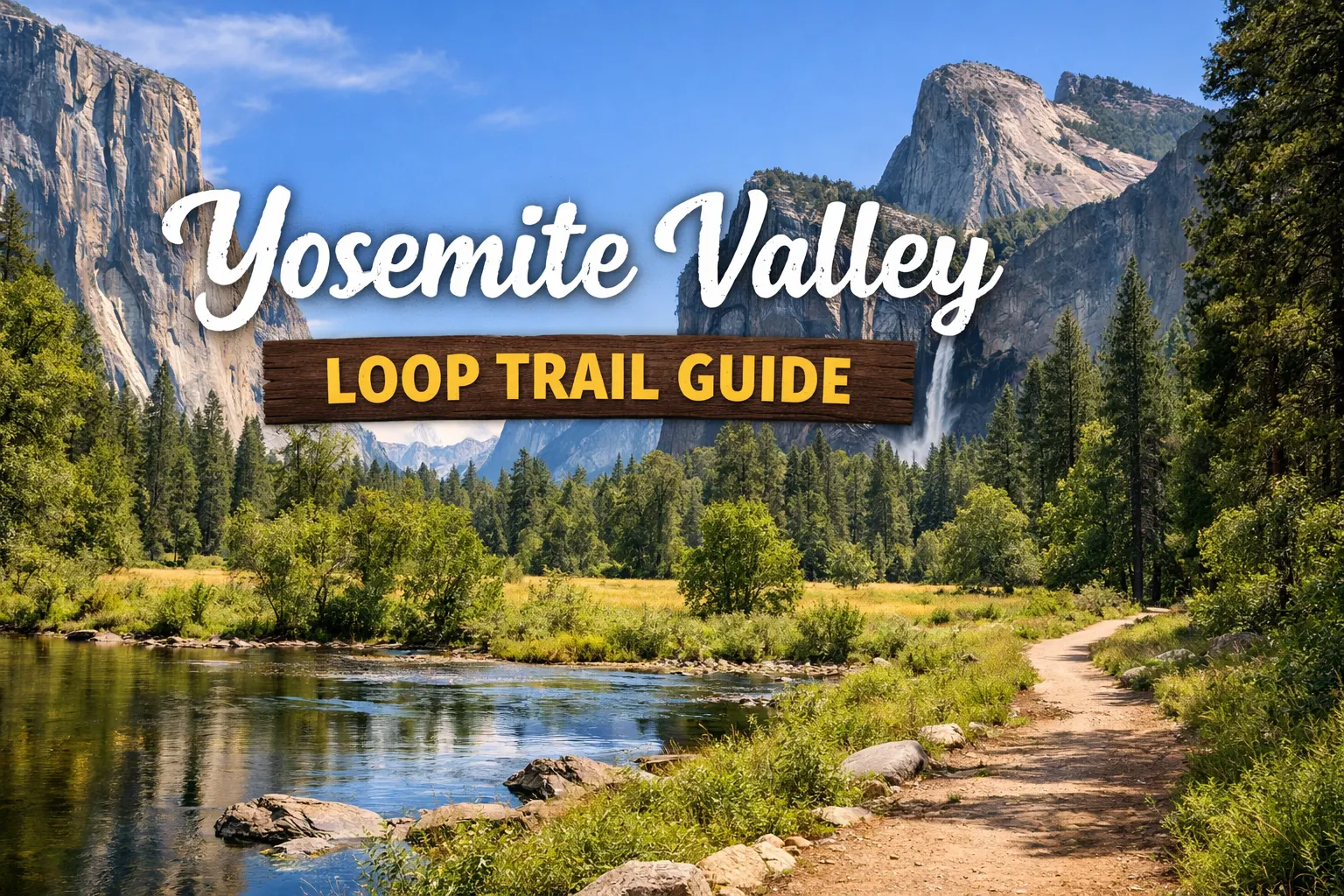
Yosemite Valley Loop Trail Guide: Distance, Difficulty & Best Time to Hike
Somewhere between El Capitan’s granite walls and the gentle mist rising from the Merced River, Yosemite Valley transforms from a spot on the map into something you truly feel inside.
That moment is most accessible from the Yosemite Valley Loop Trail.
Whether you’re a seasoned hiker logging your hundredth mile or a curious first-timer who just drove through the park’s famous Tunnel View, this trail is where the valley reveals itself at a human pace. No summit required. No backcountry permit. Just you, the meadows, the waterfalls, and one of the most iconic valley floors on Earth.
This guide covers everything you need to plan your hike — distance, difficulty, elevation, best seasons, what to pack, and the insider tips most blog posts skip right past.
What Is the Yosemite Valley Loop Trail?
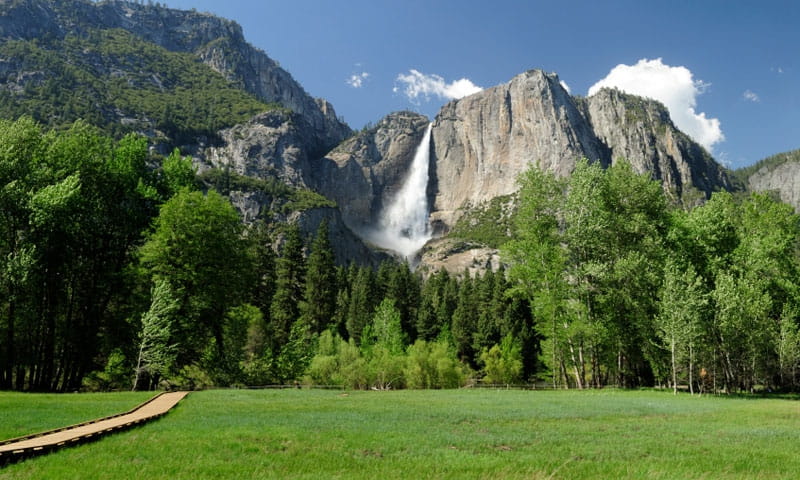
The Yosemite Valley Floor Loop Trail is a relatively flat, multi-use trail that loops around the entire floor of Yosemite Valley. It traces the edges of meadows, runs alongside the Merced River, and passes beneath some of the most famous geological formations in North America.
Unlike technical hikes such as Half Dome or Cathedral Peak, this trail was designed to be experienced by virtually everyone — families with young children, seniors, international visitors hiking in sandals (we don’t recommend it, but we’ve all seen it), and seasoned hikers looking for a meditative, view-heavy walk.
Key Trail Stats at a Glance
| Detail | Info |
|---|---|
| Total Distance | ~11.5 miles (full loop) |
| Elevation Gain | ~450 feet |
| Difficulty | Easy to Moderate |
| Trail Type | Loop |
| Surface | Paved paths, packed gravel, dirt |
| Dog Friendly | Yes, on leash (paved sections only) |
| Permit Required | No (seasonal vehicle reservations may apply) |
| Best Seasons | Spring, Early Summer, Fall |
Trail Distance: How Far Is the Yosemite Valley Loop?
The full loop covers approximately 11.5 miles (18.5 km), making it a solid half-day or relaxed full-day adventure depending on your pace and how often you stop to stare upward — which, for most people, is constantly.
The trail runs on both the north and south sides of the Yosemite Valley floor. Because the valley itself is about 7 miles long and roughly 1 mile wide at its broadest point, the loop naturally takes hikers past multiple distinct ecosystems, viewpoints, and landmarks.
Can You Hike Just a Section?
Absolutely. The trail is highly modular. Many hikers choose to walk one side of the valley — either the southern route near the meadows or the northern route closer to the base of the cliffs — and catch a free Valley Shuttle back to their starting point.
Popular shorter options include:
- Valley View to Valley Visitor Center: ~3 miles, flat, excellent for families
- Mirror Lake Loop (connected trail): ~5 miles, adds an iconic reflection view
- Yosemite Falls via Valley Loop connector: ~2.6 miles round trip to lower falls
If you’re short on time or hiking with children, a 3–5 mile section still delivers extraordinary scenery.
Trail Difficulty: Is the Valley Loop Hard to Hike?
The Yosemite Valley Loop is rated Easy to Moderate — but that rating deserves context.
The elevation gain is minimal. At around 450 feet of cumulative gain across 11.5 miles, it’s nothing like climbing Half Dome (which asks for 4,800 feet of gain in 14–16 miles). Most of the trail is nearly flat, following the natural grade of the valley floor.
However, a few things can make it harder than it looks on paper:
1. Total Mileage
11.5 miles is still 11.5 miles. For infrequent hikers, that’s a genuine physical commitment, especially on warm summer days when the sun reflects off granite and the valley can feel like a bowl of heat.
2. Uneven Terrain in Sections
The eastern sections of the trail — especially near Mirror Lake and the Happy Isles area — include rockier, root-crossed terrain. Wear proper footwear. Seriously.
3. Trail Congestion
From June through August, the Yosemite Valley sees over 20,000 visitors per day. The valley loop is heavily trafficked. This isn’t a difficulty issue in the physical sense, but mentally navigating crowds can be its own kind of exhausting.
Who Is This Trail Right For?
- Beginners: Yes, especially for sections under 5 miles
- Families with kids (5+): Yes, flat meadow sections are perfect
- Seniors and low-mobility hikers: Yes, paved sections are accessible
- Experienced hikers: Great warm-up day or photography-focused walk
What You’ll See: Landmarks Along the Loop
This is where the Yosemite Valley Loop earns its reputation. Most trails make you work for views. Here, the views find you.
El Capitan Meadow
Early in the loop, heading westward from Yosemite Village, you’ll pass through El Capitan Meadow — a broad, open grassland that frames one of the most photographed cliffs on Earth. El Capitan rises 3,000 feet directly from the valley floor, making it the largest exposed granite monolith in the world.
In the meadow below, there’s almost always a cluster of people pointing binoculars skyward. They’re watching climbers. Even tiny dots thousands of feet up, it’s riveting.
Bridalveil Fall
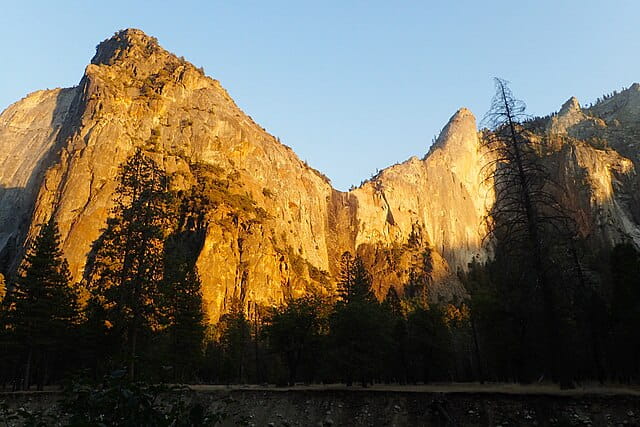
At the western end of the valley, Bridalveil Fall drops 620 feet with a characteristic swaying motion caused by updrafts — which is exactly how it earned its name. During peak snowmelt in late spring, the falls are thunderous. By late summer, they thin to a delicate wisp. Both versions are beautiful, just differently.
Valley View (Gates of the Valley)
Near the western trailhead, Valley View offers the classic postcard composition: the Merced River in the foreground, El Capitan on the left, Cathedral Rocks on the right, and Bridalveil Fall in the distance. Sunrise here is almost unfair in its beauty.
Yosemite Falls Viewpoint
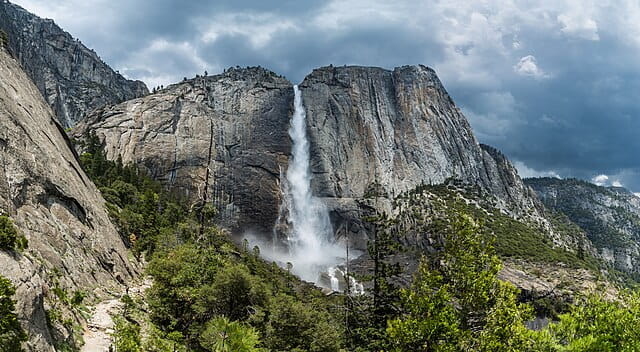
The trail passes close enough to the base of Yosemite Falls that you can feel the spray on dry days. At 2,425 feet total drop, it’s the tallest waterfall in North America. There’s no view like looking straight up at water falling from the sky.
Mirror Lake (Eastern Loop)
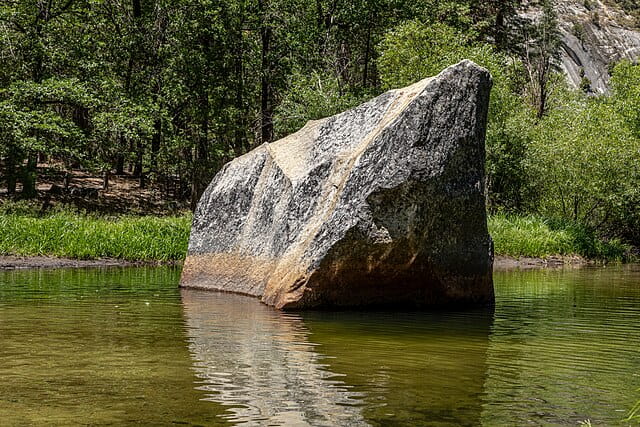
A short spur or loop extension takes you to Mirror Lake, where — on calm mornings before the wind picks up — Half Dome reflects perfectly on the water’s surface. Early risers are rewarded here with silence and photographs that look almost digitally composited.
Best Time to Hike the Yosemite Valley Loop
Yosemite is a year-round destination, but each season offers a radically different experience on the Valley Loop.
Spring (April – Early June): The Peak Season for Waterfalls
Spring is when Yosemite Valley is at its most theatrical. Snowmelt sends every waterfall roaring. Bridalveil and Yosemite Falls are at full volume. The meadows green up fast and wildflowers scatter through the grass.
The Merced River is high and fast — visually dramatic but also a reminder to stay on established crossings. Temperatures are mild, typically 50–65°F in the valley.
Downside: Trails can be muddy, and the valley fills up quickly on weekends. Book accommodations 6+ months in advance.
Early Summer (June – July): Long Days, High Energy
June brings warm days, long daylight hours, and the best trail conditions of the year. Waterfalls are still strong, the air is clear, and wildflowers continue blooming at higher elevations.
July temperatures can reach the mid-80s°F in the valley. Start your hike before 8 AM to beat both the heat and the crowds. The Valley Loop is beautiful in the golden morning light anyway.
Fall (September – November): The Underrated Gem
If spring is the headline act, fall is the secret show. Crowds thin dramatically after Labor Day. Temperatures settle into a comfortable 50–70°F range. The black oaks and cottonwoods along the Merced turn amber and gold, giving the entire valley a warm, painted quality.
Waterfalls are reduced to trickles by October, but the trade-off — fewer people, better photography light, that crisp autumn smell — is absolutely worth it for many hikers.
Fall is arguably the best season to hike the Valley Loop if you value solitude over spectacle.
Winter (December – March): Possible, But Prepared
Yes, people hike the Valley Loop in winter. Yes, it’s stunning. Snow-dusted meadows, mist hanging low, Half Dome emerging from cloud cover — it’s cinematic.
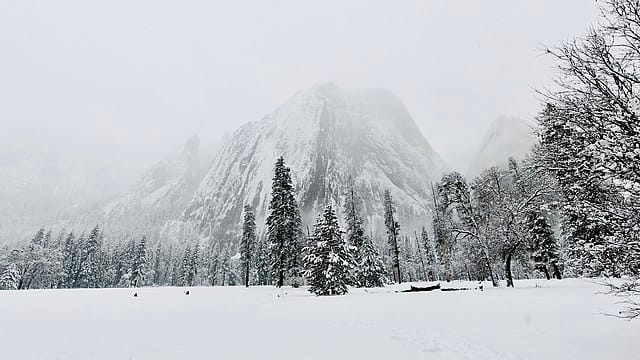
Roads into the valley may require tire chains. Some sections of trail are icy. The valley shuttle still runs, and lodging at Yosemite Valley Lodge is available year-round. Dress in layers, wear waterproof boots, and check the NPS weather page before going.
Trail Etiquette and Leave No Trace Tips
Yosemite Valley receives roughly 4 million visitors annually, according to National Park Service data. The meadows and riparian areas along the loop are fragile ecosystems, and the cumulative impact of millions of footsteps is real.
A few things every hiker should do:
- Stay on the trail. Cutting switchbacks and walking through meadow grass damages root systems that take decades to recover.
- Pack out everything. This includes orange peels, apple cores, and sunflower shells — all of which are foreign to the local ecosystem.
- Give wildlife space. Black bears are active in the valley. Do not approach, feed, or photograph wildlife from dangerously close range.
- Yield to uphill hikers on narrow sections. It’s both courtesy and physics.
- Keep voices down near the river in the morning. Other hikers — and the wildlife — will thank you.
What to Pack for the Valley Loop
For a full 11.5-mile loop, packing smart makes the difference between an enjoyable day and a miserable one.
Essentials
- Water: At least 2–3 liters per person. There are water stations at Yosemite Village and Curry Village.
- Snacks and lunch: Calorie-dense snacks like trail mix, bars, and sandwiches
- Sun protection: Sunscreen, sunglasses, and a hat — the valley floor can be exposed
- Layers: Morning temperatures in the valley can be 20°F cooler than midday
- Footwear: Trail runners or light hiking boots with grip. No flip-flops.
- Trekking poles: Optional, but helpful for longer distances
Nice to Have
- Binoculars: For watching climbers on El Capitan or spotting deer in the meadows
- Camera or phone tripod: For Mirror Lake reflections and Bridalveil spray shots
- National Parks Pass: If you’re a frequent visitor, the America the Beautiful pass pays for itself quickly
Getting There and Parking
One of the most common frustrations at Yosemite is parking — or the lack of it. During peak season (May–September), day-use reservations are required to drive into Yosemite Valley. Book through the Recreation.gov website as soon as your date is confirmed.
Alternatively, park at one of the outlying lots in El Portal or at the Merced bus station and take the YARTS bus directly into the valley. It’s cheaper, less stressful, and often faster than navigating valley traffic.
Once you’re in the valley, the free Yosemite Valley Shuttle (Routes 1 and 2) loops continuously through the valley and drops you at most trailheads. Use it to start or end your loop at any point.
Read Also: Arches National Park Hikes Ranked by Difficulty (Beginner to Expert)
Final Thoughts: Why the Valley Loop Deserves More Credit
Most people arrive in Yosemite with half a day and a wish list: Half Dome, Glacier Point, Tunnel View. The Valley Loop rarely makes the bucket list. It’s not a peak. It doesn’t have a famous cable system. You don’t need a permit or a fitness plan.
And maybe that’s why it’s so consistently wonderful.
It asks nothing of you except to show up and walk. In return, it gives you the entire valley — every wall, every waterfall, every meadow — at a pace where you can actually absorb it.
If you only have one day in Yosemite, hike the Valley Loop. You’ll cover more ground, see more landmarks, and leave with a more complete picture of the valley than almost any other single trail in the park.
That feeling in your chest? It’s waiting for you at mile one.
Frequently Asked Questions
How long does it take to hike the Yosemite Valley Loop?
At a relaxed pace with stops, plan for 5–7 hours for the full 11.5-mile loop. Faster hikers complete it in 3–4 hours.
Is the Valley Loop good for beginners?
Yes. The trail is mostly flat with minimal elevation gain, making it one of the most beginner-friendly trails in Yosemite National Park.
Can you hike the Valley Loop in one day?
Absolutely. Most hikers complete it comfortably in a single day, especially when starting early.
Are dogs allowed on the Yosemite Valley Loop?
Dogs are permitted on paved sections of the trail but not on natural surface trails. Always keep them on a leash.
What month is the best time to visit Yosemite for the Valley Loop?
Late April through early June offers peak waterfall flow. September and October offer fewer crowds and beautiful fall foliage.
Happy trails. Watch for bears. Drink water.

Rubie Rose is a travel writer who focuses on USA national parks, hiking trails, and practical travel planning. She shares easy-to-follow guides to help visitors explore parks safely and confidently. Her work on parktrailsguide.com is built on deep research, firsthand accounts from park visitors, and a commitment to giving readers information they can actually use on the trail.