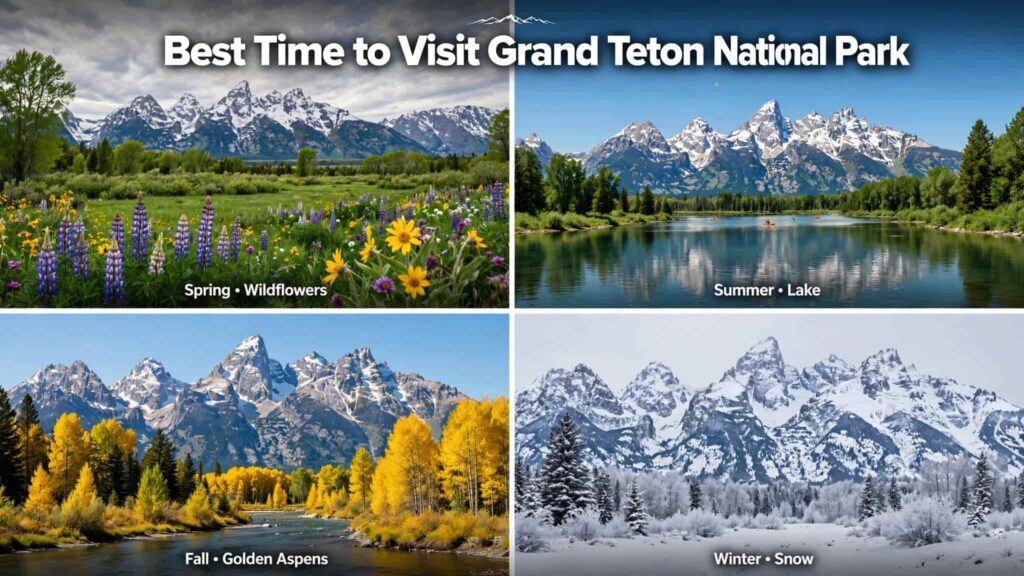
Best Time to Visit Grand Teton National Park: Weather, Crowds & Things to Know (2026)
If you’re planning a trip to Grand Teton National Park in 2026, choosing the right month can make a major difference. Weather, road access, hiking conditions, wildlife activity, crowds, and available facilities all change throughout the year.
Grand Teton National Park is open 24 hours a day, year-round, but the experience is very different between summer, fall, winter, and spring. The National Park Service identifies May through September as the park’s most popular months, while some roads, campgrounds, and visitor facilities close or operate on reduced schedules from November through April.
For most visitors looking for the widest selection of hiking trails, scenic drives, boat trips, visitor services, and accessible roads, July and August are the easiest months for a classic Grand Teton trip. September can be particularly appealing if you prefer cooler weather and fall scenery.
Quick Answer: What Is the Best Time to Visit Grand Teton National Park?
July through September is a practical window for a first visit, but the best month depends on what you want to do.
| Month/Season | Weather | Crowds | Hiking | Wildlife | Overall Experience |
|---|---|---|---|---|---|
| April | Cool, snow/rain possible | Low | Limited | Good | Early spring |
| May | Mild but unsettled | Low–moderate | Some snow | Good | Spring transition |
| June | Warmer, rain/snow possible | Moderate | Improving | Good | Early summer |
| July | Warm days, cool nights | High | Excellent | Good | Peak summer |
| August | Warm, thunderstorms possible | High | Excellent | Good | Peak summer |
| September | Cooler, occasional snow | Moderate | Good | Excellent | Fall transition |
| October | Cold nights, possible snow | Low | Limited | Good | Fall/quiet season |
| November–March | Cold, snowy | Low | Winter activities | Seasonal | Winter |
Important: Conditions can change quickly in the mountains, and snow or frost is possible even outside winter. NPS specifically advises visitors to check current conditions and forecasts before recreation.
Grand Teton Weather by Season
Summer: June, July & August

Summer is the busiest period in Grand Teton National Park and generally provides the broadest range of visitor opportunities.
The National Park Service describes July and August as having warm days and cool nights, with afternoon thunderstorms common. At lower elevations around Moose, average summer temperatures can reach the 80s°F.
July
July is one of the busiest months.
Typical conditions include:
- Warm afternoons
- Cool mornings and evenings
- Long daylight hours
- Excellent conditions for many hikes
- Possible afternoon thunderstorms
- Heavy visitor traffic at popular locations
July is useful for travelers who want to combine several activities, such as hiking, scenic drives, photography, boating, and wildlife viewing.
August
August is similar to July, although conditions can start transitioning toward fall later in the month.
The NPS climate information lists an average high around 79°F in August at its reference location, with an average low around 40°F.
Carry rain gear even when the morning starts sunny because mountain weather can change quickly.
Is June a Good Time to Visit Grand Teton?
Yes, but June can be a transition month.

June generally offers warmer conditions than spring, but snow can remain on higher-elevation trails.
The National Park Service notes that mid-April through June can bring mild days and cool nights alternating with rain and snow, and valley trails are usually snow-covered until late May.
June can be a good option if you want:
- Longer daylight
- Early summer scenery
- Fewer visitors than peak July
- Green landscapes
- Opportunities for wildlife viewing
However, don’t assume every hiking trail will be completely snow-free.
Before planning a particular hike, check current trail conditions and park alerts.
Best Time to Visit Grand Teton for Hiking

For many popular lower-elevation hikes, July through September is the easiest period for hiking because summer conditions generally provide better access.
However, trail conditions vary significantly with elevation.
Higher trails can retain snow later into the season, while lower valley trails may become accessible earlier.
The park also notes that construction is affecting some trail and road access in 2026. For example, the north side of Taggart Trail is closed for reconstruction, while Taggart Trailhead and the south side remain open; Death Canyon Trailhead is also affected by construction.
Hiking tip
Don’t plan your itinerary solely around calendar dates. Check:
- Current trail conditions
- Road closures
- Weather forecast
- Thunderstorm conditions
- Trailhead parking
- Construction notices
Best Time to Visit Grand Teton for Wildlife
Wildlife can be seen throughout the year, but the species and viewing conditions vary by season.
Spring and fall can be particularly interesting because animals are responding to seasonal changes and migrations.
In fall, the NPS notes that bison and pronghorn move east, while elk begin moving south.
Early morning and evening are often useful times for wildlife viewing because animals may be more active, but always maintain a safe distance and follow park regulations.
Never approach wildlife for a photograph.
Best Time to Visit Grand Teton for Fall Colors

September and early October can be excellent periods for fall scenery.
The NPS describes fall as a period when aspen leaves become vibrant yellow, temperatures cool, daylight decreases, and rain or occasional snowstorms become more common.
Fall can also bring fewer visitors than the peak summer period.
However, don’t expect summer conditions to continue throughout October. Temperatures drop quickly, and snow can arrive.
If your main goal is to photograph golden aspens with the Teton Range in the background, keep your schedule flexible because the timing of peak foliage varies from year to year.
Is September a Good Time to Visit Grand Teton?
September is one of the most useful shoulder-season options.
You can potentially get:
- Cooler hiking temperatures
- Fall colors
- Wildlife activity
- Fewer visitors than peak summer
- Excellent photography conditions
The trade-off is that weather becomes less predictable and some summer services begin winding down.
The NPS climate table lists an average high of about 69°F in September and about 32°F average low, although conditions vary by elevation and individual weather event.
If you’re visiting in September, bring layers rather than relying on summer clothing.
Best Time to Visit Grand Teton to Avoid Crowds
If avoiding crowds is your priority, consider the shoulder seasons, particularly parts of May, September, and October.
Grand Teton does not require an entrance reservation or timed entry reservation, but the park warns that spring, summer, and fall can be busy, with crowds and lines at entrance gates, construction areas, and popular wildlife-viewing locations.
Popular locations such as Jenny Lake can become especially busy during summer. The NPS notes that parking at Jenny Lake is limited and that the lot can fill during summer.
Ways to reduce summer crowds
- Arrive early in the morning.
- Visit popular viewpoints earlier in the day.
- Avoid relying on midday parking availability.
- Consider visiting during September.
- Check road and construction conditions before driving.
Best Time to Visit Grand Teton on a Budget
There isn’t one universal cheapest month because lodging and travel prices depend heavily on where you stay, how far in advance you book, and local demand.
However, traveling outside the busiest summer period can provide more lodging options and potentially different prices.
If you’re flexible, compare accommodation costs for:
- May
- Early June
- September
- October
Always check the actual property rate for your dates rather than assuming a particular month will be cheaper.
Visiting Grand Teton in Spring
April and May
Spring is a transitional season.
The NPS describes April through June as a period when mild days and cool nights can alternate with rain and snow. Valley trails can remain snow-covered until late May or early June.
Advantages
- Fewer visitors
- Changing landscapes
- Wildlife opportunities
- Cooler temperatures
- Good photography possibilities
Things to consider
- Snow may remain on trails.
- Some facilities may not yet be operating on summer schedules.
- Weather can change rapidly.
- Some roads and services may still be seasonally restricted.
Spring is therefore better suited to travelers who are comfortable with variable conditions than visitors expecting a fully operational summer experience.
Visiting Grand Teton in Fall
September and October

Fall brings cooler temperatures and changing foliage.
September generally provides a useful transition between summer and winter, while October becomes noticeably colder.
The NPS notes that September through November can bring sunny days and cold nights, along with rain and occasional snowstorms.
Why visit in fall?
- Golden aspens
- Cooler hiking weather
- Wildlife movement
- Beautiful mountain photography
- Generally quieter conditions than peak summer
What to watch for
- Shorter daylight
- Colder mornings
- Snowstorms
- Seasonal road closures
- Reduced visitor services
Visiting Grand Teton in Winter

Winter is a completely different Grand Teton experience.
From December through April, snow blankets the mountains and valley. The NPS describes winter as having sunny periods between storms but extremely cold nights.
At Moose, the NPS reports an average winter snowfall of roughly 14 feet, while average December–February temperatures are approximately 28°F for the high and 2°F for the low.
Winter visitors can enjoy activities such as:
- Cross-country skiing
- Snowshoeing
- Winter photography
- Wildlife viewing
- Snow-covered mountain scenery
But winter driving requires additional preparation.
The park recommends appropriate winter or all-season tires and carrying tire chains when driving over mountain passes. Roads can be snow-covered and icy.
Grand Teton Road Closures to Know About
Road access is one of the biggest reasons to consider the season when planning your trip.
For example, the Teton Park Road is closed from November 1 through April 30 between Taggart Lake Trailhead and Signal Mountain Lodge.
Other roads have their own seasonal schedules.
The park’s main US 89/191 and US 26/287 routes remain important winter travel routes, although winter driving conditions can still be difficult.
2026 construction matters
Grand Teton has several infrastructure projects underway during 2026.
The National Park Service says these projects can affect road and trail access and advises visitors to check current conditions and plan alternate routes.
Moose-Wilson Road construction is particularly important for visitors planning to travel through that corridor. The current construction information lists closures and delays during portions of the 2026 season.
What Is the Best Month to Visit Grand Teton?
There isn’t one month that works equally well for every traveler.
Choose July if you want:
- Warm summer weather
- Long daylight hours
- Extensive hiking opportunities
- The broadest summer experience
Choose August if you want:
- Warm weather
- Summer hiking
- Scenic drives
- Lakes and mountain scenery
Choose September if you want:
- Cooler temperatures
- Fall scenery
- Wildlife opportunities
- A transition away from peak summer
Choose October if you want:
- Quieter conditions
- Fall scenery
- Cooler temperatures
- A more seasonal experience
Choose winter if you want:
- Snow-covered Tetons
- Snowshoeing
- Cross-country skiing
- Winter photography
Grand Teton Weather by Month
The following figures are NPS climate averages for the park’s reference location and should be treated as general planning information rather than a forecast.
| Month | Avg. High | Avg. Low | Avg. Snowfall |
|---|---|---|---|
| January | 26°F | 0.9°F | 43.1 in |
| February | 31°F | 3.2°F | 28.7 in |
| March | 39°F | 12.1°F | 20.3 in |
| April | 49°F | 22.3°F | 9.5 in |
| May | 61°F | 30.8°F | 2.4 in |
| June | 71°F | 37.3°F | 0.1 in |
| July | 81°F | 41.6°F | 0 in |
| August | 79°F | 39.7°F | 0 in |
| September | 69°F | 32.1°F | 0.4 in |
| October | 56°F | 23.2°F | 4.7 in |
| November | 38°F | 13.6°F | 23.4 in |
| December | 27°F | 1.8°F | 39.5 in |
Mountain weather can vary considerably with elevation, and snow or frost is possible outside the traditional winter season.
What to Pack for Grand Teton in 2026
Your packing list should depend on your travel month.
Summer
- Lightweight hiking clothes
- Warm layer
- Rain jacket
- Hiking shoes
- Sun protection
- Water bottle
- Insect repellent
- Small backpack
Fall
- Warm jacket
- Base layers
- Rain shell
- Gloves
- Hat
- Hiking shoes
- Extra warm clothing
Winter
- Insulated jacket
- Thermal layers
- Gloves
- Warm hat
- Winter boots
- Snowshoes or skis where appropriate
- Emergency supplies for driving
Because mountain weather changes quickly, the NPS recommends rain gear during spring, summer, and fall and substantial cold-weather layers during winter.
Tips for Planning a Grand Teton Trip in 2026
1. Check conditions before leaving
Don’t rely only on a weather app. Check the official Grand Teton National Park conditions and road information before heading out.
2. Book lodging early
Grand Teton says its lodging and campgrounds are reservable and can fill months ahead, particularly during popular travel periods.
3. Start early during summer
Popular locations can become crowded and parking can be limited.
4. Keep your itinerary flexible
Mountain weather can change quickly, so leave room to move hikes or scenic drives between days.
5. Check construction updates
This is particularly important in 2026, when several infrastructure projects are affecting portions of the park.
6. Don’t forget wildlife safety
Wild animals are wild, even when they appear close to roads or trails. Give animals plenty of space and follow park regulations.
Frequently Asked Questions
What is the best time to visit Grand Teton National Park?
For a traditional summer trip with extensive hiking, scenic drives, and visitor services, July and August offer the broadest summer experience. September is another strong option for travelers who prefer cooler weather and fall scenery.
Is September a good time to visit Grand Teton?
Yes. September can provide cooler temperatures, changing foliage, wildlife opportunities, and fewer visitors than the peak summer period. However, snow and colder weather become increasingly possible.
Is Grand Teton open in winter?
Yes. Grand Teton National Park is open year-round, 24 hours a day, although many roads, campgrounds, and visitor facilities close or have reduced operations during winter.
Does Grand Teton get snow in summer?
Snow and frost are possible during any month, especially at higher elevations. Summer generally has much less snow in the valley, but mountain weather can change quickly.
When is Grand Teton least crowded?
Winter is generally much quieter than the popular May–September period, while portions of spring and fall can also offer fewer visitors than peak summer.
Do I need an entrance reservation for Grand Teton?
No. Grand Teton does not currently offer or require an entrance reservation or timed-entry reservation.
How many days do you need in Grand Teton?
A 2–4 day trip gives many visitors enough time to combine scenic drives, viewpoints, wildlife viewing, and several hikes. Longer trips allow more flexibility for weather and construction-related changes.
Final Thoughts: When Should You Visit Grand Teton?
The best time to visit Grand Teton National Park depends on the experience you want.
For maximum summer access and hiking opportunities, look toward July and August. For a combination of cooler weather, fall scenery, wildlife, and potentially fewer visitors, September is worth considering. Spring offers a quieter transitional landscape, while winter transforms the park into a snowy destination for skiing, snowshoeing, and winter photography.
Whatever month you choose, check official park conditions, road closures, weather, and 2026 construction updates shortly before your trip. Conditions in the Tetons can change quickly, and seasonal access is an important part of planning a successful visit.
Official planning resources: Grand Teton National Park — National Park Service · Weather Information · Park Roads & Closures
Also see: Best Things to Do in Grand Teton National Park: Complete Visitor Guide (2026)