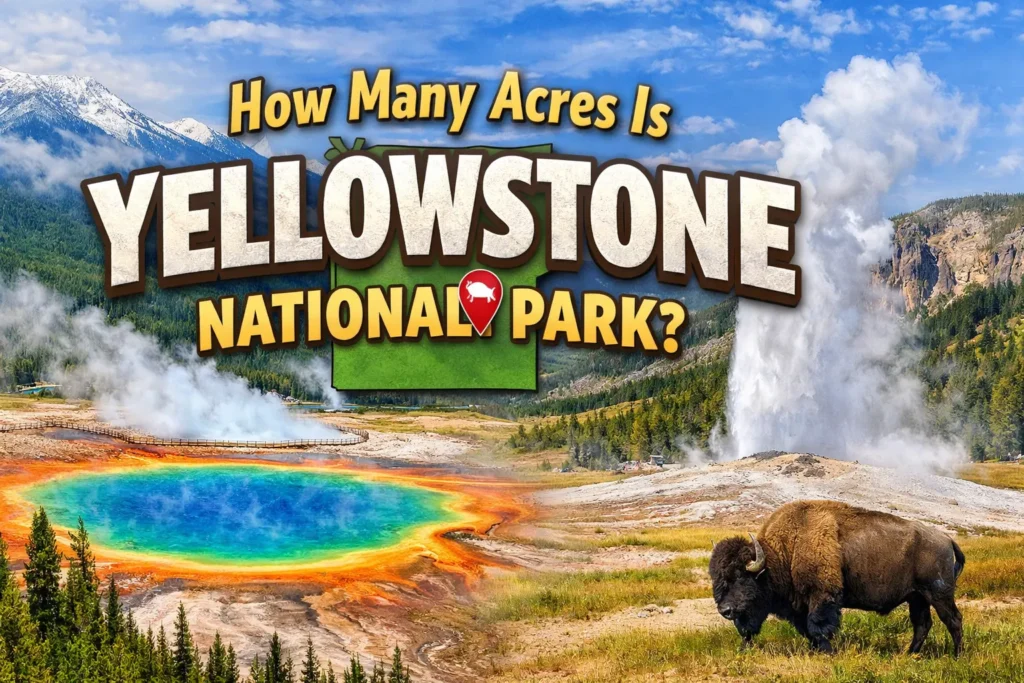
How Many Acres Is Yellowstone National Park? Size, Area & Facts (2026)
If you’ve ever wondered how many acres is Yellowstone National Park, the answer is roughly 2.22 million acres. That makes Yellowstone one of the largest national parks in the contiguous United States and a remarkably large protected landscape spread across Wyoming, Montana, and Idaho.
But acreage alone doesn’t fully explain how big Yellowstone National Park really is. The park stretches for thousands of square miles and contains forests, grasslands, mountains, lakes, rivers, wildlife habitat, and one of the world’s largest concentrations of geothermal features.
According to the National Park Service, Yellowstone currently covers about 2,221,766 acres, or approximately 3,472 square miles (8,991 square kilometers). The NPS also notes that efforts to scientifically verify the park’s exact total area are ongoing, so you may see slightly different acreage figures in older sources.
Here’s a closer look at Yellowstone National Park’s area in acres, how it compares with other places, how many hectares and square miles it covers, and why its enormous size matters.
How Many Acres Is Yellowstone National Park?
Yellowstone National Park covers approximately 2,221,766 acres.
In other words, if you’re searching for Yellowstone National Park area acres, the current National Park Service figure is about 2.22 million acres.
Here is the same area in different units:
| Measurement | Yellowstone’s Area |
|---|---|
| Acres | 2,221,766 acres |
| Square miles | 3,472 sq mi |
| Square kilometers | 8,991 km² |
| Hectares | 899,116 hectares |
| Approximate size | 2.22 million acres |
The NPS notes that Yellowstone’s area figures have not been scientifically verified to an absolute final number. That’s why older websites and documents may show a slightly different figure, including 2,219,791 acres.
So if you have seen the number 2,219,791 acres while searching for how many acres is Yellowstone, you’re not necessarily looking at a completely different park. It is an older figure that appears in some NPS and other published materials. For current visitor information, the NPS Park Facts page lists 2,221,766 acres.
Quick answer
How many acres is Yellowstone National Park?
Yellowstone covers approximately 2.22 million acres, with the current NPS figure listed as 2,221,766 acres.
That is equivalent to about 3,472 square miles or 8,991 square kilometers.
How Big Is Yellowstone National Park?
If you’re trying to understand how big Yellowstone National Park actually is, its dimensions help put the acreage into perspective.
Yellowstone measures approximately:
- 63 air miles from north to south
- 54 air miles from east to west
- 3,472 square miles in total area
- 2,221,766 acres
- 8,991 square kilometers
The park is so large that visiting one part of Yellowstone can feel completely different from visiting another.
The landscape changes from dense forests and mountain ranges to open valleys, geothermal basins, waterfalls, lakes, and wildlife-rich grasslands.
This is one reason a Yellowstone trip usually requires more planning than simply choosing a few attractions on a map. The distances between major areas can be significant, and roads can become congested during the busiest months.
How Many Hectares Is Yellowstone National Park?
For visitors and researchers who use the metric system, Yellowstone National Park covers approximately 899,116 hectares.
That is the same area as:
- 2,221,766 acres
- 3,472 square miles
- 8,991 square kilometers
- 899,116 hectares
So if your search is “Yellowstone National Park area hectares,” the simplest answer is approximately 899,000 hectares.
How Many Square Miles Is Yellowstone?
Yellowstone covers approximately 3,472 square miles.
That is a useful figure when comparing Yellowstone with states, cities, counties, and other national parks.
The park is also larger than Rhode Island and Delaware combined, according to the National Park Service.
Another way to picture the size is to compare it with Puerto Rico. Yellowstone’s total area is very close to the total land area of Puerto Rico, although the two places have very different geography and land-use patterns.
How Many Acres Is Yellowstone Compared With Other National Parks?
Yellowstone is enormous, but it is not the largest national park in the United States.
Several national parks in Alaska are dramatically larger. Even within the lower 48 states, Death Valley National Park is larger than Yellowstone.
Here is a useful comparison:
| National Park | Approximate Area |
|---|---|
| Wrangell–St. Elias, Alaska | ~13.2 million acres |
| Gates of the Arctic, Alaska | ~8.5 million acres |
| Denali, Alaska | ~4.7 million acres |
| Death Valley, California/Nevada | ~3.4 million acres |
| Yellowstone, Wyoming/Montana/Idaho | ~2.22 million acres |
| Grand Canyon, Arizona | ~1.2 million acres |
| Glacier, Montana | ~1.0 million acres |
| Yosemite, California | ~760,000 acres |
This means Yellowstone is one of America’s biggest national parks, but it isn’t the largest overall.
Is Yellowstone the biggest national park in the United States?
No.
If you’re asking whether Yellowstone is the largest national park in America, the answer is no. Alaska contains several national parks that are much larger.
Yellowstone is, however, one of the largest parks in the lower 48 states and is internationally famous for the combination of its huge protected landscape, wildlife, forests, lakes, mountains, and geothermal features.
What States Is Yellowstone National Park In?
Yellowstone is unusual because the park crosses three states:
- Wyoming — about 96%
- Montana — about 3%
- Idaho — about 1%
The vast majority of Yellowstone is in Wyoming.
The Montana portion is concentrated along the northern and northwestern edges of the park, while a small section extends into Idaho in the southwest.
This is why Yellowstone is sometimes described as a Wyoming, Montana, and Idaho national park, even though Wyoming contains the overwhelming majority of its acreage.
Why Is Yellowstone So Large?
Yellowstone’s size is closely connected to the reason the park was established in the first place.
Yellowstone became the world’s first national park on March 1, 1872.
The area was protected because of its extraordinary geothermal features, scenery, wildlife, forests, lakes, and other natural resources.
Over time, the park’s enormous protected landscape became important not only for visitors but also for maintaining connected habitats for species such as bison, elk, wolves, grizzly bears, and many other animals.
A large protected area allows wildlife to move across different habitats and gives natural processes such as wildfire, seasonal migration, flooding, and predator-prey relationships room to continue.
What Percentage of Yellowstone Is Forest?
According to the National Park Service, approximately 80% of Yellowstone is covered by forest.
Much of that forest is dominated by lodgepole pine.
The remaining landscape includes grasslands, wetlands, lakes, rivers, mountains, geothermal areas, and other habitats.
This is one reason the number 2.22 million acres can be misleading if you imagine the park as one giant open field. Yellowstone is a complex mixture of different ecosystems.
How Much of Yellowstone Is Water?
Water covers approximately 5% of Yellowstone National Park.
One of the most prominent water features is Yellowstone Lake, which sits at an elevation of approximately 7,733 feet.
The lake covers about 131.7 square miles, with a shoreline stretching roughly 141 miles.
Yellowstone Lake is one of the defining geographical features within the park and occupies a substantial area of the park’s eastern and southeastern sections.
How Big Is Yellowstone Lake?
Yellowstone Lake covers approximately 131.7 square miles, which is about 341 square kilometers.
The lake is:
- About 20 miles from north to south
- About 14 miles from east to west
- Approximately 141 miles around its shoreline
- About 7,733 feet above sea level
- About 138 feet deep on average
- Up to about 430 feet deep at its deepest point
Because Yellowstone Lake itself covers such a large area, it is an important part of the overall Yellowstone National Park area in acres.
Yellowstone’s Geothermal Features
The park’s size is impressive, but its geology is arguably even more remarkable.
Yellowstone sits above an active volcanic system and contains more than 10,000 hydrothermal features, including:
- Hot springs
- Geysers
- Mudpots
- Fumaroles
- Travertine formations
The park contains more than 500 active geysers, more than half of the world’s geysers.
Famous geothermal areas include:
- Old Faithful
- Grand Prismatic Spring
- Norris Geyser Basin
- Mammoth Hot Springs
- Midway Geyser Basin
These features occupy only a portion of Yellowstone’s total acreage, but they are among the main reasons the park became famous around the world.
Yellowstone National Park Size Compared With Cities and Places
Sometimes the easiest way to understand how many acres Yellowstone is is to compare it with familiar places.
Yellowstone vs. Rhode Island and Delaware
Yellowstone is larger than Rhode Island and Delaware combined.
This is one of the simplest comparisons for understanding the park’s scale.
Yellowstone vs. Puerto Rico
Yellowstone’s approximately 3,472 square miles of area is very close to the overall size of Puerto Rico.
The landscapes are obviously very different, but the comparison helps show just how large the park is.
Yellowstone vs. Los Angeles County
Los Angeles County covers slightly more land area than Yellowstone.
That means Yellowstone is not merely “large for a national park”; its area is comparable with that of a major U.S. county containing millions of people.
What Is the Greater Yellowstone Ecosystem?
One important distinction is that Yellowstone National Park is not the same thing as the Greater Yellowstone Ecosystem (GYE).
Yellowstone itself covers approximately 2.22 million acres.
The Greater Yellowstone Ecosystem is a much larger landscape surrounding the park. Its size varies depending on how its boundaries are defined, and the National Park Service describes estimates ranging from approximately 12 million to 22 million acres.
The Greater Yellowstone Ecosystem includes portions of:
- Yellowstone National Park
- Grand Teton National Park
- National forests
- National wildlife refuges
- Bureau of Land Management lands
- State lands
- Private lands
- Tribal lands
This larger ecosystem is important because wildlife does not recognize the boundaries drawn around a national park.
Animals can move between Yellowstone and surrounding landscapes in search of food, seasonal habitat, mates, and migration routes.
So when you see references to 22 million acres of the Greater Yellowstone Ecosystem, don’t confuse that number with the 2.22 million acres of Yellowstone National Park itself.
How Much of Yellowstone Can Visitors Actually Explore?
Although Yellowstone covers more than 2.2 million acres, visitors don’t experience every part of it.
Most first-time visitors spend their time around developed areas, scenic roads, boardwalks, viewpoints, visitor centers, campgrounds, and established trails.
The park has approximately 1,000 miles of trails, giving hikers access to areas far beyond the main tourist corridors.
Yellowstone’s backcountry is much less developed than its major visitor areas, and overnight backcountry trips require proper planning and permits.
This difference between the park’s total acreage and the areas most visitors actually visit is important.
You can spend several days in Yellowstone and still experience only a tiny fraction of the park.
How Many Roads Are in Yellowstone?
Yellowstone’s roads connect its major visitor areas, but distances can still be substantial.
The park has five entrance stations, and the National Park Service notes that it can take several hours to drive between entrances.
Road conditions and seasonal closures also matter when planning a trip.
Most park roads close to regular vehicle traffic during winter, while the road between the North Entrance at Gardiner and Cooke City is generally the main year-round route for regular vehicles.
So if you’re planning a Yellowstone visit based on the park’s 2.22 million acres, don’t assume that every part of the park is equally accessible by car.
How Much Backcountry Does Yellowstone Have?
Yellowstone has an extensive backcountry trail system.
The National Park Service currently lists approximately 1,000 miles of trails and hundreds of designated backcountry campsites.
Backcountry travel can take visitors into areas that are considerably quieter and more remote than the major sightseeing corridors.
However, hiking and camping in Yellowstone’s backcountry require preparation because of:
- Wildlife encounters
- Rapid weather changes
- High elevations
- Long distances
- River crossings
- Limited services
- Seasonal trail conditions
Visitors planning an overnight backcountry trip should check current NPS conditions and permit requirements before leaving.
How Many People Visit Yellowstone Each Year?
Yellowstone receives millions of recreation visits every year.
For example, the National Park Service reported 4,762,988 recreation visits in 2025.
That puts Yellowstone among the most heavily visited national parks in the United States.
Despite those millions of visits, the park’s enormous size means visitor use is concentrated heavily around popular attractions, roads, developed areas, and major geothermal features.
The difference between total acreage and concentrated visitor use is one reason Yellowstone can feel extremely busy in some locations while other parts remain remarkably quiet.
Yellowstone Acreage Facts at a Glance
Here’s a quick summary if you only need the key numbers:
| Yellowstone Size Fact | Figure |
|---|---|
| Total area | 2,221,766 acres |
| Approximate area | 2.22 million acres |
| Square miles | 3,472 sq mi |
| Square kilometers | 8,991 km² |
| Hectares | 899,116 ha |
| Wyoming portion | ~96% |
| Montana portion | ~3% |
| Idaho portion | ~1% |
| Forest | ~80% |
| Water | ~5% |
| North-to-south distance | ~63 air miles |
| East-to-west distance | ~54 air miles |
| Yellowstone Lake | ~131.7 sq mi |
| Hydrothermal features | 10,000+ |
| Active geysers | 500+ |
| Hiking trails | ~1,000 miles |
| 2025 recreation visits | 4,762,988 |
Why Do Some Websites Say Yellowstone Has 2,219,791 Acres?
If you searched “yellowstone national park acres” or “yellowstone national park area acres 2219790”, you may have noticed that different websites give slightly different numbers.
There is a reason for that.
Older sources commonly cite 2,219,791 acres, while the current National Park Service Park Facts page lists 2,221,766 acres and explicitly says that no area figures have been scientifically verified and that efforts to confirm the total area continue.
So the difference doesn’t mean that Yellowstone suddenly gained or lost thousands of acres.
It reflects differences in published measurements and the fact that the NPS continues to refine its geographic data.
For current trip-planning purposes, about 2.22 million acres is the easiest and most useful figure to remember.
Has Yellowstone’s Size Changed Since 1872?
Yellowstone was established on March 1, 1872, as the world’s first national park.
Its core protected landscape has remained remarkably consistent since its creation, although mapping, surveying, and land-management records have changed over time.
That’s another reason you may encounter different acreage figures when comparing historical sources with current National Park Service information.
The important point is that Yellowstone has protected an enormous landscape for more than 150 years.
Why Does Yellowstone’s Size Matter?
The answer to how many acres is Yellowstone National Park isn’t just a trivia question.
The park’s enormous size is fundamental to its ecological importance.
A landscape of more than two million acres can support:
- Large populations of wildlife
- Extensive forests
- Grasslands and meadows
- Rivers and lakes
- Migration routes
- Geothermal systems
- Predator-prey relationships
- Natural wildfire cycles
- Remote backcountry habitats
Species such as bison, elk, wolves, and grizzly bears depend on large connected landscapes.
Yellowstone is also the core of the much larger Greater Yellowstone Ecosystem, which extends well beyond the park’s official boundary.
That larger landscape helps provide the habitat and connectivity that wildlife needs to move and survive.
Frequently Asked Questions
How many acres is Yellowstone National Park?
Yellowstone National Park covers approximately 2,221,766 acres, or about 2.22 million acres, according to the current National Park Service Park Facts page.
How big is Yellowstone National Park in square miles?
Yellowstone covers approximately 3,472 square miles.
How many hectares is Yellowstone National Park?
Yellowstone covers approximately 899,116 hectares, equivalent to about 2.22 million acres.
How many acres is Yellowstone National Park in Wyoming?
About 96% of Yellowstone is located in Wyoming. The remaining approximately 4% is divided between Montana and Idaho.
Is Yellowstone bigger than Rhode Island?
Yes. Yellowstone is larger than Rhode Island and Delaware combined.
Is Yellowstone the largest national park in the United States?
No. Several national parks in Alaska are much larger. Yellowstone is nevertheless one of the largest and most significant national parks in the contiguous United States.
What is the area of Yellowstone National Park in acres?
The current NPS figure is 2,221,766 acres.
Why do some sources say Yellowstone is 2,219,791 acres?
2,219,791 acres is an older published figure that still appears in some sources. The current NPS Park Facts page lists 2,221,766 acres and notes that Yellowstone’s exact area has not been scientifically verified to a final figure.
How many square kilometers is Yellowstone National Park?
Yellowstone covers approximately 8,991 square kilometers.
What percentage of Yellowstone is in Wyoming?
Approximately 96% of Yellowstone is in Wyoming, while about 3% is in Montana and 1% is in Idaho.
How big is the Greater Yellowstone Ecosystem?
The Greater Yellowstone Ecosystem is much larger than Yellowstone National Park itself. Depending on the boundaries used, NPS sources describe it as approximately 12–22 million acres.
How many miles of trails does Yellowstone have?
The National Park Service currently lists approximately 1,000 miles of trails in Yellowstone’s backcountry system.
How many people visit Yellowstone each year?
Yellowstone receives several million recreation visits annually. In 2025, the park recorded 4,762,988 recreation visits.
Final Answer: How Many Acres Is Yellowstone?
So, how many acres is Yellowstone National Park?
The best current answer is 2,221,766 acres, or roughly 2.22 million acres.
That’s approximately 3,472 square miles, 8,991 square kilometers, or 899,116 hectares.
Yellowstone stretches across Wyoming, Montana, and Idaho, with about 96% of the park located in Wyoming. Its huge size provides room for forests, lakes, geothermal areas, mountains, grasslands, and some of North America’s most important wildlife populations.
And if you encounter the older figure of 2,219,791 acres, don’t be confused. Different published measurements exist, while the National Park Service currently lists 2,221,766 acres and notes that its total area figures are still subject to ongoing verification.
For a simple number to remember, though, Yellowstone is about 2.22 million acres — an enormous protected landscape and the heart of the Greater Yellowstone Ecosystem.