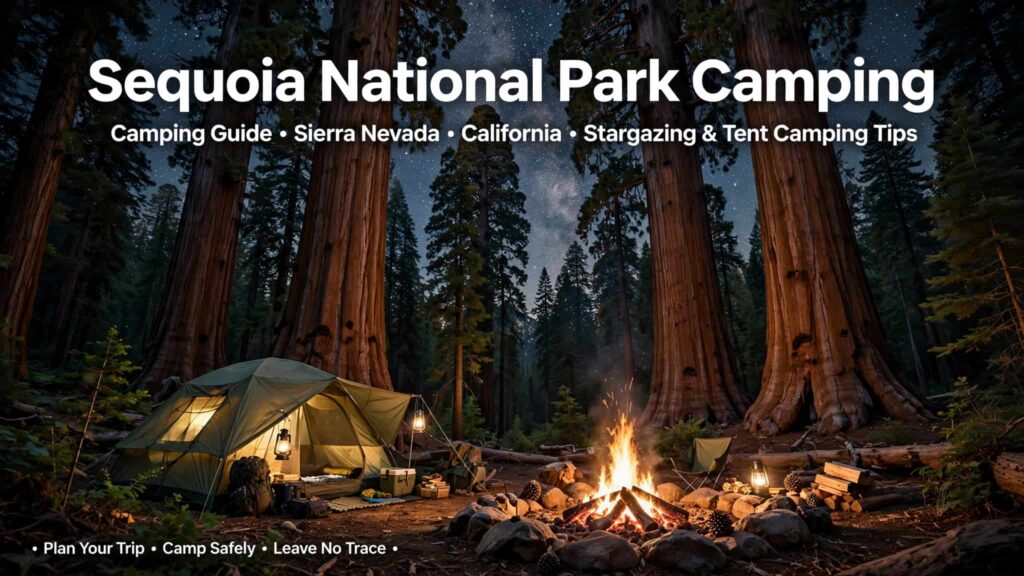
Sequoia National Park Camping: Campgrounds, Fees, Reservations & Tips (2026)
Last updated: October 1, 2026
Camping in Sequoia National Park is one of the best ways to experience the Sierra Nevada after the day-trippers leave. You can wake up beneath towering conifers, spend the day hiking among giant sequoias, and have a campsite close to some of the park’s most popular areas.
However, campground availability in 2026 is different from a normal year. Several campgrounds are closed because of storm damage, while popular locations such as Lodgepole and Potwisha require reservations.
This guide covers Sequoia National Park camping in 2026, including campgrounds, fees, reservations, camping rules, bear safety, fire restrictions, RV information, and practical tips.

2026 camping update: Current National Park Service information shows Lodgepole Campground and Potwisha Campground open, while several other Sequoia campgrounds are closed because of storm damage or seasonal closures. Always check current conditions before traveling because campground status can change.
Sequoia National Park Camping at a Glance
| Information | 2026 Details |
|---|---|
| Standard campsite fee | $32 per night |
| Maximum at standard site | Up to 6 people |
| Reservations | Required at most campgrounds |
| Main reservation website | Recreation.gov |
| Check-in | Generally noon or later |
| Check-out | Before noon |
| Food storage | Bear-resistant storage boxes provided |
| Electricity | Generally not available |
| RV camping | Available at some campgrounds |
| Fires | Subject to current fire restrictions |
| Roadside camping | Not permitted |
| Dispersed camping | Not permitted in developed park areas |
The National Park Service says standard campsites accommodate up to six people and generally include a picnic table, fire ring with grill, and metal food-storage box. The standard campsite fee is currently $32 per night.
Official NPS Sequoia & Kings Canyon camping information
Best Campgrounds for Sequoia National Park Camping in 2026
Not every campground is operating in 2026, so it is important to distinguish between the park’s regular campground list and locations that are actually available this year.
1. Lodgepole Campground

Lodgepole is one of the most convenient places to camp for visitors concentrating on the Giant Forest and central Sequoia National Park.
The campground sits at approximately 6,700 feet and is close to Lodgepole Village. The area provides access to the visitor center, market, seasonal food services, showers and laundry facilities.
The campground has 214 sites, including sites suitable for tents and some RVs. There are no electrical hookups.
Lodgepole Campground 2026 details
- Fee: $32 per night
- Maximum: generally 6 people per site
- Reservations: required
- Reservation window: up to four months ahead
- Elevation: about 6,700 feet
- Food storage lockers: available
- Potable water: seasonal
- Dump station: seasonal
- Market: seasonal
- Showers and laundry: available seasonally
- Bear activity: high
The NPS specifically warns that bears are active around Lodgepole. Food, toiletries and other scented items should be stored in the provided bear-resistant storage boxes rather than inside your vehicle.
Best for: Visitors who want to camp close to the Giant Forest, General Sherman Tree area and central park facilities.
2. Potwisha Campground

Potwisha is one of the most practical options if you want to camp in the lower elevations of Sequoia National Park.
It sits at approximately 2,100 feet along the Middle Fork of the Kaweah River and is surrounded by oak woodland. Unlike many higher-elevation campgrounds, Potwisha is generally open year-round, subject to weather and safety conditions.
Potwisha Campground 2026 details
- Fee: $32 per night
- Senior/Access camping fee: $16
- Sites: 42
- Reservations: required
- Elevation: 2,100 feet
- Flush toilets: available
- Potable water: available
- Dump station: available
- RVs/trailers: allowed at appropriate sites
- Maximum recommended RV/trailer length: 24 feet
Potwisha is particularly useful during periods when higher-elevation campgrounds are closed.
However, fire restrictions are important here. As of the current October 2026 conditions, wood and charcoal fires are prohibited in Potwisha because of Stage 1 fire restrictions.
Best for: Lower-elevation camping, year-round access and campers traveling with smaller RVs.
3. Atwell Mill Campground
Atwell Mill is located along the East Fork of the Kaweah River in the Mineral King area.
It has 21 tent-only sites and sits at approximately 6,650 feet. The campground is more primitive than Lodgepole and does not allow RVs or trailers.
Atwell Mill details
- Fee: $32 per night
- Sites: 21
- Tent only
- Reservations required
- No RVs or trailers
- No showers
- Seasonal potable water
- Vault toilets
- Food-storage lockers
- Reservations generally open up to one month ahead
The road into Mineral King is narrow and winding, so visitors should check road conditions carefully before driving there. The campground’s normal operating season runs roughly from late spring into October, with dates subject to change.
Best for: Tent campers looking for a quieter Mineral King setting.
4. Cold Springs Campground
Cold Springs is another campground in the Mineral King area.
It sits at approximately 7,500 feet and has 40 tent-only sites, including walk-in sites. The campground is surrounded by aspen and conifer trees.
Cold Springs details
- Fee: $32 per night
- Sites: 40
- Tent only
- Reservations required
- Elevation: about 7,500 feet
- Vault toilets
- Seasonal potable water
- No RVs or trailers
- No showers
- Food-storage boxes
The Mineral King Road is narrow, steep and winding, and the NPS does not recommend it for longer vehicles, including trailers and recreational vehicles.
Best for: Experienced tent campers exploring Mineral King.
5. Buckeye Flat Campground — Closed in 2026
Buckeye Flat normally provides lower-elevation camping in the foothills of Sequoia National Park.
However, Buckeye Flat is closed for the 2026 season because of damage from previous winter storms. Therefore, it should not be treated as an available Sequoia camping option for a 2026 trip.
6. Dorst Creek Campground — Closed in 2026
Dorst Creek is normally a popular high-elevation campground near the Giant Forest and Lodgepole areas.
For 2026, however, the campground is not accepting reservations because of recovery from previous winter storm damage.
That means you should not plan a 2026 camping trip around Dorst Creek even though it appears on some campground directories.
7. South Fork Campground — Closed
South Fork Campground and its access road were heavily damaged by flooding and landslides.
The NPS currently lists the campground as closed and says it is not accessible. The reopening timeline is uncertain.
Sequoia National Park Campgrounds: 2026 Status
Here’s a simplified way to think about the major Sequoia camping options:
| Campground | 2026 status | Camping type |
|---|---|---|
| Lodgepole | Open | Tent + some RV |
| Potwisha | Open | Tent + RV |
| Atwell Mill | Seasonal | Tent only |
| Cold Springs | Seasonal | Tent only |
| Dorst Creek | Closed for 2026 | Tent + RV normally |
| Buckeye Flat | Closed for 2026 | Tent + RV normally |
| South Fork | Closed | Tent/RV normally |
The park’s broader campground system includes additional campgrounds in Kings Canyon National Park, including Azalea, Sentinel, Sheep Creek, Sunset and others.
How Much Does It Cost to Camp in Sequoia National Park?
For 2026, the standard campground fee is generally:
$32 per night
The fee covers a standard campsite for up to six people. The National Park Service also lists:
- Stock campsites: $40
- Mid-sized group campsites: $50
- Large group campsites: $60–$80, depending on the site.
Some eligible Senior and Access Pass holders receive a 50% discount on certain amenity fees, including standard camping fees.
Don’t forget the park entrance fee
Camping fees are separate from the park entrance fee.
The standard vehicle entrance fee is currently $35 for up to seven days. The park also offers other entrance passes, including an annual Sequoia and Kings Canyon pass.
For non-U.S. visitors, check the park’s current entrance-fee rules before traveling because 2026 fee policies distinguish between U.S. residents and non-residents.
How to Reserve a Campsite in Sequoia National Park
Most developed campgrounds require reservations, particularly during the busy season.
Reservations are handled through Recreation.gov.
Check Sequoia & Kings Canyon campground reservations on Recreation.gov
Step-by-step
1. Open Recreation.gov
Search for Sequoia & Kings Canyon National Parks.
2. Choose your campground
For example:
- Lodgepole
- Potwisha
- Atwell Mill
- Cold Springs
3. Select your dates
Enter your arrival and departure dates.
4. Check the individual campsite
Look at the campsite’s maximum vehicle length, permitted equipment and other restrictions.
5. Complete the reservation
Pay the applicable camping and reservation fees.
6. Save your confirmation
Keep the reservation details available when you arrive.
The park advises visitors to reserve early because popular campgrounds can fill well ahead of weekends and holidays.
How Far in Advance Should You Reserve?
For popular campgrounds such as Lodgepole, booking early is important.
Some campgrounds have different reservation windows:
- Lodgepole: reservations can be made up to four months ahead.
- Potwisha: up to four months ahead.
- Atwell Mill: generally up to one month ahead.
- Cold Springs: generally up to one month ahead.
Reservation windows can change, so always verify the specific campground on Recreation.gov before planning your trip.
What Is the Best Time to Camp in Sequoia National Park?
For most traditional camping trips, late spring through early fall provides the greatest selection of open campgrounds.
However, elevation makes a big difference.
Summer
Summer is generally the easiest season for high-elevation camping. Days can be pleasant, but nighttime temperatures can still become chilly around the sequoia groves.
Fall
Fall can be excellent for camping because temperatures are cooler and the crowds can change. But campground availability begins to decrease as seasonal closures approach.
Spring
Snow can remain at higher elevations, and some roads and campgrounds may not yet be fully open.
Winter
Lower-elevation Potwisha is considerably different from the high-elevation campgrounds. Snow and winter conditions can affect roads and facilities at higher elevations.
The NPS recommends checking weather and current conditions because mountain weather can change quickly.
What to Bring for Sequoia Camping
A good packing list should account for both daytime warmth and cold evenings.
Camping equipment
- Tent suitable for the expected weather
- Sleeping bag rated for the nighttime temperature
- Sleeping pad
- Camping stove
- Headlamp
- Extra batteries
- Camp chairs
- Water bottles
- Food containers
- Trash bags
Clothing
Pack layers rather than relying on one heavy jacket:
- T-shirts
- Warm mid-layer
- Fleece or jacket
- Long pants
- Warm socks
- Rain shell
- Hat
- Comfortable hiking shoes
Higher elevations can be significantly colder than California’s Central Valley.
Bear Safety While Camping
This is one of the most important things to understand before camping in Sequoia.
Do not leave food or scented products in your vehicle.
The NPS requires campers to use the bear-resistant food-storage boxes provided at campsites. Food isn’t the only concern. Items such as:
- toothpaste
- soap
- shampoo
- toiletries
- candles
- scented products
- trash
can also attract wildlife.
Lodgepole is specifically identified by the NPS as a high bear activity area.

Simple rule
If it smells, store it in the bear box.
Don’t assume your locked car is sufficient protection.
Are Campfires Allowed in Sequoia National Park?
Campfire rules can change depending on weather and fire danger.
This is especially important at lower elevations.
As of the current October 2026 conditions, Stage 1 fire restrictions are in effect, and wood and charcoal fires are prohibited in developed campgrounds below 3,000 feet, including Potwisha.
Always check the current fire restrictions immediately before your trip rather than relying on an older article or previous visit.
Never leave a campfire unattended, and follow all local restrictions concerning wood, charcoal, propane and smoking.
Can You Camp Anywhere in Sequoia National Park?
No.
Roadside camping is not permitted, and developed camping is restricted to designated campsites.
The NPS also states that dispersed camping is not allowed within Sequoia and Kings Canyon National Parks, except for appropriate backcountry camping with the required wilderness permit.
So don’t simply pull off a road and set up a tent.
If you want to backpack and camp away from developed campgrounds, you’ll need to follow the park’s wilderness camping rules and permit requirements.
Can You Camp in an RV?
Yes, but not every campground accommodates RVs.
Potwisha has RV and trailer sites, with a recommended maximum vehicle/trailer length of 24 feet.
Atwell Mill and Cold Springs are tent-only campgrounds, so they aren’t suitable for RV camping.
Lodgepole has sites that accommodate some RVs, but vehicle-length restrictions and road conditions should be checked before arrival. The NPS advises vehicles longer than 22 feet to use Highway 180 when accessing the higher-elevation areas because of the narrow, winding Generals Highway.
Sequoia Camping Tips for First-Time Visitors
1. Reserve before you drive to the park
Don’t assume you’ll find a campsite when you arrive. Popular campgrounds can fill quickly.
2. Check the campground’s elevation
A 2,100-foot campground can feel very different from a 7,500-foot campground.
3. Pack for cold nights
Even in summer, mountain evenings can be surprisingly cold.
4. Store everything scented
Use the bear box provided at your campsite.
5. Check fire restrictions
Never assume a fire ring means campfires are currently permitted.
6. Check road conditions
Mountain roads can be narrow, winding and affected by snow, storms or construction.
7. Don’t depend on cell service
Several campgrounds list little or no cell reception. Download maps and reservation information before entering the park.
8. Bring enough food and water
Some campground areas have seasonal services, but they aren’t equivalent to a full grocery store.
9. Arrive before dark
Setting up a campsite, finding your site and securing food is considerably easier during daylight.
10. Check current conditions on the day of departure
This is particularly important in 2026 because storm-related closures and seasonal changes have affected several campgrounds.
Where Should You Camp for a Sequoia National Park Trip?
Your choice depends on what you want from the trip.
If you want to be near the Giant Forest
Look at Lodgepole Campground.
If you want lower-elevation camping
Consider Potwisha Campground.
If you’re exploring Mineral King
Consider Atwell Mill or Cold Springs, subject to seasonal availability.
If you’re planning an RV trip
Check Potwisha and appropriate Lodgepole sites first, while carefully checking vehicle-length restrictions.
If you’re planning a 2026 trip specifically
Check the current NPS conditions page immediately before departure because Dorst Creek, Buckeye Flat and South Fork have 2026 closures, while seasonal campgrounds have their own operating dates.
Frequently Asked Questions
Is camping allowed in Sequoia National Park?
Yes. Sequoia and Kings Canyon National Parks have developed campgrounds as well as backcountry camping opportunities requiring appropriate permits. Developed camping must take place at designated campsites.
How much is camping at Sequoia National Park in 2026?
A standard campsite generally costs $32 per night for up to six people. Other campsite types, including group and stock sites, have different fees.
Do I need a reservation to camp at Sequoia?
For most developed campgrounds, yes. In 2026, popular locations such as Lodgepole and Potwisha require reservations.
Can I camp for free in Sequoia National Park?
Developed campground sites are not free. Backcountry camping follows separate wilderness permit and fee rules during the applicable quota season.
Can I sleep in my car anywhere in Sequoia National Park?
No. Roadside camping is not permitted. Camping must occur in designated campsites or in permitted backcountry areas.
Are there showers at Sequoia campgrounds?
Some services are available near Lodgepole, including seasonal showers and laundry facilities. Individual campgrounds do not all have showers.
Are dogs allowed at Sequoia campgrounds?
Pets can be allowed within campgrounds when leashed, but pets are not permitted on trails in Sequoia and Kings Canyon National Parks. Check current pet regulations before traveling.
Is Lodgepole Campground open in 2026?
Yes. Current NPS information lists Lodgepole Campground as open, although availability may be very limited and reservations are required.
Is Dorst Creek Campground open in 2026?
No. Dorst Creek is closed for 2026 because of storm-damage recovery.
Final Tips for Sequoia National Park Camping in 2026
Camping in Sequoia National Park requires a little more planning than a typical campground trip, particularly because 2026 has several storm-related campground closures.
For a straightforward trip, start by checking Lodgepole and Potwisha, then look at the seasonal Mineral King campgrounds if they fit your itinerary. Reserve through Recreation.gov, check the latest NPS conditions, prepare for changing mountain weather, and use the provided bear-resistant food lockers.
Most importantly, don’t rely on campground information from an old blog post. Availability, fire restrictions, road conditions and seasonal operating dates can change.
Sequoia & Kings Canyon National Parks — official NPS site
Sequoia & Kings Canyon campground reservations — Recreation.gov
Read Also: Sequoia National Park Weather: Monthly Guide, Temperatures & Rain (2026)