Sequoia National Park Weather: Monthly Guide, Temperatures & Rain (2026)
Planning a trip to Sequoia National Park in 2026? Weather can make a big difference in what you can see, which roads and trails are accessible, and what clothing you should pack.
Sequoia National Park has a mountain climate with large elevation changes. The foothills can be warm and dry while the Giant Forest area is much cooler and can still have snow. According to the National Park Service (NPS), temperatures can change by 20–30°F as elevation changes, and it is possible to find spring flowers in the foothills while snow remains in the Giant Forest.
This Sequoia National Park weather guide for 2026 covers average temperatures by month, rain and snow patterns, summer and winter conditions, and what to expect during each season.
Sequoia National Park Weather at a Glance
Weather varies significantly depending on where you are in the park.
For the Giant Forest, Lodgepole and Grant Grove areas, which sit roughly around 5,000–7,000 feet, NPS historical averages show:
- Winter: Cold, snowy and often below freezing at night
- Spring: Cool, with snow possible into late spring
- Summer: Warm days and cool evenings
- Fall: Mild to cool, with temperatures dropping quickly after sunset
- Annual precipitation: Approximately 40–45 inches in the sequoia groves
- Much of the precipitation occurs during winter and contributes to the area’s substantial snowpack.
The park’s foothills have a very different climate, with hot, dry summers and milder winters. The foothills receive about 26 inches of rainfall annually, with most precipitation occurring from January through mid-May.
Sequoia National Park Monthly Weather
The following temperature table uses the NPS historical averages for the Giant Forest, Lodgepole and Grant Grove areas. These are climate averages, not a 2026 forecast.
| Month | Avg. High | Avg. Low | Typical Conditions |
|---|---|---|---|
| January | 42°F (6°C) | 24°F (-4°C) | Cold, snow |
| February | 44°F (7°C) | 25°F (-4°C) | Cold, snowy |
| March | 46°F (8°C) | 26°F (-3°C) | Cold, snow possible |
| April | 51°F (11°C) | 30°F (-1°C) | Cool, spring transition |
| May | 58°F (14°C) | 36°F (2°C) | Cool, lingering snow |
| June | 68°F (20°C) | 44°F (7°C) | Mild and warming |
| July | 76°F (24°C) | 51°F (11°C) | Warm, mostly dry |
| August | 76°F (24°C) | 50°F (10°C) | Warm and dry |
| September | 71°F (22°C) | 45°F (7°C) | Mild, cooler nights |
| October | 61°F (16°C) | 38°F (3°C) | Cool, fall weather |
| November | 50°F (10°C) | 31°F (-1°C) | Cold, precipitation increases |
| December | 44°F (7°C) | 27°F (-3°C) | Cold, snow |
Important: These averages apply to the higher-elevation sequoia areas rather than the entire park. Foothill temperatures can be substantially warmer.
Sequoia National Park Weather in January
January is one of the coldest and snowiest months in the higher elevations.
In the Giant Forest, Lodgepole and Grant Grove areas, the average January high is about 42°F (6°C) and the average low is around 24°F (-4°C).
Snow can be deep during winter, and road conditions can change after storms.
What to expect in January
- Cold daytime temperatures
- Freezing nights
- Frequent snow at higher elevations
- Winter driving conditions
- Shorter daylight hours
- Some roads and facilities may be affected by snow
If you’re visiting in January, check the latest road and weather conditions before driving into the higher elevations.
February Weather in Sequoia National Park
February remains firmly in the winter season.
Average temperatures around the sequoia groves are approximately 44°F (7°C) during the day and 25°F (-4°C) at night.
Snow remains an important part of the landscape, so visitors should be prepared for winter conditions.
February can be beautiful for visitors looking for a snow-covered forest, but hiking and driving require additional preparation.
March Weather
March is still cold in the higher elevations, with an average high around 46°F (8°C) and an average low around 26°F (-3°C).
Snow can remain on the ground, particularly around Giant Forest and other high-elevation areas.
Lower elevations may begin showing signs of spring earlier than the sequoia groves.
April Weather
April marks the beginning of the transition toward spring.
The average high around the sequoia groves is approximately 51°F (11°C), while the average low is about 30°F (-1°C).
Don’t assume that April means warm weather throughout the park. NPS notes that snow can remain in the Giant Forest while spring conditions are already appearing in the foothills.
May Weather
May is considerably warmer, but conditions can still feel wintry at times.
Average temperatures are around 58°F (14°C) for the high and 36°F (2°C) for the low in the higher-elevation sequoia areas.
May can be a transition month, with:
- Cool mornings
- Mild afternoons
- Remaining snow in some areas
- Increasingly accessible trails
- Spring vegetation at lower elevations
Pack layers rather than relying on a single warm-weather outfit.
June Weather
June is one of the major transition points in Sequoia’s weather.
The average high reaches approximately 68°F (20°C) and the average low is about 44°F (7°C).
Days are generally comfortable for hiking, although higher trails can still have snow depending on the year’s conditions.
NPS also notes that occasional afternoon thunderstorms can occur during summer.
July Weather in Sequoia National Park
July is generally warm and dry in the higher-elevation sequoia areas.
The average high is about 76°F (24°C) and the average low is approximately 51°F (11°C).
This creates a large difference between daytime and nighttime temperatures.
July conditions
- Warm afternoons
- Cool mornings
- Cool evenings
- Mostly dry weather
- Occasional afternoon thunderstorms
The foothills can be much hotter. NPS reports an average July high of approximately 97°F (36°C) in the foothills.

August Weather
August has temperatures similar to July in the sequoia groves.
The historical average high is approximately 76°F (24°C), with an average low near 50°F (10°C).
Rain is generally limited compared with winter, although thunderstorms can occur.
If you’re hiking during August, bring water, sun protection and layers for cooler mornings and evenings.
September Weather
September is usually a comfortable month in the higher elevations.
The average high is about 71°F (22°C), while the average low is approximately 45°F (7°C).
The weather gradually becomes cooler as the month progresses.
September can provide a useful balance between warm daytime conditions and cooler evenings, but conditions can change quickly in the mountains.
October Weather
October brings noticeably cooler temperatures.
The average high around the sequoia groves is approximately 61°F (16°C) and the average low is around 38°F (3°C).
Rain and snow become increasingly possible as the season progresses.
If you’re visiting late in October, check the forecast immediately before your trip, especially if you’re planning to drive through higher elevations.
November Weather
November is a transition into winter.
The average high is around 50°F (10°C) and the average low is approximately 31°F (-1°C).
Precipitation increases substantially compared with summer, and snow becomes increasingly likely at higher elevations.
December Weather
December is another cold and snowy month in the sequoia groves.
Average temperatures are around 44°F (7°C) during the day and 27°F (-3°C) at night.
Winter storms can affect roads and travel. The National Park Service states that occasional winter storms can close roads leading into the parks until they can be plowed or repaired.
How Much Rain Does Sequoia National Park Get?
Rainfall depends heavily on elevation and location.
The NPS reports that the sequoia grove areas receive approximately 40–45 inches of precipitation annually, while the foothills average around 26 inches. Much of the precipitation in the higher elevations occurs during winter and falls as snow.
NPS park information also identifies December through March as the wettest months and lists average annual precipitation of about:
- Ash Mountain: 27.11 inches
- Lodgepole: 45.58 inches
- Grant Grove: 42.26 inches
So, when researching “Sequoia National Park rain,” it’s important to specify the elevation or area you’re talking about.
Sequoia National Park Snow
Snow is one of the biggest differences between the higher elevations and foothills.
NPS says that much of the precipitation in the sequoia grove areas falls during winter, producing a deep blanket of snow from December through May.
This means a trip in May can look completely different depending on where you go.
The lower foothills may feel like spring while the Giant Forest can still have substantial snow.

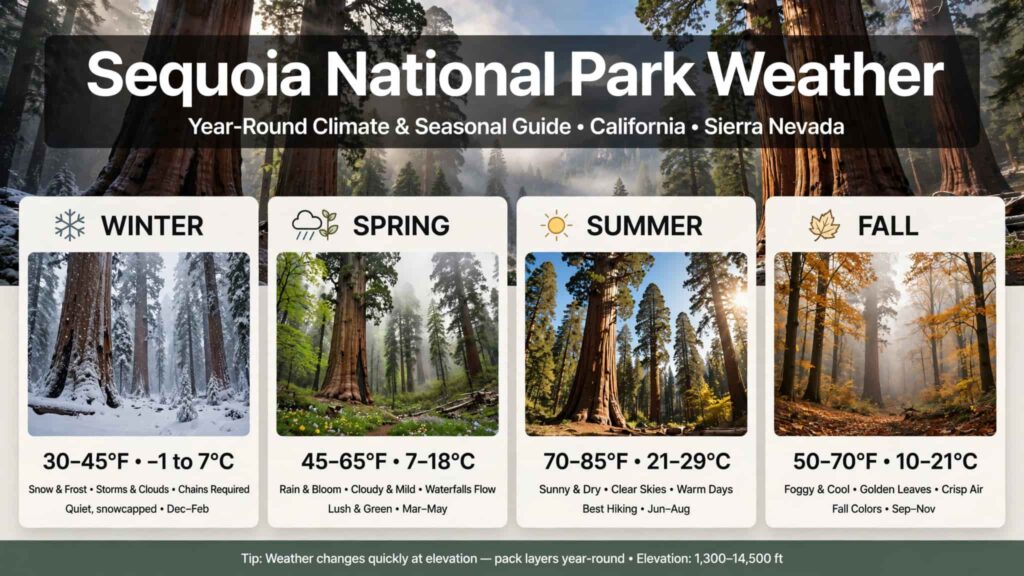
Sequoia National Park Weather by Season
Winter: December–February
Winter is cold and snowy in the higher elevations.
Typical conditions:
- Daytime temperatures around the 40s°F
- Nights below freezing
- Snow at higher elevations
- Winter storms
- Possible road closures or travel restrictions
Winter visitors should monitor official road conditions and carry appropriate winter gear.
Spring: March–May
Spring is highly variable.
Snow can remain in the sequoia groves while lower elevations become greener and warmer.
March and April are still quite cold, while May starts to feel more like spring.
Summer: June–August
Summer generally brings warm days and cool evenings to the sequoia groves.
July and August average around 76°F (24°C) for daytime highs.
Summer is also the driest period, although afternoon thunderstorms can occur.
Fall: September–November
Fall begins with comfortable temperatures and gradually becomes colder.
September averages around 71°F, October around 61°F and November around 50°F for daytime highs in the sequoia grove areas.
Rain and snow become increasingly likely as winter approaches.
Is Sequoia National Park Hot in Summer?
It depends on where you are.
The Giant Forest and other higher-elevation areas are not usually extremely hot during summer days, with July and August average highs around 76°F (24°C).
However, the foothills can become very hot.
NPS historical averages show July and August highs around 97°F and 96°F, respectively, in the foothills.
This elevation difference is one of the most important things to understand when planning a Sequoia trip.
Does It Snow in Sequoia National Park?
Yes. Snow is common in the higher-elevation areas during winter and can remain into spring.
The NPS specifically notes that the sequoia grove areas receive substantial winter precipitation and develop a deep snowpack from roughly December through May.
Snow conditions vary from year to year, so historical averages should not be treated as a prediction for a particular 2026 travel date.
Best Month to Visit Sequoia National Park for Weather
The answer depends on what type of weather you want.
For warm daytime hiking
July and August generally offer the warmest conditions in the Giant Forest/Lodgepole area, with average highs around 76°F (24°C).
For cooler hiking conditions
September and early October can offer cooler temperatures than midsummer.
For snow scenery
December through early spring is the period when winter conditions are most likely in the higher elevations.
For spring scenery
Late spring can be interesting because conditions vary dramatically by elevation.
There isn’t one universally ideal month—the best timing depends on whether your priority is hiking, snow, cooler temperatures or easier access.
What to Wear in Sequoia National Park
Because temperatures can change quickly with elevation, layers are more useful than dressing for a single temperature.
Summer
Pack:
- T-shirts
- Lightweight hiking pants or shorts
- Light jacket
- Sun hat
- Sunglasses
- Comfortable hiking shoes
- Rain layer
Spring and fall
Bring:
- Warm jacket
- Fleece or sweater
- Long pants
- Waterproof outer layer
- Hiking shoes
- Extra warm layers for mornings and evenings
Winter
Consider:
- Insulated jacket
- Warm base layers
- Gloves
- Hat
- Waterproof footwear
- Traction equipment when conditions require it
- Winter driving equipment
Always check current conditions before traveling because mountain weather can change rapidly.
Sequoia National Park Weather vs. Foothills
One of the easiest mistakes is checking a forecast for the wrong elevation.
| Area | Summer | Winter | Precipitation |
|---|---|---|---|
| Foothills | Hot and dry | Mild and wet | About 26 in/year |
| Giant Forest | Warm days, cool nights | Cold and snowy | About 40–45 in/year |
| Lodgepole | Warm days, cold nights | Very cold/snowy | About 40–45 in/year |
| Grant Grove | Warm days, cool nights | Cold and snowy | About 40–45 in/year |
| Cedar Grove | Hotter in summer | Winter access issues | Varies |
NPS specifically warns that weather differs considerably between park areas and can change rapidly.
2026 Sequoia National Park Weather Tips
If you’re visiting Sequoia National Park in 2026, don’t rely only on monthly averages.
Before leaving, check:
- The official NPS weather page
- Current road conditions
- Trail and area closures
- The forecast for your specific elevation
- Snow conditions if visiting during winter or spring
The park is open 24 hours a day, but NPS notes that winter storms can temporarily close roads.
Does Sequoia National Park Weather Change With Elevation?
Absolutely.
This is probably the most important weather fact to remember.
Sequoia National Park contains areas ranging from relatively low foothills to high mountain terrain. The NPS says temperatures can vary by 20–30°F with changes in elevation.
For example, a warm afternoon around the foothills does not mean you’ll experience the same conditions near the General Sherman Tree.
This is why checking a generic “Sequoia National Park weather” forecast can sometimes be misleading.
Final Thoughts
Sequoia National Park weather in 2026 varies dramatically by elevation and season. The higher sequoia groves have cold, snowy winters, cool springs and falls, and warm but generally comfortable summer days. The foothills are much warmer, particularly during summer.
For the Giant Forest, Lodgepole and Grant Grove areas, average summer highs reach about 76°F (24°C), while winter highs are generally in the 40s°F. The higher elevations receive roughly 40–45 inches of precipitation annually, much of it as winter snow.
For an actual 2026 trip, use these monthly averages as a planning guide, then check the latest official forecast and road conditions shortly before departure.
Quick takeaway:
🌨️ Winter: cold and snowy
🌱 Spring: variable, with lingering snow at elevation
☀️ Summer: warm days and cool nights
🍂 Fall: mild early, increasingly cold later
🏔️ Elevation: the biggest factor in Sequoia weather
Sources: National Park Service weather and park information pages, with climate figures based on historical averages.
Pingback: Sequoia National Park Camping: Campgrounds, Fees, Reservations & Tips (2026) - Park Trails Guide