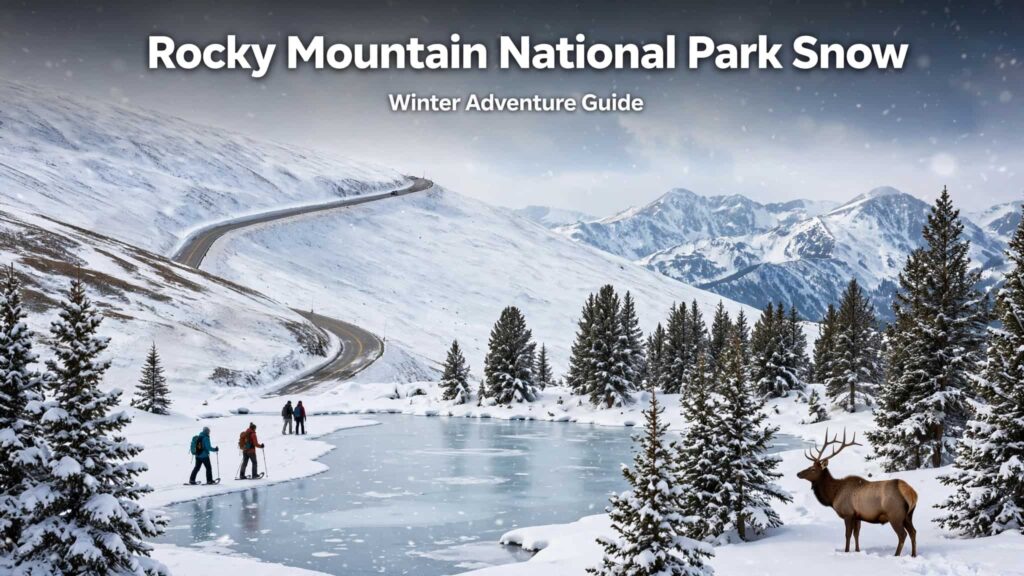
Rocky Mountain National Park Snow: When to See Snow, Snowfall & Winter Conditions
If you’re hoping to see snow in Rocky Mountain National Park, timing matters. Snow can appear as early as September or October at higher elevations, while substantial snowpack can remain into May and even June in the high country. The park’s elevation ranges from about 7,800 feet to more than 14,000 feet, so snow conditions can be very different from one part of the park to another.
For most visitors, January through April offers the best chance of experiencing a true snowy Rocky Mountain National Park, although March and April can be particularly snowy. If you want easier access to snow-covered scenery, the Bear Lake area is one of the most popular places to visit during winter.
This guide explains when Rocky Mountain National Park gets snow, how much snowfall to expect, the best months for a snowy visit, winter road conditions, and what you should know before hiking in the snow.
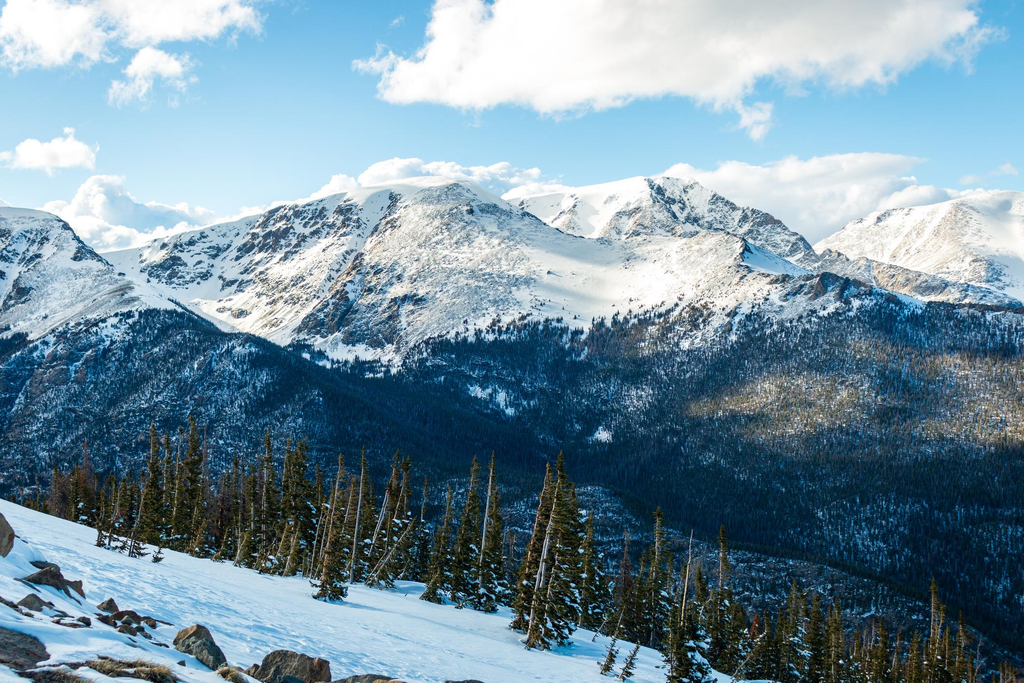
When Does It Snow in Rocky Mountain National Park?
Snow season in Rocky Mountain National Park generally stretches from fall through spring, but there isn’t one exact start or end date.
The National Park Service advises visitors planning trips from late October through early June to be prepared for snow and winter conditions, particularly at higher elevations.
At the highest elevations, snow can occur outside the traditional winter season. In fact, the National Park Service notes that areas such as Bear Lake, Trail Ridge Road and Longs Peak can receive snow even in July.
Typical Rocky Mountain National Park snow season
| Month | What to Expect |
|---|---|
| September | Early snow possible at high elevations |
| October | Snow becomes increasingly common, especially higher up |
| November | Winter conditions begin becoming widespread |
| December | Snow-covered landscapes and winter recreation |
| January | Excellent snow conditions |
| February | Excellent snow conditions |
| March | One of the snowiest periods |
| April | Heavy snow is still possible |
| May | Snow remains at higher elevations |
| June | Snow can remain in the high country |
| July–August | Mostly snow-free at lower elevations, but high elevations can still have snow |
The exact conditions change every year depending on storms, temperatures and elevation.
What Month Has the Most Snow in Rocky Mountain National Park?
If your primary goal is to see snow-covered landscapes, winter and early spring are the safest choices.
The National Park Service says January, February and March generally provide the best skiing and snowshoeing conditions, while March and April are historically among the snowiest months in the Rocky Mountains.
Weather data for Rocky Mountain National Park also shows significant snowfall through the colder months, with snowfall continuing into April and May at higher elevations.
Best months for snow
January:
Cold, snowy and reliably wintry. Good for visitors who want a classic winter landscape.
February:
Usually an excellent combination of snowpack and winter recreation.
March:
One of the strongest choices if you want deep snow, snowshoeing and snowy mountain scenery.
April:
Don’t assume spring means the snow is gone. March and April can be among the snowiest months, and higher trails can remain heavily snow-covered.
May:
Lower elevations begin transitioning toward spring, but snow can remain at higher elevations.
How Much Snow Does Rocky Mountain National Park Get?
There isn’t one snowfall number that represents the entire park.
That’s because Rocky Mountain National Park has dramatic elevation differences and two distinct climate patterns on either side of the Continental Divide. The west side generally receives more snow, while higher elevations can have much deeper and longer-lasting snowpack than areas near Estes Park.
For example, official National Park Service weather statistics for Estes Park, at about 7,522 feet, show average snowfall of:
- January: 4.6 inches
- February: 6.3 inches
- March: 7.8 inches
- April: 3.8 inches
- November: 3.8 inches
- December: 5.7 inches
These figures represent the Estes Park weather station rather than the entire national park, so snowfall inside RMNP can be substantially different, especially at higher elevations.
At places such as Bear Lake and areas above 9,000–10,000 feet, snow can remain on the ground long after lower elevations begin to thaw.
When Is the Best Time to See Snow in Rocky Mountain National Park?
Best overall: January through March
For travelers specifically looking for a snowy Rocky Mountain National Park experience, I’d choose January, February or March.
These months typically offer the strongest combination of:
- Snow-covered forests
- Frozen or snow-covered lakes
- Snowshoeing opportunities
- Winter hiking
- Snow-covered mountain peaks
- Fewer visitors than summer
- A genuine winter atmosphere
The National Park Service specifically identifies January, February and March as the best period for skiing and snowshoeing conditions.
Best for heavy snow: March and April
If your priority is deep snow rather than simply seeing some snow, March and April deserve special consideration.
However, winter conditions can make trails significantly more difficult. A beautiful snowy landscape can also mean deep powder, hidden rocks, icy sections and difficult route-finding.
Where Can You See Snow in Rocky Mountain National Park?

1. Bear Lake
Bear Lake is one of the most popular areas for experiencing winter in Rocky Mountain National Park.
The Bear Lake Road corridor remains an important winter-access area, although visitors should be prepared for snow and ice on the road and trails. Bear Lake itself sits at approximately 9,500 feet, making it much more likely to hold snow than lower areas around Estes Park.
Winter visitors can explore snowy scenery around Bear Lake and nearby trails when conditions permit.
2. Dream Lake
Dream Lake is another iconic destination for winter scenery.
The route can become considerably more difficult after fresh snowfall, and conditions may change from packed snow to deep powder. Visitors should check current trail conditions and use appropriate traction or snowshoes depending on conditions.
3. Moraine Park
Moraine Park can provide beautiful views of snow-covered peaks and winter wildlife. Because it is lower than many high-alpine destinations, snow conditions can vary considerably during the season.
4. Kawuneeche Valley
The west side of the park around Kawuneeche Valley generally receives more snow than the Estes Park side. The National Park Service also identifies the west side as a good area for winter recreation, including cross-country skiing when snow conditions allow.
Is Rocky Mountain National Park Open in Winter?
Yes. Rocky Mountain National Park is open year-round.
However, being open does not mean every road, trail or destination is accessible throughout winter.
The biggest example is Trail Ridge Road.
Trail Ridge Road generally closes to through traffic around October and doesn’t reopen for through travel until late May or early June, depending on weather and road conditions. In 2025, the road closed to through travel on November 14, while its typical seasonal closure occurs around mid-October.
During winter, visitors can still access portions of the road from either side, depending on current conditions and closures.
Is Trail Ridge Road Open When It Snows?
Usually, Trail Ridge Road is not open all the way across the park during winter.
The road climbs to 12,183 feet and includes approximately 11 miles above 11,500 feet. Heavy snow, drifting, strong winds and freezing temperatures make maintaining the road during winter impractical and unsafe.
If you’re visiting Rocky Mountain National Park specifically for snow, don’t plan your trip around driving across Trail Ridge Road in January or February.
Instead, focus on winter-accessible areas such as the Bear Lake Road corridor and other destinations that are open according to current park conditions.
What Are Winter Roads Like in Rocky Mountain National Park?
Winter driving in RMNP can be challenging.
The National Park Service warns that roads may become snow-packed and icy, and conditions can change quickly. Temporary road closures can occur because of storms or other adverse conditions. Colorado’s vehicle traction law may also be activated when conditions require it.
If you’re driving into the park during winter:
- Check road conditions before leaving.
- Carry appropriate winter equipment.
- Drive slowly on snow and ice.
- Leave extra distance between vehicles.
- Be prepared for sudden weather changes.
- Check for temporary road closures.
- Don’t assume a road that was open earlier in the day will remain open.
Are Rocky Mountain National Park Trails Snowy in Winter?
Yes, many trails are snowy or icy during winter.
However, snow depth varies dramatically by elevation and location.
Lower-elevation trails may alternate between snow, ice, mud and bare ground, while trails above 9,000–10,000 feet can remain snow-covered for extended periods. The National Park Service recommends traction devices for icy and snow-packed trails and notes that snowshoes may be necessary when snow is deep.
A trail that is easy during summer can become significantly more challenging in winter.
Do You Need Snowshoes at Rocky Mountain National Park?
Not always.
Whether you need snowshoes depends on recent snowfall, trail traffic, temperature, elevation and snow depth.
You may need snowshoes when:
- There has been recent heavy snowfall.
- The snow is deep and soft.
- You’re hiking at higher elevations.
- Your boots are sinking deeply into the snow.
- The trail isn’t packed down by other hikers.
Microspikes or traction devices may be better when:
- The trail is hard-packed.
- Snow has partially melted and refrozen.
- The surface is icy.
- Many hikers have already packed the trail.
The National Park Service recommends carrying traction devices and, depending on snow depth, snowshoes for winter and spring trips.
What Should You Wear for a Snowy Visit?
A winter trip to Rocky Mountain National Park requires more preparation than simply bringing a winter jacket.
Consider packing:
- Insulated waterproof boots
- Warm wool or synthetic socks
- Base layers
- Insulating mid-layer
- Waterproof or wind-resistant outer layer
- Warm gloves
- Hat or beanie
- Sunglasses
- Sunscreen
- Microspikes or other traction devices
- Snowshoes when conditions require them
- Hiking poles
- Plenty of water and food
- Headlamp for shorter winter daylight
- Emergency supplies
Remember that conditions can change quickly in the mountains. Wind, snow and temperatures can make a relatively short hike much more demanding than it appears from the trail distance alone.
Can You See Snow in Rocky Mountain National Park in June?
Yes.
June is not necessarily snow-free in Rocky Mountain National Park.
The lower montane areas begin transitioning toward summer, but snow can remain at higher elevations. The National Park Service notes that in June, spring is only reaching the subalpine areas, and many trails can still be snow-covered.
If you’re visiting in June because you want mountain scenery without deep winter conditions, expect a mixture of snow, mud, bare ground and changing weather depending on elevation.
Can You See Snow in Rocky Mountain National Park in July or August?
Yes, but it depends heavily on elevation and the year.
Lower elevations are generally much warmer and largely snow-free during summer. However, the highest parts of the park can still have patches of snow.
The National Park Service specifically notes that snow can occur at high elevations even in July, particularly around places such as Bear Lake, Trail Ridge Road and Longs Peak.
So if you’re visiting in July or August, don’t expect a full winter landscape—but you may still encounter snow in the high country.
Does Rocky Mountain National Park Get More Snow Than Estes Park?
Generally, higher elevations inside the park receive more persistent snow than the town of Estes Park.
Estes Park sits at about 7,500 feet, while many popular RMNP destinations are considerably higher. Elevation has a major effect on temperature, snow accumulation and how long snow remains on the ground.
The west side of RMNP also tends to receive more snow than the east side near Estes Park.
That’s why a winter forecast for Estes Park should not be treated as a complete forecast for the entire national park.
How to Check Current Snow Conditions Before Your Visit
Historical snowfall averages are useful for planning, but current snow depth is much more important when you’re actually preparing for a trip.
Rocky Mountain National Park uses SNOTEL monitoring sites to track snow conditions at different locations. The park’s trail conditions page provides current information and links to snow-depth data for sites including Bear Lake and other locations.
Before leaving for a winter hike, check:
- Current weather forecast
- Trail conditions
- Snow depth
- Avalanche information
- Road conditions
- Trail or road closures
- Park webcams
The National Park Service also recommends checking with park staff for the latest conditions before starting a winter adventure.
Rocky Mountain National Park official planning and conditions information
Rocky Mountain National Park Snow: Month-by-Month Guide
October
October is the beginning of the transition into winter. Snow can occur at higher elevations, and Trail Ridge Road typically closes for the season around this period.
November
Winter conditions become increasingly common. Snow and ice can affect trails and roads, and Trail Ridge Road is generally closed to through travel.
December
A good month for visitors looking for a classic snowy mountain experience. Temperatures are cold, and winter recreation becomes more dependable.
January
One of the best months for a snowy RMNP visit. Snowshoeing and winter hiking can be excellent when conditions cooperate.
February
Another strong month for snow. Snowpack is usually well established, although individual trail conditions vary.
March
March is among the best months for deep snow and winter recreation. Fresh storms can dramatically change trail conditions.
April
Don’t let the calendar fool you—April can still be very snowy in Rocky Mountain National Park. Higher trails can remain buried under substantial snow.
May
Lower elevations increasingly transition toward spring, but higher elevations can still be very snowy. Trail Ridge Road may remain closed until conditions allow reopening.
June
Snow starts disappearing from lower areas, but high-elevation trails can still have significant snow and ice.
July and August
Summer dominates the lower and middle elevations, but snow patches can remain at high elevations, particularly after a snowy season.
Best Time to Visit Rocky Mountain National Park for Snow
If you want the highest likelihood of seeing a beautiful snowy landscape, plan your trip between January and March.
If you want deep snow and winter recreation, January through March is generally the strongest period.
If you want snow plus slightly longer and warmer spring days, consider March or April—but be prepared for rapidly changing conditions.
And if you simply want to photograph snow-covered peaks without committing to a full winter hiking trip, late fall through spring can offer excellent opportunities depending on the year’s snowfall.

Final Thoughts
Rocky Mountain National Park snow can last much longer than many first-time visitors expect. While the main winter season generally runs from late fall through spring, elevation makes a huge difference.
For the best chance of seeing extensive snow, January, February and March are excellent choices, while March and April can also bring significant snowfall. Higher elevations can remain snowy well into May and June, and occasional snow is possible even during summer.
The most important thing is to check current conditions rather than relying only on historical averages. Snow depth, road conditions and trail difficulty can change quickly after a storm or during a warm spell.
For a safe winter visit, bring appropriate clothing and traction equipment, check the National Park Service’s latest trail and road reports, and remember that a snowy Rocky Mountain National Park can be beautiful—but it demands proper preparation.
Read Also: Rocky Mountain National Park Tickets: Prices, Passes & How to Buy