How Big Is Yellowstone National Park? Size, Area & Facts
Yellowstone National Park is enormous, covering about 3,472 square miles (8,991 square kilometers), or 2,221,766 acres. It stretches across parts of Wyoming, Montana, and Idaho and is larger than the states of Rhode Island and Delaware combined.
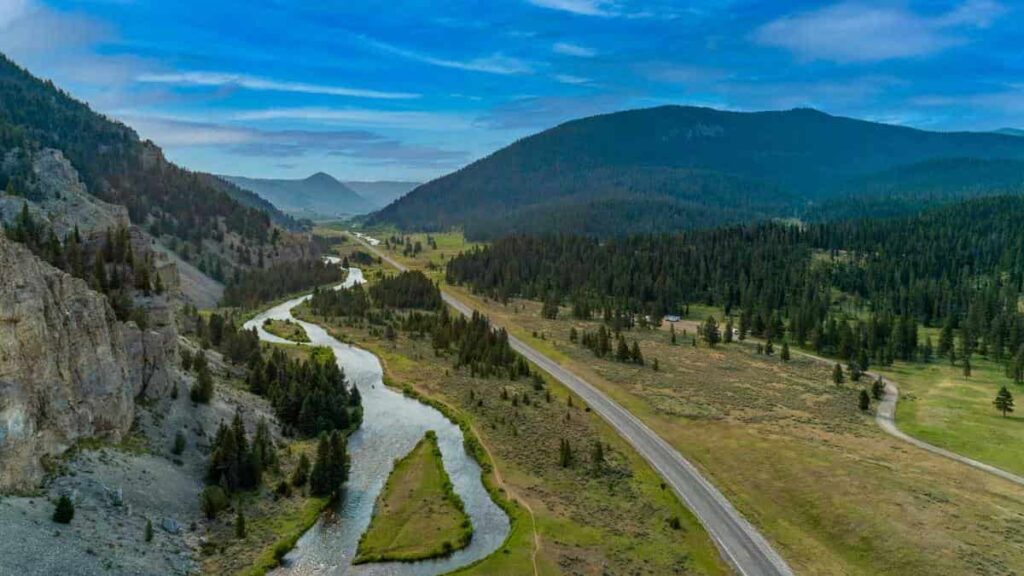
But Yellowstone’s size is only part of what makes it remarkable. Within its huge landscape are mountains, forests, lakes, rivers, waterfalls, wildlife habitats, geysers, hot springs, and the famous Yellowstone Caldera.
If you’re wondering how big Yellowstone National Park really is, this guide breaks down its area, dimensions, state-by-state location, and some fascinating facts.
How Big Is Yellowstone National Park?
Yellowstone National Park covers approximately:
- 3,472 square miles
- 8,991 square kilometers
- 2,221,766 acres
- 899,116 hectares
According to the National Park Service, the commonly cited area figures have not been scientifically verified, and efforts to confirm the park’s exact total area continue.
Yellowstone National Park Size at a Glance
| Measurement | Yellowstone |
|---|---|
| Total area | 3,472 sq mi |
| Total area in km² | 8,991 km² |
| Total area in acres | 2,221,766 acres |
| North to south | 63 air miles |
| East to west | 54 air miles |
| Approx. water coverage | 5% |
| Approx. grassland | 15% |
| Approx. forest | 80% |
The park extends about 63 air miles (102 km) from north to south and approximately 54 air miles (87 km) from east to west.
How Many Acres Is Yellowstone National Park?
Yellowstone National Park covers approximately 2.22 million acres.
That makes Yellowstone one of the largest national parks in the contiguous United States. Its enormous area includes forests, mountain ranges, valleys, geothermal areas, lakes, rivers, waterfalls, and extensive wildlife habitat.
The National Park Service lists Yellowstone’s area as 2,221,766 acres, equivalent to approximately 899,116 hectares.

How Many Square Miles Is Yellowstone?
Yellowstone National Park covers 3,472 square miles.
For comparison, this is:
- Larger than Rhode Island
- Larger than Delaware
- Slightly larger than the combined area of Rhode Island and Delaware
- Roughly the size of a large U.S. county or small state
The National Park Service specifically notes that Yellowstone is larger than Rhode Island and Delaware combined.
This is one reason visitors often underestimate how much time it takes to explore the park.
How Big Is Yellowstone Compared With States?
One of the easiest ways to understand Yellowstone’s size is to compare it with U.S. states.
Yellowstone is larger than Rhode Island and Delaware individually, and the National Park Service says the park is larger than the two states combined.
| Place | Approximate area |
|---|---|
| Yellowstone National Park | 3,472 sq mi |
| Rhode Island | ~1,545 sq mi |
| Delaware | ~2,489 sq mi |
| Rhode Island + Delaware | ~4,034 sq mi |
So although Yellowstone is not as large as some western states, it is extraordinarily large for a single national park in the Lower 48.
Which States Is Yellowstone National Park In?
Yellowstone is located in three states:
- Wyoming — 96%
- Montana — 3%
- Idaho — 1%
Most of the park lies in northwestern Wyoming, while smaller portions extend into Montana and Idaho.

The three-state location is one of Yellowstone’s interesting geographic features. Despite portions of the park being in Montana and Idaho, Wyoming contains the overwhelming majority of its land.
How Long and Wide Is Yellowstone National Park?
Yellowstone isn’t a perfect rectangle, but its approximate dimensions give an idea of its scale.
From north to south, the park measures about 63 air miles (102 km).
From east to west, it measures about 54 air miles (87 km).
That means crossing Yellowstone can take considerably longer than the straight-line distance might suggest because visitors must follow the park’s road network, terrain, traffic conditions, and seasonal restrictions.
The National Park Service notes that it can take many hours to drive between Yellowstone’s entrance stations.
Why Does Yellowstone Feel Even Bigger?
Yellowstone’s size isn’t just about its acreage. The landscape is extremely varied.
About:
- 80% of the park is forest
- 15% is grassland
- 5% is covered by water
These figures help explain why Yellowstone can feel much larger than its dimensions suggest.
Visitors can travel through dense forests, open meadows, high-elevation landscapes, geothermal basins, deep canyons, and lake country without leaving the park.
How Much Water Is in Yellowstone?
Yellowstone has an impressive network of lakes, ponds, rivers, and streams.
The National Park Service reports that the park contains more than 600 lakes and ponds, covering approximately 107,000 surface acres. Around 1,000 rivers and streams run through the park, representing roughly 2,500 miles of running water.
Yellowstone Lake
One of the park’s most important water bodies is Yellowstone Lake, a huge high-elevation lake surrounded by mountains and forests.
Water isn’t just important for scenery and wildlife. It also plays a major role in Yellowstone’s geothermal system by feeding underground geothermal processes that produce hot springs, geysers, mudpots, and fumaroles.
Yellowstone’s Geothermal Area Is Huge

Yellowstone is famous for its geothermal activity. The park contains more than 10,000 hydrothermal features, including geysers, hot springs, mudpots, and fumaroles. The National Park Service’s current fact sheet lists about 500 active geysers, representing more than half of the world’s active geysers.
Some of the best-known geothermal attractions include:
- Old Faithful
- Grand Prismatic Spring
- Mammoth Hot Springs
- Norris Geyser Basin
- Upper Geyser Basin
- Midway Geyser Basin
These features are powered by the enormous volcanic system beneath Yellowstone.
How Big Is the Yellowstone Caldera?
Yellowstone sits above one of the world’s largest active volcanic systems.
The Yellowstone Caldera is approximately 45 by 30 miles (72 by 48 km), according to National Park Service information.
The caldera is much larger than what most visitors imagine when they hear the word “volcano.” It represents the broad area affected by past enormous volcanic eruptions and subsequent collapse.
Importantly, Yellowstone National Park and the Yellowstone Caldera are not the same thing. The park covers about 3,472 square miles, while the caldera is a geological feature within the broader landscape.
Yellowstone’s Highest Point
The highest point in Yellowstone National Park is Eagle Peak, which reaches approximately:
11,358 feet (3,462 meters) above sea level.
The park also has much lower elevations. Its lowest point is approximately 5,282 feet (1,610 meters) at Reese Creek.
This considerable elevation difference contributes to Yellowstone’s diverse landscapes and weather conditions.
Yellowstone Has Hundreds of Waterfalls
Yellowstone’s landscape contains approximately 290 waterfalls, according to National Park Service information.
One of the most famous is found in the Grand Canyon of the Yellowstone, where the Yellowstone River cuts through colorful canyon walls.

The canyon and its waterfalls are among the park’s most recognizable landscapes and demonstrate that Yellowstone is much more than a geothermal destination.
How Much of Yellowstone Is Forest?
Approximately 80% of Yellowstone is forested, according to the National Park Service. Grasslands account for about 15%, while approximately 5% of the park is covered by water.
These forests provide important habitat for animals such as:
- Elk
- Bison
- Black bears
- Grizzly bears
- Wolves
- Coyotes
- Moose
- Bighorn sheep
Yellowstone is also a core part of the much larger Greater Yellowstone Ecosystem, one of the largest nearly intact temperate ecosystems on Earth.
Is Yellowstone the Biggest National Park in the USA?
No.
Yellowstone is extremely large, but it is not the largest U.S. national park.
The largest national park in the United States is Wrangell–St. Elias National Park and Preserve in Alaska, which is vastly larger than Yellowstone.
However, Yellowstone is particularly significant because it was established in 1872 as the world’s first national park.
So Yellowstone’s importance comes not only from its size but also from its history, geology, wildlife, and global influence on the national park idea.
When Was Yellowstone National Park Established?
Yellowstone was officially established on March 1, 1872.
It became the world’s first national park, creating a model for protecting large natural landscapes for public enjoyment and conservation.
Today, the park remains one of the most important protected landscapes in the United States.
Yellowstone National Park Size: Quick Facts
Here are the most important Yellowstone size facts at a glance:
Area: 3,472 square miles
Area in square kilometers: 8,991 km²
Area in acres: 2,221,766 acres
North-to-south distance: 63 air miles
East-to-west distance: 54 air miles
States: Wyoming, Montana and Idaho
Wyoming portion: 96%
Montana portion: 3%
Idaho portion: 1%
Highest point: Eagle Peak, 11,358 feet
Lowest point: Reese Creek, 5,282 feet
Forests: About 80%
Grasslands: About 15%
Water: About 5%
Established: March 1, 1872
Why Yellowstone’s Size Matters for Visitors
Yellowstone’s huge area is important when planning a trip.
You cannot realistically see the entire park in a few hours. Even traveling between major attractions can take significant time because roads follow the terrain and attractions are spread across a large area.
For example, Old Faithful, Grand Prismatic Spring, Yellowstone Lake, Mammoth Hot Springs, and the Grand Canyon of the Yellowstone are located in different parts of the park.
The National Park Service recommends checking road and entrance conditions before traveling because some roads and entrances have seasonal restrictions.
For a first visit, it is generally better to choose a few major areas rather than trying to see everything in one day.
Frequently Asked Questions About Yellowstone’s Size
How big is Yellowstone National Park?
Yellowstone covers approximately 3,472 square miles (8,991 km²) or 2,221,766 acres.
Is Yellowstone bigger than Rhode Island?
Yes. Yellowstone is larger than Rhode Island and Delaware individually, and the National Park Service states that Yellowstone is larger than the two states combined.
Is Yellowstone bigger than Delaware?
Yes. Yellowstone’s approximately 3,472 square miles are greater than Delaware’s total area.
What percentage of Yellowstone is in Wyoming?
Approximately 96% of Yellowstone is in Wyoming, while 3% is in Montana and 1% is in Idaho.
How many acres is Yellowstone?
Yellowstone covers approximately 2,221,766 acres.
How wide is Yellowstone National Park?
Yellowstone is approximately 54 air miles (87 km) from east to west and about 63 air miles (102 km) from north to south.
Is Yellowstone the largest national park in the United States?
No. Several Alaska national parks are dramatically larger. Yellowstone is, however, the world’s first national park, established in 1872.
How many states does Yellowstone cover?
Yellowstone covers portions of three states: Wyoming, Montana, and Idaho.
Final Thoughts: Just How Big Is Yellowstone?
So, how big is Yellowstone National Park?
The simplest answer is about 3,472 square miles, or 2.22 million acres. It stretches roughly 63 miles north to south and 54 miles east to west and occupies parts of three states.
But the numbers only tell part of the story. Within that enormous area are vast forests, mountain landscapes, lakes, rivers, hundreds of waterfalls, abundant wildlife, and one of the world’s greatest concentrations of geothermal features.
That combination of size, geology, wildlife, and history is what makes Yellowstone one of America’s most extraordinary national parks.
Read Also: Yellowstone National Park Weather: Best Time to Visit
Pingback: Bozeman to Yellowstone National Park: Distance, Drive Time & Best Routes - Park Trails Guide
Pingback: Nearest Airport to Yellowstone National Park: 7 Closest Airports & Travel Guide - Park Trails Guide