Yellowstone National Park Entrance Fee 2026: Ticket Prices, Passes & Do You Need Reservations?
Figuring out what you’ll actually pay to enter Yellowstone sounds like it should take thirty seconds — until you start reading about annual passes, nonresident surcharges, and a South Entrance that quietly charges you for a second park. It doesn’t have to be complicated, but it does help to know which rules apply to your specific trip before you’re standing at the gate.
This guide walks through the entrance fees themselves, the passes worth considering, whether you need a reservation, and a straightforward way to decide which option fits your visit. Start with the numbers below, then read on for the details that actually change which pass makes sense for you.
Quick Answer
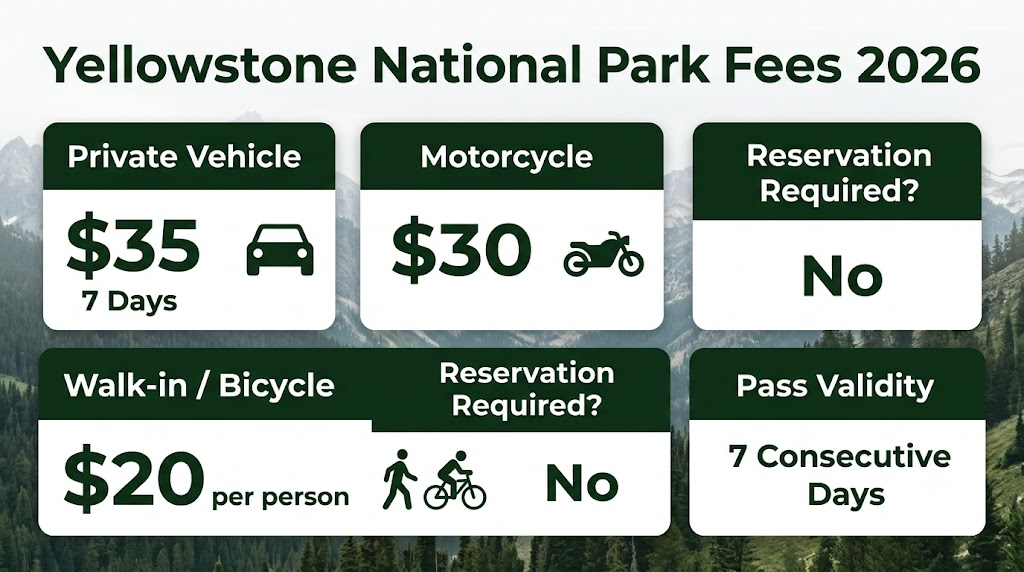
- Standard vehicle fee: $35 (covers everyone in the car)
- Motorcycle fee: $30 (up to 2 motorcycles, 4 people)
- Walk-in / bicycle fee: $20 per person (16 and older)
- Pass validity: 7 consecutive days from date of purchase
- Reservation required to enter? No — Yellowstone doesn’t require a vehicle reservation
- Best pass for multiple parks: America the Beautiful Pass ($80 for U.S. residents, $250 for non-residents)
- Where to buy: Online in advance, or in person (cash or card) at the Northeast, East, North, South, or West entrance stations
Which Yellowstone Pass Should You Buy?
| If you are… | Best Pass | Why |
|---|---|---|
| Visiting Yellowstone once | Standard Vehicle Pass ($35) | Covers your whole car for 7 days — nothing cheaper does the job |
| Visiting Yellowstone twice in one year | Yellowstone Annual Pass ($70) | Cheaper than two standard passes ($70 total), if Yellowstone is your only stop |
| Visiting Yellowstone + Grand Teton | Interagency annual pass ($80) | Covers both parks’ entrance fees, where two standard passes wouldn’t |
| Visiting multiple U.S. national parks | Interagency annual pass ($80) | Pays for itself after roughly two to three park visits |
| International visitors (groups of 3+) | Non-Resident Annual Pass ($250) | Replaces the $100-per-person surcharge rather than stacking on top of it |
| International visitors (1–2 people) | Standard Vehicle Pass + surcharge | The surcharge alone is often cheaper than the $250 annual pass for small groups |
| Families in one vehicle | Standard Vehicle Pass ($35) | Covers everyone in the car regardless of family size |
| Solo travelers arriving by car | Standard Vehicle Pass ($35) | Same $35 fee whether the vehicle has one occupant or five |
The Nonresident Surcharge Changes the Math for International Travelers
Starting January 1, 2026, every non-U.S. resident aged 16 or older pays an additional $100 per person on top of the standard entrance fee, unless they’re admitted using an Annual Pass or an America the Beautiful Pass.
This isn’t a park-specific quirk. It’s part of a broader federal fee restructuring that added the same surcharge at several of the country’s most-visited parks, including Glacier and Grand Teton.
For a family of four traveling from outside the U.S., this changes the calculation considerably. The $35 vehicle fee no longer covers everyone the way it does for U.S. residents — the surcharge is assessed per person, not per vehicle. Four non-resident travelers 16 and older would owe $400 in surcharges on top of the standard entrance fee.
Planning Tip: If you’re traveling as a larger group or visiting multiple eligible national parks during the year, compare the total surcharge with the cost of a Non-Resident Annual Pass before you arrive. Depending on your itinerary and group size, the annual pass may offer better value.
Choosing Between a Standard Pass, an Annual Pass, and the America the Beautiful Pass
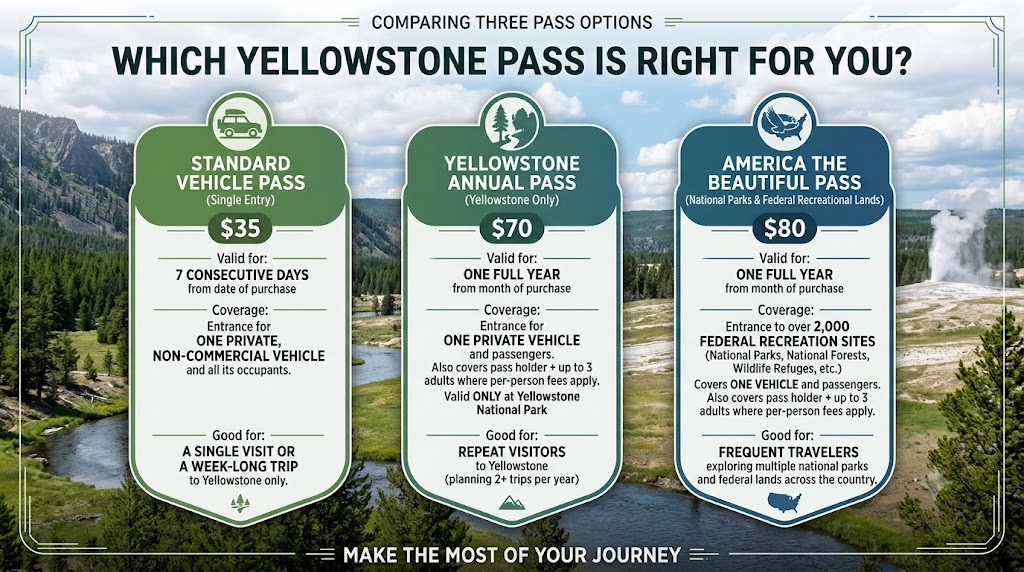
If you’re visiting Yellowstone once and driving in as a private vehicle, the $35 standard pass is the simplest and cheapest option. It’s valid for seven consecutive days from the date of purchase, so it also covers side trips out of and back into the park during that window.
If you’re a U.S. resident planning to return to Yellowstone more than once within a year, the park’s own Annual Pass costs $70 and covers unlimited entry through the month of purchase the following year. It admits the pass holder plus everyone in the same vehicle, or up to three additional people where per-person fees apply.
For travelers planning to visit multiple national parks or federal recreation sites — not just Yellowstone — the America the Beautiful Pass is usually the better value. It covers entrance fees at sites managed by the National Park Service, U.S. Fish & Wildlife Service, Forest Service, Bureau of Land Management, Bureau of Reclamation, and Army Corps of Engineers. Depending on how a given site structures its fees, it covers one private vehicle or up to four people entering on foot or bicycle.
Seniors 62 and older can get an annual version for $20 or a lifetime version for $80. Current U.S. military members and their dependents, visitors with a permanent disability, and U.S. fourth graders can all get versions of this pass for free. Non-U.S. residents pay $250 for the equivalent annual pass, which — as noted above — is often the more economical route for groups larger than two.
Good to Know: America the Beautiful Passes are non-refundable and non-transferable, and they can’t be replaced if lost or stolen. Every pass holder needs to carry valid photo ID and present it at the gate — a phone photo of the pass isn’t accepted.
Pass Comparison
| Pass Type | Price | Valid For | Covers | Best For |
|---|---|---|---|---|
| Standard Vehicle Pass | $35 | 7 days | 1 vehicle + all passengers | One-time visitors driving in |
| Motorcycle Pass | $30 | 7 days | Up to 2 motorcycles, 4 people | Motorcycle travelers |
| Per Person Pass | $20 | 7 days | 1 person on foot/bike/ski | Walk-in or cycling visitors |
| Yellowstone Annual Pass | $70 | 12 months | 1 vehicle + passengers | Repeat Yellowstone-only visitors |
| America the Beautiful (Resident) | $80 | 12 months | 1 vehicle or up to 4 people, at any federal site | Multi-park trips, road trips |
| America the Beautiful (Non-Resident) | $250 | 12 months | Same as above | International travelers in groups of 3+ |
| Senior Annual Pass | $20 | 12 months | Same as America the Beautiful | U.S. residents 62+ |
| Senior Lifetime Pass | $80 | Lifetime | Same as America the Beautiful | U.S. residents 62+ planning years of visits |
| Military / Access / 4th Grade Passes | Free | Varies | Same as America the Beautiful | Eligible military, disabled visitors, 4th graders |
Entering Through the South Entrance Means Paying for Two Parks
If your route brings you in through Yellowstone’s South Entrance, you’ll pass through Grand Teton National Park first, and Grand Teton charges its own separate entrance fee.
This catches a fair number of visitors off guard, especially those flying into Jackson Hole and driving north. The two parks don’t share a combined pass at the gate, so budget for both unless you’re using the interagency annual pass, which covers entry to both.
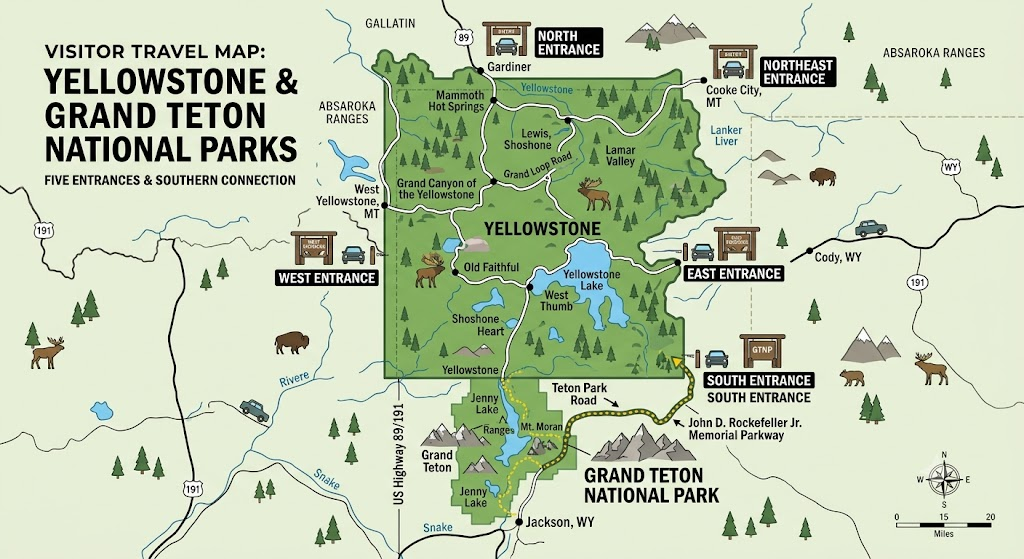
Avoid: Assuming your Yellowstone pass automatically covers Grand Teton, or the reverse. They’re separately administered, and only the interagency pass bridges both.
You Don’t Need a Reservation to Enter Yellowstone
Unlike some other major parks that now require timed-entry reservations during peak season, Yellowstone does not require a vehicle reservation to enter. You can buy your pass in advance online or simply pay at any of the five entrance stations — Northeast, East, North, South, and West — all of which accept cash or card.
Buying ahead saves a small amount of time at the gate during the busiest summer weeks, but it isn’t required the way it is at parks like Arches or Glacier.
Traveler Tip: During peak summer mornings, the West and South entrances often experience longer wait times than other entrances.
Where to Buy Yellowstone Passes
Most visitors simply pay at the gate. Each of the five entrance stations — Northeast, East, North, South, and West — accepts cash or card, and buying a standard pass on arrival typically takes only a couple of minutes.
If you’d rather not think about it at the gate, standard passes and the Yellowstone-only annual pass can be bought online in advance through the park’s official pass partner, and downloaded to a phone or printed. A digital national parks annual pass — the interagency version — can also be purchased directly through Recreation.gov and used immediately from a mobile device, which is worth doing if you’re crossing into the park with limited cell signal, since you’ll want it saved before you lose reception.
Advance purchase isn’t necessary for entry, but it does mean one less thing to manage on arrival day, particularly if you’re coming through a busy entrance during peak summer months.
Before You Arrive: A Quick Checklist
✓ Carry photo ID for every adult in your group — required for annual and interagency passes ✓ Keep your pass or receipt somewhere accessible in the vehicle, not packed in luggage ✓ Confirm current entrance fees on the official NPS fees page before you leave, since rates and surcharges can change ✓ Check the park’s current conditions and alerts page for seasonal road closures ✓ Download offline maps if you’re entering an area with limited cell service ✓ If entering through the South Entrance, budget separately for Grand Teton’s fee
Free Entrance Days in 2026
The National Park Service designates several fee-free days each year for U.S. citizens and residents. For 2026, those dates are:
- February 16 — Presidents Day
- May 25 — Memorial Day
- June 14 — Flag Day
- July 3–5 — Independence Day weekend
- August 25 — National Park Service birthday
- September 17 — Constitution Day
- October 27 — Theodore Roosevelt’s birthday
- November 11 — Veterans Day
Free entrance days waive the standard entrance fee, but they don’t necessarily waive other charges, like the nonresident surcharge. If you’re planning around one of these dates specifically to save money, it’s worth confirming what is and isn’t included before you go.
These are also, unsurprisingly, some of the most crowded days of the year to visit.
Where the Money Actually Goes
Under the Federal Lands Recreation Enhancement Act, Yellowstone keeps 80% of the entrance fees it collects, rather than sending that revenue back to a general federal fund.
On average, that amounts to roughly $12.1 million a year that goes directly toward accessibility improvements, campground upkeep, road and infrastructure repair, native fish restoration, and efforts to control aquatic invasive species within the park. It doesn’t change what you pay, but it does explain why the fee exists and why it’s tied so directly to visible, on-the-ground park conditions.
Money-Saving Tips
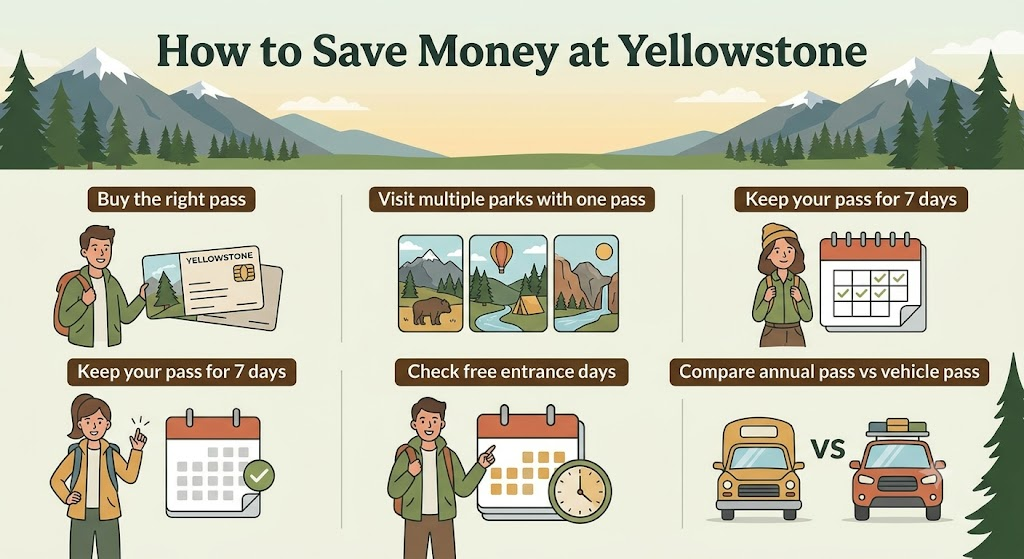
Skip the interagency annual pass if you’re a one-time visitor. At $80, it only pays for itself once you’ve covered roughly two to three separate park entrance fees within the same 12 months. A single Yellowstone trip doesn’t clear that bar on its own.
The Yellowstone Annual Pass makes sense in a narrower case than people assume. At $70, it’s only cheaper than the standard $35 pass if you’re returning to Yellowstone specifically — and only Yellowstone — within the same 12-month window. If there’s any chance you’ll visit Grand Teton, Glacier, or another federal site on the same trip, the $80 interagency pass covers more ground for $10 more.
If you’re combining Yellowstone with Grand Teton on one trip, run the numbers before buying separate passes. Two standard passes ($35 + Grand Teton’s own entrance fee) can easily exceed the $80 federal recreation pass once you add a third stop, like a Forest Service campground or another nearby federal site.
Free entrance days help most if you were visiting on that date anyway. Don’t reroute a trip around a fee-free date purely to save $35 — the added crowding at gates, parking areas, and boardwalks usually costs more in time than the fee itself.
Don’t buy a pass you don’t need out of caution. If you’re a single visitor entering once by car, nothing beats the plain $35 standard pass. Passes bought “just in case” are non-refundable if plans change.
Common Ticket & Entrance Mistakes
Assuming a reservation is required. Yellowstone doesn’t use a timed-entry system. Visitors sometimes book third-party reservation services online that aren’t affiliated with the park and aren’t necessary.
Buying the Yellowstone Annual Pass when the America the Beautiful Pass would serve better. The $10 price difference is easy to overlook, but the interagency pass covers far more ground.
Forgetting the seven-day window on standard passes. A pass bought on the way in is valid for seven consecutive days, not indefinitely — plan multi-stop itineraries with that clock in mind.
Not realizing the South Entrance means paying for Grand Teton too. Covered above, but it’s the single most common source of at-the-gate confusion for visitors flying into Jackson Hole.
Losing the entrance receipt or pass. Your receipt or pass is your proof of payment for re-entry during the seven-day window. Keep it in the vehicle, not packed away in luggage.
Assuming a phone photo of an America the Beautiful Pass will work. It won’t. Rangers require the physical pass and matching photo ID.
A Practical Way to Decide
If you’re a U.S. resident visiting once, buy the $35 vehicle pass and stop there — nothing else saves you money at that scale.
If you’ll return within the year, or you’re headed to other parks on the same trip, the $80 national parks annual pass usually pays for itself after two to three park visits.
If you’re traveling from outside the U.S. with more than two adults in your group, run the numbers on the $250 non-resident annual pass before you assume the per-person surcharge is cheaper — for most families, it isn’t.
If you are planning to visit there then check this guide also Best Yellowstone National Park Hotels for 2026 Trip
Frequently Asked Questions
Do I need to print my entrance pass, or is a digital version accepted?
Digital America the Beautiful Passes purchased through Recreation.gov are accepted on a mobile device. Standard entrance pass receipts purchased at the gate are physical, and it’s worth keeping them accessible in the vehicle for re-entry.
Can I use one standard pass to visit Yellowstone and then Grand Teton later in the same week?
No. The $35 Yellowstone pass only covers Yellowstone. Grand Teton charges separately unless you’re using an interagency annual pass, which covers both.
Does the entrance fee include camping or backcountry permits?
No. Entrance fees cover access to the park itself. Campground fees, backcountry permits, and boat permits are billed separately.
Are pets allowed, and do they affect the entrance fee?
Pets don’t change the entrance fee, but they’re restricted to roads, parking areas, and campgrounds — they’re not allowed on boardwalks or trails.
What happens if I lose my receipt during a multi-day visit?
Entrance stations generally cannot reissue a lost standard-pass receipt, so re-entry could mean paying again. This is a good reason to photograph your receipt as a backup in addition to keeping the physical copy.
Is the entrance fee different in winter?
The standard entrance fee structure applies year-round, though winter access to some interior roads is limited to guided snowmobile or snowcoach travel, which carries its own separate costs.
Can I get a refund if weather or closures cut my visit short?
Standard entrance passes and America the Beautiful Passes are non-refundable, regardless of how much of your visit you’re able to complete.
Do senior and military passes work for the whole vehicle, or just the pass holder?
They work the same way as other America the Beautiful Passes — covering the pass holder and everyone in the same vehicle, or up to three additional people where per-person fees apply.