The $80 Card That Unlocks All of America’s Parks and Why You’re Dumb for Not Having It Already
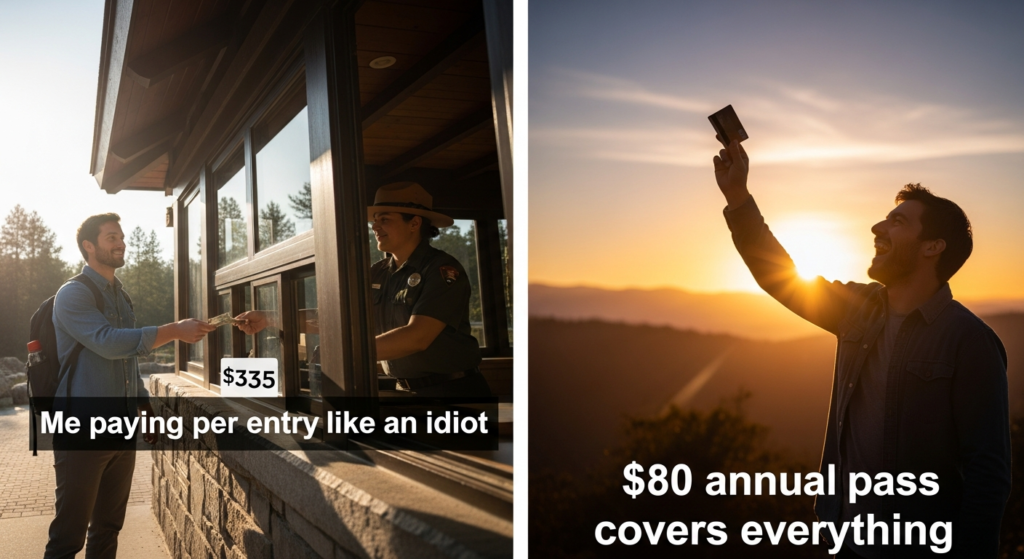
Every year, millions of Americans drive up to a national park entrance booth, get told the entry fee is $35, and do a little silent calculation in their heads that goes something like: wait, how many times am I doing this trip exactly? And then they either pay it, grumble about it, or drive away and go back to their Airbnb to Google whether there was a better option. There was. There is. There always has been. It’s called the America the Beautiful Pass, it costs $80 for an entire year, and it gets you and everyone in your car into every single national park in the country. Every. Single. One. If you’ve been paying per-entry fees like some kind of unprepared tourist at your own country’s landmarks, this blog is going to make you feel some things. You’re welcome in advance.
Okay But What Actually Is the America the Beautiful Pass and Why Does It Sound Like a Patriotic Hallmark Movie
The official name is the America the Beautiful National Parks and Federal Recreational Lands Pass, which is the kind of name a government committee invents when nobody in the room was willing to say “just call it the parks pass.” Everyone calls it the America the Beautiful Pass. Some people call it the National Parks Pass. A few extremely online people call it the [Pass] because they’ve been in the content creator pipeline too long. All of these are correct.
Here is what it actually does. You buy it once for $80. It covers entrance fees at over 2,000 federal recreation sites across the United States. This includes all 63 national parks, national monuments, national recreation areas, national forests, national wildlife refuges, and Bureau of Land Management sites. The pass covers the entire vehicle, meaning you, your partner, your three kids, your mother-in-law who insisted on coming, and whoever else is physically inside the car all get in on one pass.
For people who come in on foot, bike, or motorcycle, the pass covers the individual plus three guests. So if you’re doing a bike tour of the Southwest like a genuinely unhinged adventurer, the pass still has you covered.
The math is not complicated. Yellowstone is $35 per vehicle. Grand Canyon is $35 per vehicle. Zion is $35 per vehicle. If you visit just three of the major parks in a year, you have already paid for the pass twice over. The average American who buys this pass visits between five and eight park sites per year. At standard per-entry rates that would cost somewhere between $100 and $200. You paid $80 at the start of January and then just walked in everywhere for free like someone who absolutely has their life together.
The pass is valid for 12 months from the date of purchase, not the calendar year. So if you buy it in March, it works through March of next year. This matters because some people buy it in January thinking it expires in December and then feel cheated. It does not expire in December. The government got this one right.
Where to buy it: store.usgs.gov, recreation.gov, or at any national park entrance station. You can also buy it at many REI locations, which is convenient if you’re already there buying the hiking boots you definitely needed and the water filter you probably did not.
The Different Versions of This Pass Because of Course There Are Multiple Versions
The federal government, in its infinite wisdom, has decided that one pass is not enough and created several variations. Most people only need the standard annual pass. But here are the others because you deserve the full picture:
• Annual Pass ($80): This is the one. This is what 90 percent of readers should buy. One year, all sites, one vehicle. Do not overthink it.
• Senior Pass (Ages 62+) — $20 annual or $80 lifetime: If you or anyone in your household is 62 or older, this is one of the greatest deals in the entire American economy. Eighty dollars. One time. Every federal recreation site. For life. The lifetime Senior [Pass] is genuinely one of the best financial decisions a person in that age bracket can make if they spend any time outdoors at all. Buy it. Gift it. Evangelize it.
• Access Pass (Free, for people with permanent disabilities): Free lifetime access for U.S. citizens or permanent residents with a permanent disability. You apply in person at a federal recreation site with documentation. This program exists and is underused because not enough people know about it.
• Military Pass (Free): Active duty U.S. military members and their dependents get free access. You present your CAC card or other military ID at the entrance. Gold Star families are also covered under a related program. If you or someone you know is serving, this is free. Use it.
• 4th Grade Pass (Free): Every fourth grader in the U.S. can get a free annual pass through the Every Kid Outdoors program. This includes a pass for the kid’s whole family vehicle. Free. For a fourth grader. The program runs from September to August of the school year. If your kid is in fourth grade right now and you do not have this pass yet, please go get it immediately.
• Volunteer Pass (Free): 250 hours of service at federal lands earns you a free annual pass. If you’re the kind of person who volunteers at parks anyway, congratulations, you already earned it.
The fact that most Americans are not walking around with one of these passes is a genuine mystery. The marketing budget for this program is apparently zero dollars and a dream, so it mostly spreads by word of mouth between people who figured it out and feel personally offended that others haven’t yet. Consider this your word of mouth moment.
What the Pass Covers (And What It Doesn’t, Because Nothing Is Ever Fully Simple)
Let’s address the fine print before you roll up to a campsite expecting everything to be free and then have a conversation with a ranger that ruins your afternoon. The [Pass] covers entrance fees. That’s it. That is the thing it covers.
What it does NOT cover:
• Camping fees. You still pay to camp. Campsite reservations at national parks go through recreation.gov and cost anywhere from $10 to $50 per night depending on the park and the site. The pass does not touch this. Book your campsite separately and book it early, because popular spots sell out months in advance.
• Tours and special programs. Ranger-led cave tours, boat tours, special guided experiences. These have separate fees. The pass does not cover them.
• Parking fees at certain sites. A small number of federal recreation sites have separated the parking fee from the entrance fee specifically to work around the pass. This is mildly annoying and worth knowing about in advance. Muir Woods near San Francisco is a notable example where you pay a separate reservation and parking fee.
• State parks. This is the big one people misunderstand. State parks are run by individual states, not the federal government. The America the Beautiful Pass does not work at state parks. California State Parks, New York State Parks, Texas State Parks all have their own separate fee systems. Some states have their own annual passes. Do not confuse the two.
• Most concession services. Lodges, restaurants, gift shops, gear rentals inside parks. These are run by private concessionaires. The pass does not give you a discount at the Yellowstone General Store. Would have been nice though.
Also worth knowing: the pass covers entrance at staffed entrance stations, self-pay kiosks, and fee areas. If you enter through a side road that doesn’t have a fee station, you’re technically supposed to still have paid. Rangers occasionally check. Just buy the pass and display it correctly.
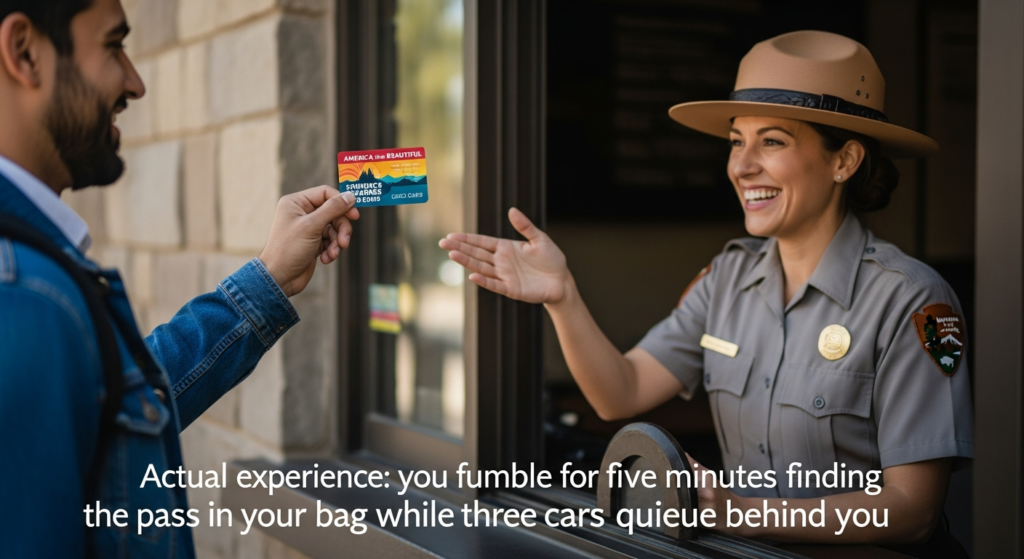
How to display it: The pass goes on the dashboard, passenger side, facing up so the ranger can read it through the windshield without you doing an awkward lean across your entire center console. Do not put it in the glove box. Do not put it in your bag. It needs to be visible from outside the car. The first time you roll up to Yellowstone at 7am with your pass already displayed and the ranger just waves you through while everyone else fumbles for their wallets is one of the most quietly satisfying experiences available to an adult in this country.
Is the Pass Actually Worth It or Are You Just Buying It Because a Blog Told You To
Fair question. Let’s actually do this math instead of just vibing about value. Here are some real trip scenarios:
Scenario A: The Casual Weekend Warrior
You live in Colorado. You go to Rocky Mountain National Park three times over the summer because it’s close and you like to pretend you’re outdoorsy even though you mostly hike to a viewpoint and then turn around. Entry fee without a pass: $35 per visit times three visits equals $105. Pass cost: $80. You are already $25 ahead and you haven’t even gone anywhere else yet. The math is not mathing against you here.
Scenario B: The Great American Road Trip Person
You’re taking two weeks to drive through Utah and Wyoming this summer. Your itinerary includes Arches, Canyonlands, Bryce Canyon, Zion, and Yellowstone. Entry fees without a pass: $35 plus $35 plus $35 plus $35 plus $35 equals $175. Pass cost: $80. You saved $95 and you’re not even counting the national forests and monuments you’ll pass through along the way. The [Pass] paid for itself before you left Utah.
Scenario C: The Person Who Only Goes to One Park Per Year
You go to the Grand Canyon once. Entry is $35. Pass is $80. Mathematically you overpaid by $45. However. This is the one scenario where the pass might not be the move unless you also use it for national forests, BLM lands, or other federal sites, which are also covered and which many people use for dispersed camping, fishing, and off-road recreation without realizing it counts. If you genuinely only visit one federal site per year and that’s it, the math does not favor you. But also, maybe visit more parks. You live in America. This is a feature of the country.
The honest answer is that the pass is worth it for most people who spend any meaningful time outdoors. The breakeven point is about two and a half visits to major parks. If you’re anywhere near that number, buy the pass, display it proudly, and stop handing $35 to entrance booths like someone who hasn’t done the math.
Pro Tips for Using the Pass That Nobody Puts on the Official Website Because That Would Be Too Helpful
You have the pass. You’re feeling smug. Good. Now here’s how to actually maximize it instead of just using it as a glorified entrance ticket for Yellowstone every summer.
National Forests are underrated and the pass covers them.
Most people think national parks when they think federal lands. But national forests are enormous, often less crowded, frequently stunning, and covered by the same [Pass]. The Angeles National Forest is 45 minutes from downtown Los Angeles and most people in LA have never visited it. The Tongass National Forest in Alaska is the largest in the country and is absolutely unhinged in terms of natural beauty. National forests allow dispersed camping, meaning you can camp outside designated campgrounds for free in most areas. This is a whole lifestyle that the pass enables and most people have no idea.
National monuments are included and some of them are incredible.
Devils Tower in Wyoming. Rainbow Bridge in Utah. Bears Ears in Utah. Chaco Culture in New Mexico. These are federally protected sites with entrance fees that your pass covers. They’re also significantly less crowded than the headline national parks. If you want the experience of standing somewhere genuinely awe-inspiring without sharing it with four thousand other people doing the same TikTok sound, national monuments are the move.
The pass works for free days but saves you the stress.
The NPS has about five fee-free days per year, typically around Martin Luther King Jr. Day, Presidents Day, the first day of National Park Week in April, Juneteenth, and Veterans Day. On these days, everyone gets in free. These days are also the most crowded days of the year because obviously. If you have the pass, fee-free days are irrelevant to you. You go whenever you want without the free-day crowd circus.
Timed entry reservations are separate from the pass.
Several parks now require timed entry reservations during peak season in addition to entrance fees. Arches, Zion, Rocky Mountain, Glacier, and others have implemented reservation systems. Having the pass does not exempt you from needing a timed entry reservation. You still need to book the reservation at recreation.gov. The pass covers the fee once you get there. These are two separate things and confusing them will result in you driving to a park and getting turned away at the entrance, which is a deeply specific kind of horrible experience.
Replace a lost pass for $10.
If you lose your pass, you can replace it for $10 with proof of purchase. The original receipt or order confirmation works. Keep the email. This is not a fun scenario to be in but it’s better than paying $80 again or going the remaining months without it.
The pass makes spontaneous trips actually spontaneous.
One of the best things about having the pass year-round is that it removes the mental calculation from impromptu park visits. You’re driving past a national monument on your way home from somewhere. Do you stop? Without the pass, you’re thinking about the $20 entry fee for 45 minutes of browsing. With the pass, you just stop. The friction is gone. This is underrated. Removing small financial barriers to spontaneous outdoor experiences meaningfully increases how much time you actually spend outside, which is good for your general wellbeing and your ability to function like a person who isn’t entirely defined by remote work misery and scrolling.
The Parks You Should Actually Visit With This Pass: A Ranking Nobody Asked For But You’re Getting Anyway
You have the pass. Now what do you do with it. Here’s a quick breakdown organized by what kind of person you are, because apparently we’re all different and that matters.
If you want to feel small and reconsider your life choices:
Grand Canyon. Stand at the rim. Stare into the geological record of 1.8 billion years. Think about your inbox. Feel it matter less. The South Rim is accessible year-round. The North Rim is only open May through October and is significantly less crowded and significantly more worth the drive if you can manage it.
If you want to feel like you’re in a video game:
Arches National Park in Utah. Over 2,000 natural stone arches in one park. The landscape looks genuinely unreal. Delicate Arch is the one on the license plate and the hike is 3 miles round trip with 480 feet of elevation gain. Go at sunrise or sunset. Bring more water than you think you need. The desert is not joking around.
If you want to see wildlife do whatever it wants:
Yellowstone. Wolves, bison, bears, elk, and geysers performing on a geological schedule that cares nothing about your itinerary. The Lamar Valley in the northeast corner of the park is one of the best places in North America to see wildlife in the wild. Go early morning. Bring binoculars. Expect traffic caused by animals who have right of way and know it.
If you want coastline that doesn’t require a flight:
Acadia National Park in Maine. Rocky coastline, carriage roads built by a Rockefeller, lobster rolls in Bar Harbor, the first sunrise on the continental U.S. from Cadillac Mountain if you’re willing to get up before 5am. The park is beautiful in fall in a way that feels almost theatrical. Shoulder season here is October and it is spectacular.
If you need it to be free on top of free:
Great Smoky Mountains in Tennessee and North Carolina. No entrance fee even without the pass. Free. Twelve million visitors per year. Black bears, 800 miles of trails, waterfalls, historic homesteads from Appalachian settlers, fireflies in summer that sync their flashing in a phenomenon that draws crowds from around the world. Actual bioluminescent firefly synchronization. In Tennessee. For free. America.
Go Buy the Pass. Seriously. This Blog Is Done and So Are Your Excuses.
You read the whole thing. That means you either really wanted to know about the pass or you were avoiding a work email with impressive commitment. Either way, here you are at the end. The America the Beautiful [Pass] is $80. It works everywhere. The math is almost always in your favor. The Senior Pass is $80 for life and if you know someone who qualifies, you are obligated to send them this blog immediately. Now go to store.usgs.gov, buy the pass, and do something outside that isn’t just your commute. The parks are there. They’re funded by your tax dollars. You already paid for them. You might as well show up.
Rubie Rose is a travel writer with a focused specialty in USA national parks, hiking trails, and practical outdoor trip planning. She is the founder and lead writer of Park Trails Guide — an independent resource built to help everyday visitors explore America’s parks with real confidence, not just enthusiasm.