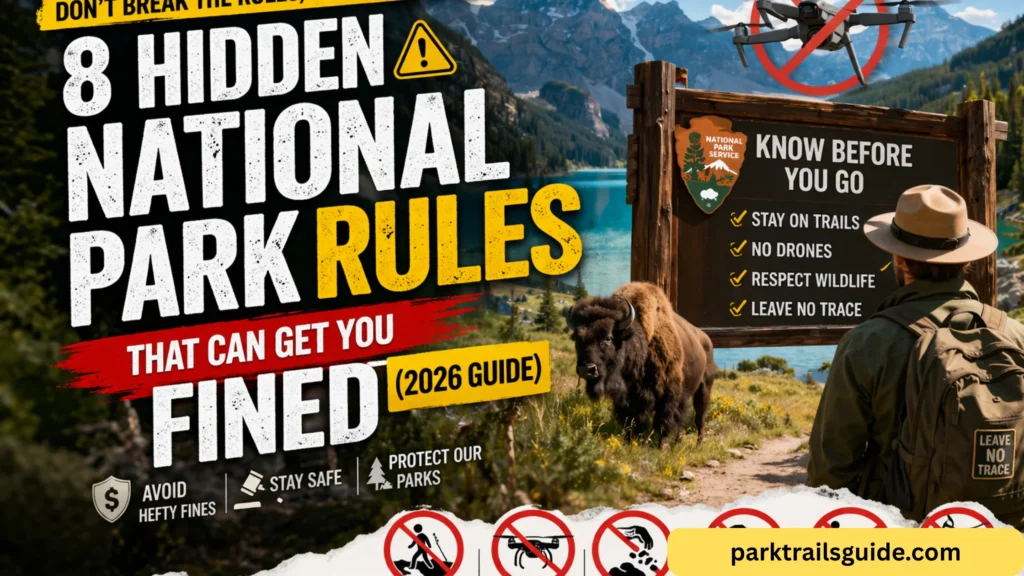
8 Hidden US National Park Rules That Can Get You Fined (2026 Guide)
“I had no idea that was even a rule.” That sentence — spoken by a hiker who’d just been handed a citation at the trailhead — is more common than the National Park Service would like to admit. Most people walk into America’s wild places with the best of intentions. They leave their trash behind, they don’t mess with wildlife. But the rules go much deeper than that — and ignorance is never a legal defense.
Every year, the National Park Service (NPS) hosts somewhere north of 325 million visits across more than 400 sites. That number has climbed sharply since 2020, when a pandemic-era wave of outdoor enthusiasm permanently reshaped how Americans spend their free time. More visitors means more pressure on fragile ecosystems — and more enforcement of rules that many people simply don’t know about.
What follows isn’t a scare piece. Think of it as the honest conversation a really good ranger friend would have with you before your trip — the kind of talk that saves you money, keeps you out of legal trouble, and honestly makes the parks better for everyone who comes after you.
Why Most People Have No Idea These Rules Exist
Part of the problem is how parks are perceived. People think of them as open land — public property they’re welcome to roam freely. And while that instinct is largely right, “public land” doesn’t mean “unregulated land.” National parks operate under a dense body of federal law, most of it codified in Title 36 of the Code of Federal Regulations, which most visitors have never heard of, let alone read.
The other issue is inconsistency. Some rules change from park to park. What’s fine at Joshua Tree might get you cited at Yellowstone. What’s acceptable in the backcountry might be forbidden on a designated trail. Rangers enforce selectively, based on staffing, visitor pressure, and the sensitivity of a given area. This creates the false impression that the rules are loose when, in reality, they’re just inconsistently enforced.
Let’s go through the specific rules that trip people up — starting with the ones that surprise visitors the most.
Rule 01
You Cannot Simply Park Anywhere — Even If It Looks Empty
⚠ Fine: Up to $150 — Plus Towing
This one bites road-trippers constantly. You pull up to a scenic overlook, the gravel shoulder looks wide enough, nobody else is parked there — so you figure it’s fine. It often isn’t. Many areas within national parks have designated parking only policies, and pulling off on an unmarked shoulder — even if you’re technically out of the travel lane — can earn you a citation and, in some parks, a tow.

In parks like Zion and Yosemite, where parking pressure is extreme, rangers actively patrol popular areas for improper stops. During peak season, even a “quick photo stop” on a non-designated shoulder can result in a ticket. The rule of thumb: if there’s no painted line, designated sign, or obvious pull-out area, keep driving until you find one.
Some parks, like Zion, have solved this problem elegantly by eliminating private car access on their main corridor altogether — their shuttle system is mandatory between April and October. If you drive your car in during that window, you won’t just get ticketed. You’ll be turned around at the entrance.
Rule 02
Drone Flying Is Prohibited in All National Parks — No Exceptions
⚠ Fine: Up to $5,000 + Criminal Charges
This is probably the most widely violated rule in the entire national park system right now, and the penalties are among the harshest. Since 2014, the NPS has had a blanket prohibition on launching, landing, or operating unmanned aircraft within park boundaries. That includes drones, remote-controlled planes, and paragliders with motors. All of them. Everywhere.

The rule wasn’t created arbitrarily. Drones startle wildlife in ways that have documented physiological effects — they spike cortisol levels in nesting birds and have been shown to cause nest abandonment. They create noise pollution in landscapes people seek out specifically for quiet. And they create safety concerns in areas with heavy foot traffic.
The catch is that enforcement has been inconsistent enough that a generation of hikers has grown up believing drone use is a gray area. It is not. Several high-profile cases — including a tourist who filmed inside the Grand Canyon’s restricted airspace and another who crashed a drone into a Yellowstone hot spring — ended in criminal referrals, not just civil fines.
If you want aerial footage, some parks allow permitted commercial drone operations in specific, designated zones. But for recreational use, the answer is a flat no across all 400+ NPS sites.
“The parks are not broken. But they are under pressure in ways that didn’t exist twenty years ago — and the rules exist to absorb that pressure so the land doesn’t have to.”— Former NPS District Ranger, Intermountain Region
Rule 03
Collecting Rocks, Plants, Feathers, and Fossils Is Illegal
⚠ Fine: Up to $500 for minor violations — Federal charges for fossils
The “take nothing but photographs, leave nothing but footprints” ethic is older than the internet, but people still stuff their pockets with interesting pebbles, press wildflowers into their journals, or pocket the occasional bird feather they find on a trail. All of it is illegal under federal law.
Title 36 of the Code of Federal Regulations is explicit: the removal of any natural object from a national park — including rocks, minerals, plants, wood, and soil — is prohibited without a permit. This applies even if the object appears common, appears dead, or appears to have been naturally dislodged.
Fossils are a category of their own. Under the Paleontological Resources Preservation Act of 2009, removing vertebrate fossils from federal land carries criminal penalties. People have received felony charges for pocketing what they thought was “just an interesting bone.” Rangers in fossil-rich parks like Badlands, Dinosaur National Monument, and Petrified Forest are specifically trained to watch for this behavior.
Petrified Forest National Park is worth singling out. The park has a documented tradition of visitors mailing back stolen petrified wood, often with guilt-laden letters explaining they’ve had nothing but bad luck since taking it. The park calls this collection of returned wood its “Conscience File.” It’s charming. It’s also an indicator of just how widespread the violation is.
Rule 04
The “Timed Entry” Permit Requirement Is Now Enforced Strictly
⚠ Consequence: Turned Away at the Gate — No Refunds
Starting around 2021 and expanding significantly through 2025 and into 2026, a growing number of America’s busiest parks have implemented timed-entry reservation systems. It’s not just about paying the entrance fee anymore. For parks like Rocky Mountain, Acadia, Glacier, and parts of Olympic, you now need a timed-entry permit on top of your America the Beautiful pass — and that permit must be used within a specific window.

What catches visitors off guard is that these permits are time-sensitive in both directions. Show up too early and you’ll be turned away. Show up significantly late and your window may have expired. Unlike an airline ticket, there’s typically no grace period. Rangers at the gate check the permit timestamp on your phone — and they turn people away without sympathy.
The reservation systems vary. Recreation.gov handles most of them, but a few parks use third-party systems. Some require permits only during peak hours; others require them all day from May through September. The specific rules change year to year, so checking the individual park’s official NPS page in the weeks before your trip — not months before — is essential.
⚠ Important for 2026
As of early 2026, the NPS has expanded timed-entry requirements to at least 11 additional parks that previously had no such system. If your last visit was pre-2022, assume the entry process has changed. Always verify on nps.gov directly — third-party travel sites frequently display outdated entry requirements.
Rule 05
Your Dog’s Leash Cannot Be Longer Than Six Feet
⚠ Fine: $175 in many parks
Most pet owners know dogs need to be leashed in national parks. Far fewer know that the leash itself is regulated. A standard retractable leash — the kind that lets your dog roam 16 or 26 feet ahead of you — is illegal in most national parks. The NPS mandates a maximum leash length of six feet in virtually all developed areas and on most designated trails.

The reason is straightforward: a dog 20 feet ahead of its owner can startle a bison, corner a deer, disrupt nesting birds, or simply get into trouble before its owner can respond. Rangers at Yellowstone and Grand Teton report that retractable-leash violations are among their most frequent citations during summer months.
Beyond leash length, it’s worth knowing that in many parks, dogs are prohibited from trails altogether — even on a standard leash. Dogs are generally permitted in parking areas, campgrounds, and paved roads, but not in the backcountry, not on most unpaved trails, and not in any area where wildlife is actively managed. Acadia National Park is one notable exception, with a broader trail network open to leashed dogs — but even there, some trails restrict access during peregrine falcon nesting season.
Rule 06
You Cannot Feed Wildlife — Not Even “Accidentally”
⚠ Fine: Up to $5,000 and jail time in serious cases
Everyone understands you’re not supposed to hand a granola bar to a bear. But the feeding prohibition is broader and more nuanced than that. Leaving food unattended in a way that allows wildlife access — even briefly, even while you’re nearby — constitutes “feeding” under NPS regulations. That includes leaving a bag of trail mix on your picnic table while you go take a photo, or leaving food scraps near your tent.
In parks like Yosemite, where human-conditioned bears have become a multi-decade management crisis, rangers will issue citations for food storage violations even when no bear is present. The offense is creating the conditions for habituation, not just the act of feeding itself. Food must be stored in hard-sided, bear-resistant containers or park-provided food storage lockers. Coolers — even the high-end camping kind — do not qualify as bear canisters.
The stakes are higher than a fine. A bear that becomes human-food-conditioned is nearly always eventually euthanized. Rangers have a grim saying about this outcome that park families across the country have heard too many times: “A fed bear is a dead bear.” The citation you avoid by being careless comes at a cost the bear pays permanently.
Park-Specific Rules That Catch Visitors Off Guard
Beyond the system-wide regulations above, individual parks have their own highly specific rules — some of which seem almost arbitrary until you understand the ecological context behind them.
| Park | Surprising Rule | Why It Exists |
|---|---|---|
| Yellowstone | You must stay 100 yards from wolves and bears, 25 yards from all other wildlife | Protects wildlife behavior and visitor safety; enforced with binoculars from ranger stations |
| Grand Canyon | Hiking below the rim rim-to-river in a single day is officially discouraged and may be actively stopped | Hundreds of heat-related rescues annually; rangers have authority to turn back hikers |
| Yosemite | Swimming in the Merced River above Vernal Falls is prohibited | Multiple drowning deaths above the falls; swift water is deceptive even when calm-looking |
| Arches | You cannot touch or stand on Delicate Arch | Irreplaceable geological formation; physical contact causes long-term microbiotic damage |
| Hawaii Volcanoes | Taking lava rocks is illegal and tracked | Cultural significance; the “Pele’s Curse” phenomenon generates thousands of mailed-back rocks yearly |
| Everglades | Airboats are prohibited inside park boundaries | Propeller noise and wake disrupts nesting birds and alligator habitats |
| Olympic | Tidepool touching is prohibited in protected zones | Marine invertebrate populations have declined measurably from casual handling |
| Glacier | Backcountry campsites require advance permits; walk-in availability is nearly zero in summer | Overuse protection; permits can sell out within minutes of the reservation window opening |
Rule 07
Off-Trail Hiking Is Not Freely Permitted Everywhere
⚠ Fine: $100–$500 depending on zone
There’s a popular idea in outdoor culture — especially among more experienced hikers — that going off-trail is just part of wilderness exploration. In many national forests and Bureau of Land Management areas, that’s largely true. In national parks, it’s much more complicated.
Some parks have “Leave No Trace” wilderness zones where off-trail travel is explicitly permitted and encouraged as a way to disperse foot traffic. Others have biologically sensitive zones where walking even one step off the designated path can damage soil crusts that took decades — sometimes centuries — to form. Utah’s canyon country parks (Arches, Canyonlands, Capitol Reef) are particularly strict about this because of their cryptobiotic soil crusts, which look like dark, lumpy dirt but are actually living colonies of organisms that fix nitrogen and prevent erosion.
The only reliable way to know if off-trail travel is permitted is to ask at the visitor center on arrival — not to assume based on what you’ve read online, which may be outdated.
Rule 08
Campfires Are Governed by Rules That Change Daily
⚠ Fine: Up to $5,000 — Criminal liability if fire spreads
You reserved a campsite. You packed the marshmallows. You know there’s a fire ring at your site. None of that means you’re allowed to have a fire on the night you arrive. Fire restrictions in national parks operate on a dynamic system — they can change within 24 hours based on weather forecasts, wind conditions, fire danger indices, and active fire activity in the surrounding region.

A campsite that had fires permitted on Tuesday might be under a Stage 2 fire restriction by Saturday. Rangers check. Citations are issued. And in the worst-case scenario — if your fire escapes containment — you face criminal liability for the suppression costs, which can run into the millions of dollars for even a moderately sized wildfire.
The practical advice is this: check the NPS fire restrictions page for your specific park on the day you arrive, or call the park’s visitor information line. Never assume the rules from your last visit still apply.
✓ Ranger-Approved Travel Tip
Download the NPS app before your trip. It includes real-time alerts for fire restrictions, road closures, and entry requirement changes by park. Many rangers recommend it as the single most useful pre-trip tool — more current than any guidebook or travel blog.
The Cultural Site Rules People Consistently Ignore
About a third of NPS sites are cultural or historical — battlefields, monuments, native sacred sites, historic buildings. These sites carry their own set of regulations that feel different from wilderness rules but are equally binding.
At many sites containing Native American artifacts, pictographs, or burial grounds, touching the rock art — even lightly — is a federal crime under the Archaeological Resources Protection Act. Body oils accelerate deterioration of pigments that have survived for thousands of years. Rangers at sites like Canyonlands, Mesa Verde, and Canyon de Chelly have documented measurable fading from visitor contact in just the past decade.
At Civil War battlefield sites managed by the NPS, metal detecting is explicitly prohibited. This surprises people because metal detecting is a legitimate hobby with a large recreational community — but the Battlefield Preservation Act makes it illegal on federal battlefield land, and the penalties include equipment seizure in addition to fines.
Walking through restricted vegetation at cultural sites — particularly at Mesa Verde’s cliff dwellings and Chaco Culture — can cause irreversible damage to buried archaeological deposits that haven’t yet been excavated. The ground itself is the artifact. Rangers will stop you.
The Permit System Has Become Far More Complex Than Most People Realize
If you haven’t visited a major national park since 2019, the permit landscape has changed dramatically. The pandemic era permanently altered how the NPS manages peak-season visitation, and the systems that were introduced as emergency measures have largely become permanent policy.
Beyond timed-entry day permits, many parks now require separate permits for specific trails and backcountry routes. Zion’s Angels Landing — one of the most famous hikes in the American West — now requires a lottery permit, not just for overnight camping but for the day hike as well. The permit lottery opens months in advance and is competitive. Walk-up slots exist but are not guaranteed.
Havasupai Falls, technically part of the Havasupai Tribal lands adjacent to Grand Canyon National Park, requires a permit that historically sold out within minutes of the reservation window opening. The tribe has made attempts to manage this better, but demand continues to vastly exceed supply.
The practical implication: planning a national park trip in 2026 more closely resembles planning international travel than it does a spontaneous road trip. The days of rolling up to Yosemite Valley on a summer Saturday without advance preparation and having a reasonable experience are functionally over — not because the park closed those doors, but because the volume of people who want to be there on any given weekend exceeds what the infrastructure can sustainably hold.
If want to visit yellowstone then check: What Is the Closest Airport to Yellowstone National Park? (Complete 2026 Guide)
Frequently Asked Questions
Can I bring my own firewood into a national park?
Many parks restrict or outright prohibit bringing firewood from outside — particularly from more than 50 miles away. Invasive insects like the emerald ash borer and the Asian longhorned beetle travel in firewood. Some parks require that wood be purchased on-site or from a certified local source. Always check the specific park’s firewood policy before packing any.
Is it legal to carry a firearm in a national park?
Yes, in most cases — but with significant conditions. Since 2010, federal law allows visitors to carry firearms in national parks if they comply with the state laws where the park is located. However, you absolutely cannot discharge a firearm (except for legal hunting in specific designated areas), and you cannot carry a firearm into any federal facility, including visitor centers, ranger stations, and park offices.
What happens if I’m caught breaking a park rule — will I actually be fined?
Rangers have discretion, and first-time violators of minor rules often receive a warning. But for drone use, wildlife feeding, fossil collection, and fire violations, enforcement has hardened significantly in recent years — particularly as parks deal with increased visitation pressure. Rangers are federal law enforcement officers with full arrest authority. Fines are not just administrative; they go through federal magistrate court.
Does the America the Beautiful pass cover all fees?
No — and this surprises people significantly. The pass covers entrance fees at most federal recreation sites. It does not cover timed-entry reservation fees, camping fees, special use permits, or boat launch fees. At sites like Haleakalā in Hawaii, where the sunrise viewing permit has its own separate fee system, the America the Beautiful pass reduces but does not eliminate costs.
Can I bring a bicycle on any trail I choose?
No. Bicycles in national parks are treated similarly to motorized vehicles — they’re permitted on roads and in designated bicycle lanes, but not on most hiking trails unless a specific trail is signed as bike-accessible. Riding a mountain bike on a foot-traffic-only trail is a violation. The trails at parks like Moab’s adjacent Bureau of Land Management areas are very bike-friendly; those inside Arches National Park largely are not.
How to Actually Prepare for a Rule-Free Visit
None of this should feel overwhelming — it just requires more intentionality than the average park visitor has historically exercised. Here’s a practical sequence that will keep you on the right side of every regulation.
At Least Two Weeks Before Your Visit
Go directly to the park’s official NPS page (nps.gov/[parkcode]) and read the current “Plan Your Visit” and “Permits & Reservations” sections. Check whether a timed-entry permit is required and whether the trail or route you want to use has its own separate permit. Book accordingly.
The Day Before
Check the park’s current alerts page for fire restrictions, road closures, and wildlife advisories. These change faster than any guidebook or travel site can track. A five-minute check the evening before could save a significant drive-back-to-camp situation.
At the Trailhead
Read the posted signs. Not just the main billboard — the smaller ones adjacent to it. They often contain the current-season specifics that override the general regulations: temporary trail closures for peregrine nesting, closures for bear activity, or water hazard warnings. Rangers place these signs deliberately, and they carry the force of regulation.
When in Doubt
Ask a ranger. This sounds almost too obvious, but the culture of not wanting to “bother” a uniformed officer has stopped many visitors from getting information that would have cost them nothing to receive and saved them significant money in fines. Rangers generally love answering genuine questions from people who are trying to visit responsibly. That’s the encounter they went into this work for.
The Parks Are Still Worth Every Bit of Effort
Everything above might read like a list of obstacles — and it is, if you’re coming in unprepared. But read differently, it’s something else: a map of how much people care about these places, written in legal language.
The regulations that govern America’s national parks aren’t bureaucratic overreach. They’re the accumulated lessons of more than a century of watching what happens when magnificent, irreplaceable landscapes are loved too carelessly. The bison that can’t be approached. The arch that can’t be climbed. The petrified wood that has to stay put. Every rule has a story behind it — usually a loss, or a near-loss, that someone fought hard to prevent from happening again.
Go. Take your family. Take your dog if the trail allows it. Watch the light change on Delicate Arch from the distance the sign specifies. Camp under skies you can’t see anywhere else. And leave the pebble where you found it. These places will outlast all of us — but only if we help them.
Read Also this helpful guide: National Park Camping Reservations: How to Book Before They Sell Out